CN
CN  EN
EN 
Choosing a broker isn’t just about its trading cost or how sleek the trading app looks. You’re deciding who you trust to hold your money and execute your trades—so the rules that broker operates under really matter. In Singapore, those rules are set by the 新加坡金融管理局 (MAS). Some brokers are fully MAS-regulated, while others operate 离岸, outside Singapore’s regulatory framework but often still target local traders.
In this article, we’ll unpack the key differences between MAS-regulated brokers and offshore brokers, explain why regulation can make or break your trading experience, walk you through how to check if a broker is MAS-licensed, and why many traders prefer trusted MAS-regulated brokers in Singapore such as Phillip Nova.
What are MAS-Regulated Brokers

MAS-regulated brokers are financial institutions that have been officially licensed and supervised by the Monetary Authority of Singapore (MAS) to offer trading services such as forex, CFDs, and other capital markets products.
In practical terms, this means:
- They must meet minimum capital requirements
The broker must maintain enough financial resources to operate soundly and withstand market stress, instead of running with small capitals.
- Your funds are kept separate from the broker’s own money
Client monies are held in segregated accounts, so they’re not mixed with the broker’s operating funds. This reduces the risk of your money being used to pay the broker’s expenses or creditors if things go wrong.
- They follow strict conduct and disclosure rules
MAS expects licensed brokers to deal fairly, provide clear information about risks and fees, and keep proper records. There are standards for how they communicate with you.
- There is a regulator you can turn to
Licensed brokers must report to MAS and comply with Singapore’s regulatory framework on an ongoing basis, not just at the point of licensing.
For traders, a MAS-regulated broker signals that the firm operates within a supervised framework designed to protect clients and support the stability of the wider financial system.
What Are Offshore Brokers?
Offshore brokers are forex and CFD brokers that are based and licensed outside a trader’s home country, often outside the major, well-regulated markets. Many are registered in places such as Belize, Seychelles, Vanuatu, Mauritius or St. Vincent and the Grenadines, where the rules for brokers are generally lighter and cheaper to follow. For a Singapore trader, that means these brokers are not supervised by MAS and may not fall under any highly regarded regulator.
Offshore brokers usually attract traders with things like:
- Very high leverage
Leverage of 1:200 to 1:1000 or even higher is common, heavily marketed as a way to “maximize your trading power” with a small deposit.
- Low headline trading costs
Many offshore brokers advertise ultra-tight spreads on major Forex pairs or CFD contracts.
- Easy account opening
Know-Your-Client (KYC) checks can be minimal, which means it very easy for less experienced clients to start trading complex, high-risk products.
The trade-off is that these brokers typically operate under weaker regulation and thinner safeguards. Oversight from local authorities may be limited, client money protections and capital requirements can be less robust than in top-tier jurisdictions, and if something goes wrong, recovering your funds or resolving disputes means dealing with a foreign legal system.
So, while offshore brokers can look more flexible and exciting on the surface, that extra flexibility usually comes from having fewer protections around your money and your rights as a client.
MAS-Regulated Brokers vs Offshore Brokers: A Side-by-Side Comparison
Here’s how MAS-regulated brokers and offshore brokers compare at a glance if you’re choosing where to open an account.
Quick comparison at a glance
| Aspect | If you choose a MAS-regulated broker (Singapore) | If you choose an offshore broker |
| Who regulates them | Supervised by MAS under Singapore’s regulatory framework. | Regulated overseas, often in jurisdictions with lighter oversight. |
| Safety of your funds | Client money held in segregated accounts. | Client money protection may be weaker or unclear, depending on the jurisdiction. |
| Leverage & risk | Typically more conservative leverage (e.g. up to 1:20 for many FX and CFD products). | Very high leverage is common (e.g. 1:100–1:1000). |
| Opening an account | 标准 KYC checks (ID, address, source of funds) before you can trade. | Often faster onboarding with less checks on trading knowledge and experience. |
| Transparency & conduct | Must follow strict rules on disclosure, fair dealing, reporting and advertising. | Marketing, promotions and fee practices are generally less controlled. |
| If something goes wrong | Issues fall under Singapore law and MAS oversight. | You rely on a foreign regulator and legal system to resolve disputes. |
Why Regulation Matters More than You Think

The table above shows how MAS-regulated and offshore brokers differ on paper. But as a Singapore trader, what really matters is how those differences play out in real life.
Here are three ways regulation can shape your actual trading experience:
It limits how bad problems can get
With a MAS-regulated broker, there are limits on how messy issues like pricing errors, platform failures or withdrawal delays can become. With an offshore broker, the same problem may quickly turn into money you may never recover.
How the broker treats you
MAS-regulated brokers must be careful with how they market, handle complaints and change trading terms. Some offshore brokers, facing lighter oversight, can be more aggressive – for example with more frequent promotions, restrictive bonus conditions, sudden tweaks to leverage or spreads, and slower or less helpful responses when you raise an issue.
How clearly you understand what you’re getting into
MAS-regulated brokers must explain products, costs and risks more clearly, so you’re less likely to misunderstand how something works or what it really costs. In addition, you can more easily approach a local broker to ask for explanation. Offshore brokers may highlight the upside while key details sit in the fine print.
Put simply: offshore brokers might look more attractive on the surface, but stronger regulation protects you when things don’t go according to plan and helps keep the game fair for you as a retail trader in Singapore.
How to Check If a Broker Is MAS-Regulated
Before you open an account or send any funds, take a moment to confirm whether the broker is actually regulated in Singapore.
Use the MAS Financial Institutions Directory
- Go to the 新加坡金融管理局 (MAS) website and open the Financial Institutions Directory.
- Type in the broker’s full legal name (not just the brand or marketing name).
- Check that:
- The firm appears in the results
- It holds a Capital Markets Services (CMS) licence
- 这 licensed activities/products match what it offers on its website
If you can’t find the broker at all, that means the broker is not licensed and regulated in Singapore.
If you do find it, but the licensed activities don’t match the products it is pushing online, that part of its business is likely not regulated in Singapore.
Example: How Phillip Nova appears in MAS’ directory
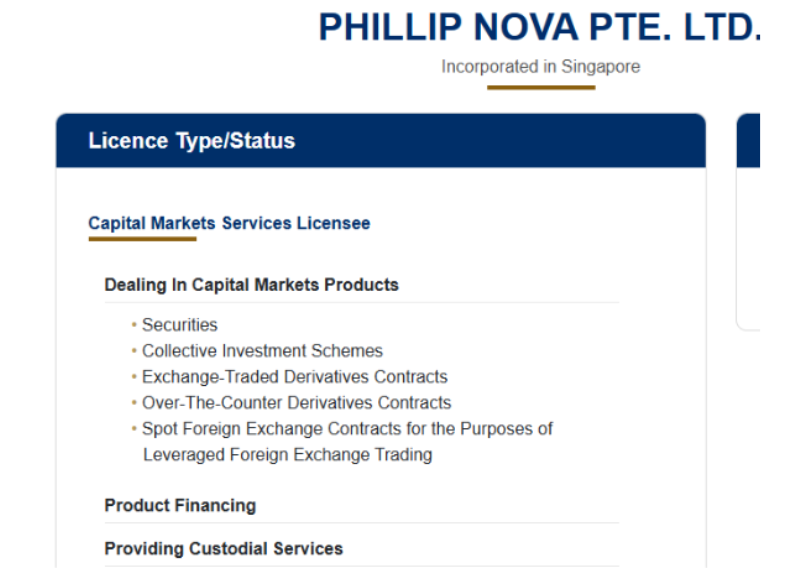
Search for “PHILLIP NOVA PTE. LTD.” and you’ll see it listed as a Capital Markets Services Licensee. Under Dealing in Capital Markets Products, it is authorised for securities, collective investment schemes, exchange-traded derivatives contracts, Over-The-Counter derivatives contracts, 和 spot FX for leveraged trading.
These permissions line up with what Phillip Nova offers on its platforms (forex, CFDs and other derivatives), which tells you those activities are conducted under MAS supervision, not from an offshore entity.
By contrast, imagine a broker that does appear in the directory and holds a CMS licence, but is not authorised for Over-The-Counter (OTC) Derivatives Contracts—yet its platform actively offers CFDs and leveraged forex.
In a case like that, it is likely not operating as a MAS-regulated forex and CFD broker even if it mentions having a MAS licence.
Why Many Traders Choose Phillip Nova as Their MAS-Regulated Broker
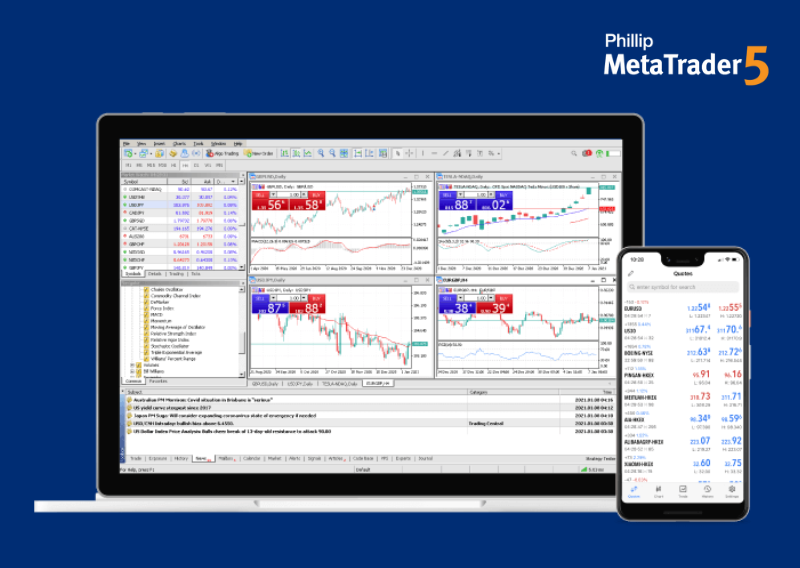
After weighing MAS-regulated brokers against offshore brokers, many Singapore traders decide they’d rather trade with strong protection and local oversight. If you’re in that camp, Phillip Nova is one MAS-regulated broker to consider.
Here’s why:
- Firmly under MAS supervision
Phillip Nova is a Singapore-based broker regulated by the Monetary Authority of Singapore按照本文讨论的关于客户资金、行为和监督的相同规则进行运营。
- 良好的业绩记录和雄厚的财务实力
Phillip Nova在新加坡金融市场拥有超过40年的历史,凭借稳健的财务状况,建立了良好的业绩记录。这种长期稳健的经营让客户更加信任和放心,相信他们与一家在不同市场周期中都保持稳定的机构进行交易。
- 关键合约零佣金交易
在 Phillip Nova 的 MetaTrader 5 平台上,外汇、所有差价合约、现货外汇和现货黄金/白银合约均可交易。 零佣金 – 你的主要交易成本来自点差和掉期,而不是交易手续费。
- 本地团队和透明的方式
Phillip Nova 背后有新加坡一家历史悠久的金融集团的支持,提供 本地支持,信息清晰以及对……的关注 教育和风险意识 ——如果您希望稳步增长而不是冒险,这将非常有用。
结论与下一步
离岸经纪商看起来或许很诱人,但如果出现严重问题,它们可能会让你面临更大的风险。对于许多新加坡交易者来说,这就是为什么…… 受新加坡金融管理局监管的经纪商,例如Phillip Nova 从长远来看,这是更明智的选择。
注册一个 今天即可免费获得模拟账户 先进行无风险练习,准备就绪后,再开设实体店。 Phillip MetaTrader 5 账户 解锁 Acuity AnalysisIQ 交易信号的全部功能 此处