The SpaceX IPO: Everything You Need to Know Before SPCX Lists on 12 June

08 6 月 2026

SpaceX is set to debut on Nasdaq on 12 June 2026 under the ticker SPCX — the largest IPO in financial history. Here is what the company does, why markets are paying close attention, and how investors can gain exposure to the space economy. 


For six decades, reaching orbit meant building a rocket, firing it once, and watching a $60 million machine sink into the ocean. The economics were brutal, access was limited to governments, and the pace of progress was slow. 

SpaceX changed that. 

Founded by Elon Musk in 2002, SpaceX set out to make space travel reusable, affordable and commercially viable. Today, it controls approximately 85% of global orbital launches, operates the world’s largest satellite internet network, and is preparing to list on the Nasdaq Stock Exchange on 12 June 2026 under the ticker SPCX. 

At a planned $135 per share and a $1.75 trillion valuation, it will be the largest IPO in financial history, raising $75 billion from investors led by Goldman Sachs, Morgan Stanley, Bank of America, Citigroup and JPMorgan Chase. That figure is more than double Saudi Aramco’s 2019 global record of $29.4 billion, and nearly five times the capital raised by Meta Platforms in its 2012 IPO. 

This article looks at the business behind the headline, the three revenue segments driving its valuation, and the ways investors can gain access to the space economy. 


Why SpaceX Is Different: The Reusability Breakthrough 

The central innovation at SpaceX is not the rocket itself. It is the ability to land it and fly it again. 


Before SpaceX, every orbital rocket was discarded after a single use. The Falcon 9 changed that. According to SpaceX’s own S-1 filing with the US Securities and Exchange Commission, one Falcon 9 first-stage booster has been successfully reflown up to 34 times. The cost to reach low Earth orbit has fallen by approximately 95% compared to the Space Shuttle era, from over $54,000 per kilogram to under $3,000. 


The practical result is a structural advantage that no competitor has yet matched. In 2025, SpaceX completed 165 orbital launches, a new annual world record achieved for the sixth consecutive year. The company delivered 11 of 12 National Security Space Launch missions for the US government, operated all five crewed and cargo missions to the International Space Station on behalf of NASA, and achieved a 99%+ mission success rate across all Falcon rocket flights. In terms of output, SpaceX launched nearly twice as many orbital missions as China did in the same year. 


That operational track record is the foundation on which SpaceX’s three business segments are built. 


The Three Businesses Inside SpaceX 

SpaceX’s S-1 filing discloses three distinct revenue streams. Each is material. Together, they explain why the company is valued far above comparable aerospace businesses. 


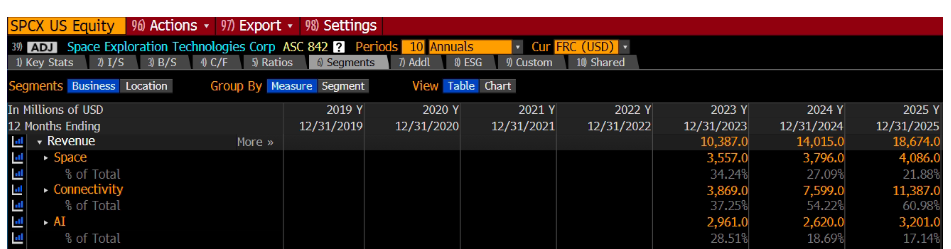
  1. Launch Services (22% of 2025 Revenue)

Launch services generated $4.1 billion in revenue in 2025. Falcon 9 performs over 90% of global commercial orbital launches, a market position that took two decades to build. Government contracts with NASA, the US Space Force and the intelligence community provide stable, long-term revenue that underpins the entire business. 


The launch segment deliberately operates at a loss, posting a $657 million operating deficit in 2025. The reason is Starship. SpaceX invested approximately $3 billion in Starship research and development during the year, using Falcon 9’s profitability to fund its successor. Starship is a fully reusable super-heavy-lift vehicle designed to carry over 100 tonnes to orbit per flight. The S-1 states it is engineered to reduce the cost of reaching orbit by 99% or more relative to the historical average. If it delivers, it would do for heavy lift what Falcon 9 did for medium lift: collapse the price floor and widen SpaceX’s competitive advantage further. 


  1. Starlink Connectivity (61% of 2025 Revenue)

Starlink is the largest and most commercially significant business inside SpaceX. 


In 2019, it had zero subscribers and zero revenue. By Q1 2026, it had grown to 10.3 million paying subscribers across 164 countries, with a constellation of approximately 9,600 satellites in low Earth orbit representing around 65% of all active satellites globally. 


The financial profile is distinctive. In 2025, Starlink generated $11.4 billion in revenue, growing at 49.8% year on year, with a segment adjusted EBITDA margin of 63%. For context, global mobile network operators typically achieve EBITDA margins of 30% to 40%. Traditional satellite operators such as Viasat and Eutelsat operate at around 20%. Starlink’s margin profile is in a different category. 


Starlink is also the only consistently profitable segment within SpaceX on a GAAP basis, generating $4.4 billion in operating profit in 2025. That cash is what funds everything else, including rocket development, Starship, and xAI infrastructure. 


Starlink is not solely a consumer broadband product. A $537 million Department of Defense contract runs through 2027. United Airlines operates inflight connectivity through Starlink. Government and defence customers, alongside aviation and maritime operators, represent the fastest-growing and highest-margin portion of the business. 


In May 2026, SpaceX raised Starlink plan prices for the first time, a move that signals the service has shifted from customer acquisition into monetisation. Analysts at Quilty Space project Starlink revenue will reach approximately $20 billion in 2026, representing around 79% of SpaceX’s projected total revenue for the year. 


  1. AI and Compute (17% of 2025 Revenue)

In February 2026, SpaceX completed the acquisition of xAI, Elon Musk’s artificial intelligence company. The AI segment contributed $3.2 billion in 2025 revenue and represents SpaceX’s long-term bet on orbital AI infrastructure. 


SpaceX’s S-1 describes a vision for data centres operating in space: server farms powered by solar energy, cooled by the vacuum of space, and potentially offering lower latency for AI workloads than terrestrial alternatives. The company expects to begin deploying orbital AI compute satellites as early as 2028. The concept remains early-stage, but its explicit inclusion in the prospectus signals that SpaceX views it as a material future revenue stream. 


The AI segment posted an operating loss of $6.35 billion in 2025, making it the largest drag on SpaceX’s consolidated financials. The xAI business burned a further $2.5 billion in Q1 2026 alone. 


The Valuation Question 

In its S-1 filing, SpaceX described its total addressable market as $28.5 trillion: $370 billion in space, $1.6 trillion in connectivity, and $26.5 trillion in AI. The document describes this as “the largest actionable total addressable market in human history.” 


At the IPO price of $135 per share, SpaceX carries a Price-to-Sales ratio of approximately 94 times its 2025 revenue. That multiple does not reflect the company as it exists today. It reflects market expectations that all three segments execute on their stated roadmaps: Starlink scaling to tens of millions of subscribers, Starship achieving commercial operations, and orbital AI compute generating meaningful revenue. 


SpaceX posted a consolidated GAAP net loss of $4.94 billion in 2025, with an accumulated deficit of $41.3 billion. It has never reported a full-year GAAP profit following the xAI merger, though it generated $791 million in net income in 2024 before the acquisition. 

At the $1.75 trillion valuation, SpaceX would rank as the seventh-largest US company by market capitalisation, valued higher than every major US company except the six largest. 


The Bull Case 

Those constructive on SPCX point to several structural advantages that are difficult to replicate. 


Falcon 9 holds a near-monopoly on commercial orbital launch, performing over 90% of global missions at a 99%+ success rate. Starlink subscriber growth has compounded at 97% annually since 2023, with the service now crossing 12 million customers globally. The US government paid SpaceX $5.9 billion in 2025 across NASA, the Department of Defense and the intelligence community. These are multi-year contracts tied to national security infrastructure, not discretionary spending. Every dollar of the $75 billion raised in this IPO goes directly to SpaceX for operations and development. No insiders are selling into the offering. And if Starship delivers on its engineering specifications, it opens entirely new markets that do not yet exist: mass cargo deployment, orbital AI infrastructure and eventually interplanetary transport. 


There is also a structural tailwind specific to this IPO. When SPCX becomes eligible for inclusion in major US equity indices, including the Nasdaq 100 and Russell benchmarks, index-tracking funds that passively mirror those benchmarks will be required to purchase SPCX shares to maintain accurate replication. Analysts have estimated this forced buying at between $22 billion and $27 billion. A Nasdaq rule revision effective May 2026 means SPCX will automatically enter the Nasdaq 100 on its 15th trading day, around 6 July 2026. 


The Bear Case 

Those cautious on SPCX at the current valuation raise equally substantive points. 


SpaceX posted a $4.94 billion net loss in 2025. Q1 2026 alone produced a $4.3 billion loss, an acceleration rather than an improvement. The accumulated deficit stands at $41.3 billion. At 94 times 2025 revenue, the valuation prices in flawless execution across all three business lines for years. Elon Musk retains approximately 82% of voting power after the offering through a dual-class share structure, meaning public shareholders have limited ability to influence board decisions, executive compensation or strategic direction. The xAI segment lost $6.35 billion in 2025 and continues to burn significant capital. When the lockup period expires in December 2026, early employees, venture investors and pre-IPO shareholders all become sellers simultaneously, a known event on a known timeline that institutional traders have been positioning around for months. 


Morningstar has described the valuation as close to twice fair value based on current financials. University of Florida IPO researcher Prof. Jay Ritter, who has studied hundreds of listings, notes that a great company is not the same thing as a great stock, and that the price at listing is no longer low. 


What History Says About IPO Day One 

Based on data covering hundreds of IPO listings since 2020, the average first-day price gain is approximately 30%. However, that figure is an average across a wide range of outcomes. High-profile, heavily anticipated IPOs, where significant investor demand has already been expressed through bookbuilding, tend to exhibit more moderate first-day moves than lesser-known listings, as much of the price discovery has already occurred before the opening bell. 


A longer-term pattern is equally worth noting. Research shows that returns on IPO stocks over 12 to 36 months frequently underperform the broader market after the initial listing period. The pattern is not universal, but it is consistent enough to be material for investors with longer time horizons. The December 2026 lockup expiry is already circled on institutional calendars. 


Two things can be simultaneously true: SPCX may see significant first-day activity, and long-term returns may be less predictable. Your investment time horizon is the most relevant factor in determining which of those observations matters more to you. 


Ways to Gain Exposure to the Space Economy 

For investors interested in the SpaceX IPO or the broader space economy, several instruments are available through Phillip Nova. 


SPCX — SpaceX  

The most direct route. SpaceX lists on Nasdaq on 12 June 2026 under the ticker SPCX at $135 per share. Phillip Nova clients can trade SPCX from the first day of trading. 


Space Economy ETFs 

For investors seeking diversified exposure to the space sector, two actively managed ETFs are available on Phillip Nova today. 

ETF 

Full Name 

SpaceX Exposure 

Expense Ratio 

ARKX 

ARK Space & Defense Innovation ETF 

Indirect via space ecosystem holdings 

0.75% 

NASA 

Tema Space Innovators ETF 

6.70% via SPV as of early June 2026; direct post-IPO 

0.87% 


ARK Space & Defense Innovation ETF (ARKX) 

Actively managed by ARK Invest, ARKX holds between 35 and 55 companies focused on orbital and suborbital aerospace, enabling technologies, and defence innovation. Top holdings include Advanced Micro Devices, Rocket Lab, L3Harris Technologies, Kratos Defense & Security Solutions and Teradyne. The fund provides broader exposure to the space and defence ecosystem rather than pure-play space companies. Assets under management stand at approximately $893 million as of early June 2026. Expense ratio: 0.75%. 


Tema Space Innovators ETF (NASA) 

An actively managed pure-play space ETF that invests only in companies earning the majority of their revenue from space-based products and services. NASA already held SpaceX through a special-purpose vehicle pre-IPO, with a 6.70% portfolio allocation as of early June 2026. The fund crossed $1 billion in assets in 37 trading days after its March 2026 launch and held $2.58 billion in AUM by the end of May. Expense ratio: 0.87%. 


Individual Space Stocks 

Investors interested in the space economy beyond SpaceX itself may consider publicly traded companies operating in adjacent areas. 

公司 

股票代码 

描述 

Rocket Lab USA 

RKLB 

Small-to-medium launch provider. Named as a direct competitor in SpaceX’s own S-1. Q1 2026 revenue: $200.3 million, up 63.5% year on year. 

AST SpaceMobile 

ASTS 

Building a satellite network designed to deliver broadband directly to standard smartphones. FCC granted commercial authorisation in April 2026. Full-year 2026 revenue guidance: $150 million to $200 million. 

Intuitive Machines 

LUNR 

Lunar logistics and NASA-contracted payload delivery. Awarded a $180.4 million NASA contract in March 2026 for payload delivery to the Lunar South Pole. 


These companies are early-stage and carry higher execution risk than established businesses. Each holds a distinct position within the space economy and does not replicate SpaceX’s business model directly. 


Choosing the Right Instrument 

目标 

Instrument 

Direct SpaceX ownership from Day One 

SPCX  

Pure-play space economy with SpaceX allocation 

NASA ETF 

Broader space and defence exposure 

ARKX ETF 

Individual space sector growth stories 

RKLB, ASTS, LUNR 


Trade SPCX from Day One with Phillip Nova

SpaceX lists on Nasdaq on 12 June 2026. Phillip Nova clients can trade SPCX, ARKX and NASA through a single account, from the first day of trading.

Whether you are looking to own SpaceX directly or gain diversified exposure to the rapidly growing space economy, there are now two ways to participate:

(1) Gain Early Exposure to SpaceX via ETFs (ARKX and NASA)

(2) Trade SpaceX (SPCX) from 12 June 2026


Trade US Stocks and ETFs from as low as 0.01%, with attractive conversion rates. Click here to open an account now!


Trade CFDs, ETFs, Forex, Futures, Options, Precious Metals, and Stocks on NOVA

Features of trading on NOVA

  • 访问 20 多个全球交易所
    从 20 多个全球交易所的 200 多个全球期货中捕捉机会
  • 全球股票的交易机会
    Over 11,000 Stocks and ETFs across Singapore, US, China, Hong Kong, Malaysia and Japan markets.
  • Charting Powered by TradingView
    View live charts and gain access to over 100 technical indicators
  • True Multi-Asset Trading
    Trade CFDs, ETFs, Forex, Futures, Options, Precious Metals and Stocks on a single ledger on NOVA
  • USD & SGD Shares Margin Rate at Only 4.5% p.a
  • Fractional Shares from US$1

Start investing in fractional shares from US$1 notional value, at US$0.38 commission per order.

交易所交易基金 (ETF) 是一种有价证券,可用于跟踪几乎所有内容,包括特定指数、行业、商品或越来越多的主题。它们最常用于跟踪一篮子股票,通常可以通过与常规股票相同的渠道访问。 ETF 通常分为被动管理的 ETF,它们仅反映它们所跟踪的证券(例如 STI),以及试图提供更高回报或特定投资目标的主动管理的 ETF,通常考虑到预先指定的主题(例如 ARK Invest 的创新 ETF)。

我为什么要交易 ETF 差价合约?

  • 多年来,ETF 越来越受欢迎。 2020 年是 ETF 最好的一年,全球股票 ETF 在 12 个月内的流入量超过 $1T。使用差价合约获得 ETF 的敞口可以提高资本效率,因为只需合约价值的一部分作为保证金即可建立头寸。
  • ETF 尤其受到寻求相对轻松的投资体验,同时希望接触一系列特定且相对易懂的证券的投资者的欢迎。交易 ETF 差价合约通过消除交易者持有多种货币以访问全球 ETF 的需要,带来了更大的便利。
  • 希望参与大流行后经济复苏的投资者可以在著名的 SPDR S&P 500 ETF (SPY) 中建仓,该指数跟踪标准普尔 500 指数的表现。另一位可能相信环境未来重要性的投资者,社会和治理问题 (ESG) 可能会发现,越来越多的 ESG 主题 ETF 选择跟踪一篮子 ESG 评级高的公司是一项不错的投资,而不是手动挑选单个股票。 ETF 差价合约可以作为一种强大的工具,交易者可以通过持有多头或空头头寸从市场的两个方向获利。

看看我们提供的两种 ETF 差价合约:

1) ARKK 被击沉了吗?

方舟创新ETF(ARKK) ARKK 是 ARK Invest 积极管理的 ETF,根据其创新和行业颠覆潜力投资于一系列公司。 ARKK 最大的持股是特斯拉、Square 和 Zoom 等公司。 ARKK 从 12 日的峰值下跌约 -33% 2 月,由于市场经历了资金的避险外流,今年迄今处于亏损状态。然而,超级明星基金经理凯西伍德一直在加倍押注,购买更多正在经历动荡时期的成长型股票,如 DraftKings、Peloton、Teladoc 和特斯拉。在她看来,ARKK 正在玩长期游戏,并且仍然坚信这些成长型股票在当前波动之后的长期前景。同样在流出方面,投资者仍然对 ARKK 押注很大,因为 ARK Invest 今年在其所有六只基金中仅损失了约 $1.2B 的资产,而同期则流入 $15.1B。最近,投资者一直紧张地关注 ARKK 的一篮子科技股,因为它们未来的盈利潜力仍然容易受到高通胀的侵蚀——这是最近几周市场的主要担忧。随着大宗商品——近期通胀担忧加剧的主要因素——从历史高位急剧下跌,投资者对恶性通货膨胀的担忧是否被夸大了?

2) 寻找亚洲股票的敞口?

iShares MSCI Asia ex Japan ETF (AAXJ) AAXJ 目前的交易价格为 -10.6%,偏离 2 月份创下的历史高点,在当时亚洲范围内的股票抛售中放弃了收益。鉴于该 ETF 持有的略高于 40% 的资产位于中国,中国股市的持续动荡目前在 AAXJ 中几乎完美延续,因为中国投资者在过去一年取得了惊人的收益后喘了口气。展望未来,亚洲——尤其是中国,正在加速其经济复苏。外界普遍预计,中国将成为今年表现最好的主要经济体之一,大大提振企业盈利前景。随着亚洲其他地区和世界逐渐开放自己的经济,在贸易前景增强的情况下,AAXJ 可能会再次受益于亚洲的强劲表现。

差价合约可用于在 Phillip MetaTrader 5 (MT5) 上进行交易。

交易差价合约的特点:

  • 在牛市和熊市中交易
    进入多头和/或空头头寸的能力使交易者能够利用上涨和下跌的市场。
  • 进入门槛更小
    灵活且较小的合约规模。这意味着交易者将能够以适度的资本签订合同。
  • 没有到期日期或交付风险
    与通常具有固定到期日的期货不同,差价合约允许交易者永久持有头寸。差价合约以现金结算,无需担心标的资产的交割。


使用飞利浦 MT5 的好处:

在提供低点差的动态平台上以零佣金进行交易。与 Autochartist 和 交易中心指标,并在移动、网络和桌面应用程序上可用,您将永远不会错过使用 Phillip MT5 的交易机会。

注册一个免费的 30 天 Phillip MetaTrader 5 模拟账户

更多市场趋势

Nvidia’s Strategic Double Moat: How It Stays Ahead in AI

阅读更多 >

Oil Traders Caught Between Conflict Risks and Peace Talks

阅读更多 >

投资者如今拥有比以往更多的工具来表达他们对新加坡市场的观点。 除了传统的投资产品,如 股票、ETF 和期货, 杠杆型与反向型交易所交易产品(ETP) 也逐渐成为适用于短期策略的灵活选择。

阅读更多 >