CN
CN  EN
EN 
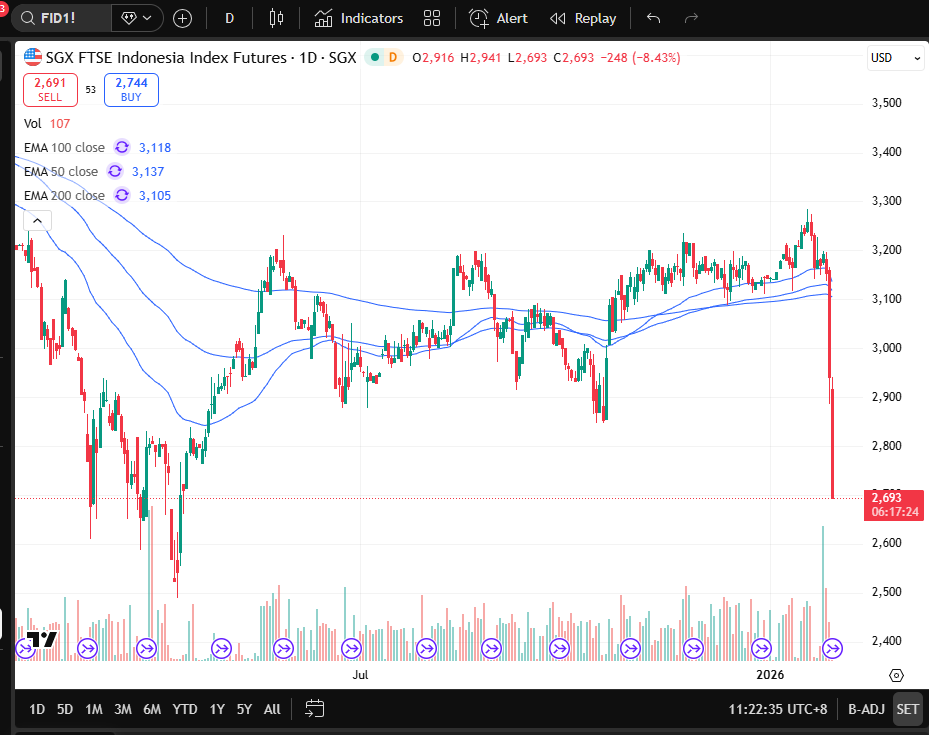
Indonesia Markets Under Pressure: What MSCI’s Warning Signals for Investors
Indonesian equities were hit by a sharp sell-off this week, underscoring how market structure and governance concerns can quickly reshape investor confidence. The Jakarta Composite Index (JCI) plunged as much as 8.8% intraday, triggering a 30-minute trading halt, before closing 7.4% lower — marking the worst two-day decline since the 2008 Global Financial Crisis.
The catalyst was not an earnings shock or macro data miss, but a warning from global index provider MSCI, which raised concerns over Indonesia’s “investability” and signalled the risk of a potential downgrade from emerging market 至 frontier market status.
Why MSCI’s Decision Matters
MSCI plays a critical role in global capital allocation. Trillions of dollars track or benchmark against MSCI indices, and any change in a country’s classification can materially impact capital flows.
In its statement, MSCI said it would immediately pause certain index changes, including upcoming additions, until Indonesian regulators address concerns over tightly held ownership structures 和 free float transparency. The decision stems from what MSCI described as “fundamental investability issues”, including investor worries over coordinated efforts to distort prices.
If Indonesia fails to make sufficient progress by May 2026, MSCI will reassess its market accessibility status — a move that could lead to a reduction in weighting across Indonesian companies in the MSCI Emerging Markets Index, or even a downgrade to frontier-market status.
Stocks in the Crosshairs
The sell-off was especially pronounced in stocks that had been widely expected to enter MSCI’s indices in the upcoming review. Names such as Bumi Resources, Petrosea and Pantai Indah Kapuk Dua plunged close to 15%, as investors rapidly unwound positions built on index inclusion expectations.
This episode highlights a recurring risk in index-driven markets: when benchmark assumptions change, price adjustments can be swift and severe.
Free Float Concerns Resurface
At the core of MSCI’s warning is Indonesia’s long-standing free float issue. Many of the market’s largest companies remain thinly traded and tightly controlled by a small group of shareholders, increasing the risk of sharp price swings and market distortion.
MSCI has indicated it may rely on alternative data sources to assess actual free float levels. If companies are found to have smaller tradable floats than reported, passive funds could be forced to cut existing positions, intensifying selling pressure.
While regulators have taken steps to improve transparency — including publishing free float data on the exchange’s website — Indonesia’s current minimum free float of 7.5% remains low compared with regional peers. Plans are in place to raise this to 10–15%, with a longer-term target of 25%, in line with standards in markets such as Hong Kong and India.
Capital Flows Are Already Shifting
Foreign investors sold a net US$192 million of Indonesian equities in the week ended Jan 23, marking their first weekly outflow in 16 weeks, and remain net sellers this week. Market participants note that some probability of a negative MSCI outcome has already been priced in, particularly among index-heavy names.
As one market strategist observed, “MSCI’s freeze is a warning shot, not a verdict.” Nevertheless, the episode underscores how sensitive global capital remains to governance and accessibility signals.
Macro and Policy Overhang Adds to Uncertainty
The timing of MSCI’s warning has compounded broader concerns over Indonesia’s economic and policy trajectory. Investor sentiment has already been tested by:
-
Policy uncertainty following leadership changes in economic institutions
-
Concerns over fiscal direction amid ambitious growth targets
-
Reduced foreign participation in the equity market over recent years
Together, these factors have left the market more vulnerable to external shocks.
What Investors Should Watch Next
A downgrade is not inevitable, but the implications are meaningful:
-
Passive fund flows could be materially affected
-
Liquidity risk may rise in concentrated names
-
Volatility is likely to persist in the near term
-
Opportunities may emerge for investors able to navigate fast-moving markets
For investors, the episode serves as a reminder that market accessibility, governance and liquidity are just as important as growth narratives.
Final Takeaway
“Indonesian stocks sank on Jan 28 after MSCI raised concerns about their investability and warned of a potential downgrade to frontier-market status.” (The Straits Times)
Against this backdrop of heightened volatility, investors can look to SGX FTSE Indonesia Futures to express market views or manage risk efficiently. Trade at an exclusive, lowest-in-town rate from just US$1.38 per contract (exchange fees included) and take advantage of opportunities arising from rapidly changing market conditions.
Trade the SGX FTSE Indonesia Index Futures (FID) at just $1.38 now.
点击 立即开户。 to learn more about our exclusive SGX FTSE Indonesia Index Futures (FID) promotion now!
Trade CFDs, ETFs, Forex, Futures, Options, Precious Metals, and Stocks on NOVA
Features of trading on NOVA
- 访问 20 多个全球交易所
从 20 多个全球交易所的 200 多个全球期货中捕捉机会 - 全球股票的交易机会
Over 11,000 Stocks and ETFs across Singapore, US, China, Hong Kong, Malaysia and Japan markets. - Charting Powered by TradingView
View live charts and gain access to over 100 technical indicators - True Multi-Asset Trading
Trade CFDs, ETFs, Forex, Futures, Options, Precious Metals and Stocks on a single ledger on NOVA - USD Shares Margin Rate at Only 4.5% p.a
- Fractional Shares from US$1