CN
CN  EN
EN 
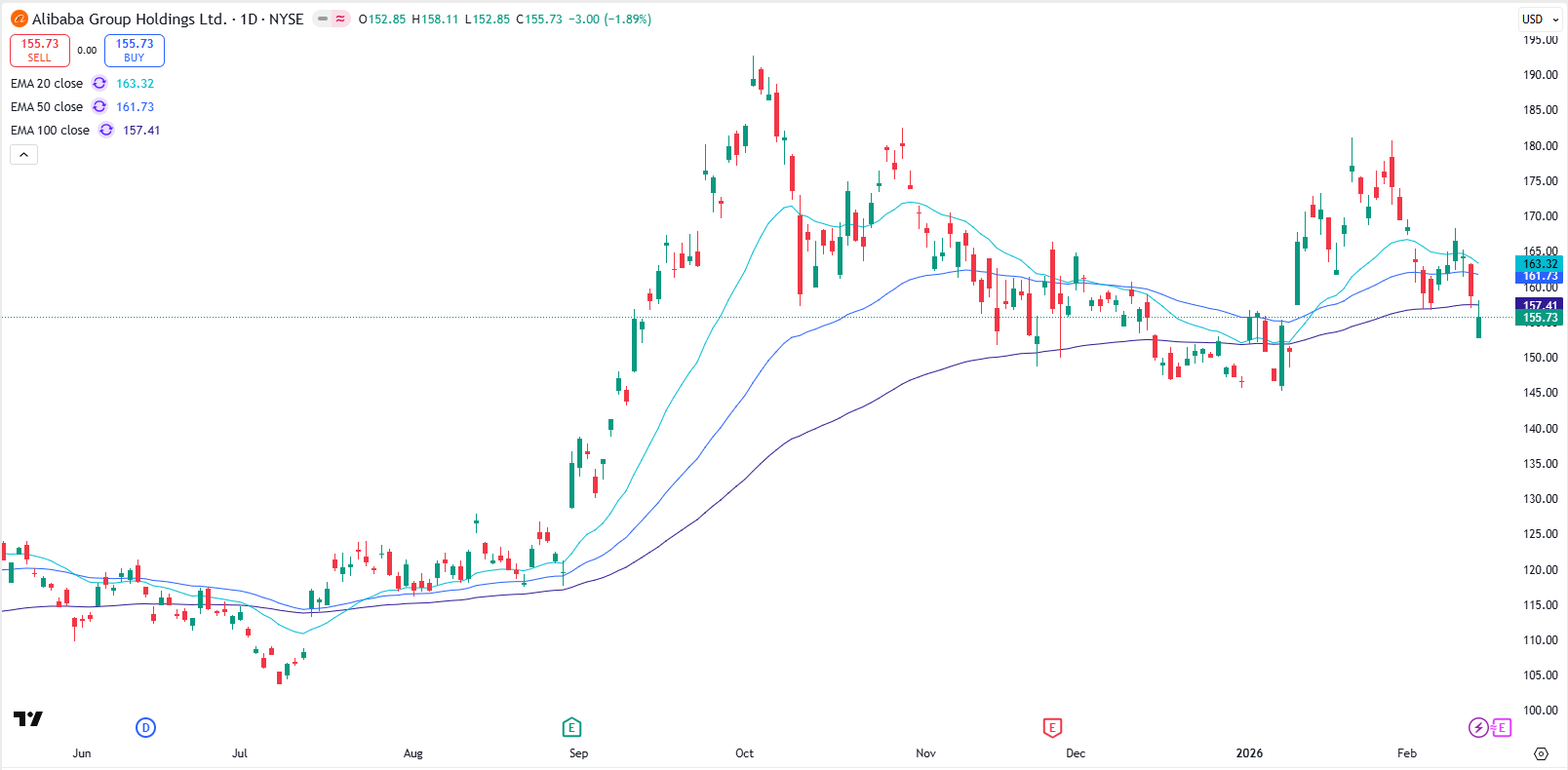
As China entered the Year of the Horse, the country’s annual Chinese New Year marketing blitz took on a distinctly artificial-intelligence flavour. What was once a contest over digital “red envelopes” has evolved into a multi-billion-yuan race to anchor consumers inside AI-powered ecosystems.
At the centre of the campaign is Alibaba Group (NASD: BABA | SGX: HBBD | HKEX: 9988), which used the holiday to position its Qwen AI assistant as more than a chatbot – pitching it instead as a transaction engine embedded across its sprawling commerce network.
From Traffic Wars to AI Entrances
For over a decade, the Chinese New Year has been prime time for Chinese internet companies to buy traffic and habits. Subsidies, coupons and gamified promotions have historically boosted downloads and wallet activation.
This year’s iteration appears more structural.
Market estimates suggest Alibaba earmarked several billion yuan in incentives tied to AI-assisted purchases, exceeding promotional spending by rivals including Tencent and Baidu, both of which also rolled out holiday AI campaigns. ByteDance, operator of Douyin, leaned on gala sponsorships and traffic distribution rather than direct commerce integration.
The shift reflects a broader pivot: AI is no longer being marketed primarily as a conversational novelty, but as a utility layer for real-world transactions.
Agentic Commerce
Alibaba’s differentiator lies in what executives have described as deeper integration. Rather than confining AI to search or chat, Qwen connects directly to Alibaba’s internal ecosystem — from Taobao retail listings to logistics, maps and payments.
The company’s thesis is straightforward: if users can research, decide and pay through a single AI prompt, friction — and potentially customer acquisition cost — declines.
Promotions tied to AI-assisted purchases, including heavily discounted food and beverage orders, drove a surge in user activity during the holiday period, according to company statements and local media reports. While precise transaction figures have not been fully disclosed, the campaign was widely seen as a stress test of infrastructure and consumer willingness to transact through AI.
For investors, the more consequential question is not short-term order volume but whether AI can lift conversion rates and increase repeat purchasing without permanently compressing margins through subsidies.
Infrastructure and Standards
Alibaba’s push also extends beyond the consumer layer. Its cloud division has aggressively open-sourced versions of its Qwen large language models, aiming to cultivate developer adoption domestically and overseas.
The strategy creates a dual exposure:
- AI as a consumer-facing commerce layer
- AI as infrastructure delivered through cloud services
That approach contrasts with peers that are more concentrated in search monetisation or social distribution.
Founder Jack Ma has reappeared publicly over the past year, a symbolic shift after a prolonged period of regulatory pressure on China’s technology sector. While he holds no formal executive role, his renewed visibility has been interpreted by some investors as a sign of stabilisation in Alibaba’s strategic direction.
China’s Execution Model
The Chinese New Year campaign underscores a broader divergence in the global AI race.
In the U.S., companies such as OpenAI and Google continue to emphasise frontier model capabilities — reasoning, multimodal inputs and enterprise productivity tools.
China’s leading platforms, by contrast, are embedding AI into payments, logistics and manufacturing systems at scale. The country remains the world’s largest installer of industrial robots and has made AI integration a national policy priority, smoothing commercial deployment across sectors from factories to municipal services.
Public sentiment may also play a role. Surveys in recent years have shown higher consumer acceptance of AI-driven services in China relative to Western markets, lowering friction for adoption in daily transactions.
The Margin Question
The central uncertainty for Alibaba is economic durability.
Subsidy-led growth has long been a feature of China’s internet landscape. The open question is whether AI-enabled transactions represent a structural improvement in efficiency — reducing search costs and improving personalisation — or simply another channel requiring sustained promotional spending.
If AI becomes the default “front door” to Alibaba’s commerce universe, the company could strengthen user stickiness and cross-sell across travel, groceries and retail. If not, the campaign risks being remembered as a costly experiment during a period of heightened competition.
For now, the holiday provided a glimpse of a potential future in which AI is less a chatbot in a browser and more an invisible operator inside the transaction itself.
The race for AI supremacy may capture headlines in Silicon Valley. In China, the battle is increasingly being fought at the checkout counter.

Trade Alibaba shares (NASD: BABA | SGX: HBBD | HKEX: 9988) from as low as 0.01%. Open an account now!
在 NOVA 交易 CFDs、ETF、外汇、期货、期权、贵金属和股票
NOVA 交易功能
- 接入超过 20 个全球交易所
从 20 多个全球交易所的 200 多个全球期货中捕捉机遇 - 全球股票的交易市场
覆盖新加坡、美国、中国、香港、马来西亚及日本市场,提供超过 11,000 只股票及 ETF。 - 由 TradingView 提供图表功能
查看实时图表,并使用超过 100 种技术指标。 - 真正的多资产交易体验
通过 NOVA 单一账本交易 CFDs、ETF、外汇、期货、期权、贵金属和股票。 - 美元及新元股票融资利率低至 4.5% p.a.
- 美股碎股低至 1 美元起
以低至 1 美元名义金额开始投资美股碎股,每笔订单佣金为 0.38 美元。