CN
CN  EN
EN 
作者:Priyanka Sachdeva,Phillip Nova 高级市场分析师
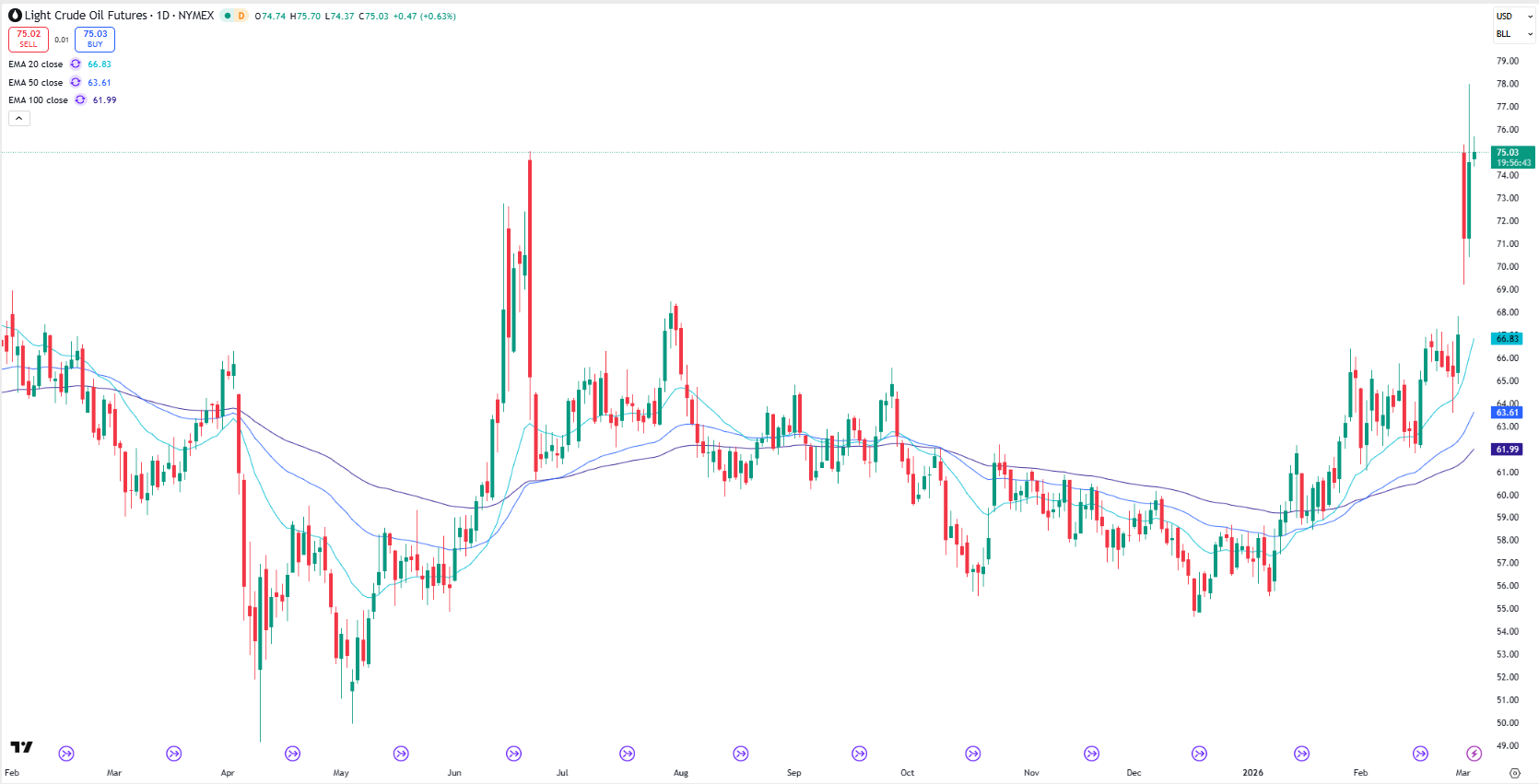
Crude oil prices have surged over 30% year-to-date amid concerns about an oil flow halt in the Strait of Hormuz, with 50% of the increase attributed to this weekend alone. The Strait of Hormuz is a key chokehold point that handles almost 20% of the global flow of Oil and over 25% flow of LNG. With more and more headlines of escalation and damage to critical infrastructure, sentiments are sore all across the financial markets.
As of 9:25 am Singapore standard time WTI futures trade at $75.34 per barrel, up by +1.02%, while Brent futures trade at $82.40 per barrel, up by +0.56%.
As per a recent headline, President Trump has announced that the US Development Finance Corporation will immediately provide insurance and guaranteed passage through Hormuz, with the US Navy prepared to escort Oil tankers. Trump stated the US will ensure the free flow of energy to the world, at a very reasonable cost, citing the country’s economic and military strength. Now, while the US Navy with its Fifth Fleet is based in Bahrain, it has historically escorted vessels during periods of heightened tensions. Especially during the 1987-88 war, they escorted Kuwaiti oil tankers to protect them from Iranian attacks, but “Guarantee” is a strong word.
If Iran has truly decided to use its “Wildcard” and halt trade via Hormuz, they can use Anti-ship missiles, drones to attack, and even one successful tanker damage could send shockwaves to Oil prices. And unlike the 1980s, Iran’s missile and drone capabilities today are far more advanced. So the US can reduce risk, but it cannot eliminate asymmetric warfare risk. However, attacking an Oil vessel under US Navy protection would be a direct US-Iran military confrontation, something that the world isn’t prepared for.
Iran’s retaliation is stronger than ever, and its warfare capabilities have evolved, too. So underestimating isn’t a good strategy, especially for Asian Buyers. Hundreds of oil tankers are stranded after the 4日 straight day of standstill in the Strait of Hormuz. Meanwhile, the rush to secure barrels has begun, insurance costs are sky-rocketing and giants like Saudi Aramco are contemplating re-routing.
Since the attacks began, Qatar has stopped liquefied natural gas production, Israel has stopped production at some gas fields, and Saudi Arabia shut its biggest refinery. India and Indonesia said they were seeking alternative energy supplies. In China, some refineries were shutting down or bringing maintenance plans forward. Refiners and physical players are bracing for adversities, while in financial markets, almost 4.8 million Brent futures and options contracts traded on March 1 on the ICE, the highest since June 2025.
关键要点
At this stage, geopolitics has overtaken traditional price drivers such as inventory data, US macro releases, or OPEC commentary. The dominant factor is now risk perception — specifically whether tensions around the Strait of Hormuz translate into actual supply disruptions.
In the near term, key indicators to monitor include Gulf export data, confirmed tanker incidents, US naval deployments, and shifts in Iran’s rhetoric. While both sides continue to retaliate, what ultimately matters is whether physical oil flows are interrupted. If exports continue largely uninterrupted, the current risk premium could gradually fade. However, even a single successful strike on an oil tanker, critical infrastructure or a sustained disruption to shipping could trigger another sharp price spike.
Through month-end, prices are likely to remain volatile but range-bound unless a material supply shock emerges. For now, markets are pricing in fear rather than confirmed shortages. Without clear evidence of falling exports, we may continue to see sharp intraday swings rather than a sustained upward trend. Ultimately, direction will depend less on headlines and more on whether barrels physically stop moving.
Navigate the Crude Oil and Gold Futures market on NOVA, or monitor prices on related ETFs, CFDs and stocks now. Open an account 此处.
在 NOVA 交易 CFDs、ETF、外汇、期货、期权、贵金属和股票
NOVA 交易功能
- 接通超过 20 个全球交易所 通过超过 20 个全球交易所的 200 多个环球期货产品,把握市场机会。
- 全球股票交易机会 覆盖新加坡、美国、中国、香港、马来西亚及日本市场超过 11,000 只股票和 ETF。
- TradingView 图表支持 查看实时图表,并使用超过 100 种技术指标。
- 真正的多资产交易 通过 NOVA 的单一账簿,交易 CFDs、ETF、外汇、期货、期权、贵金属及股票。
- 美元及新元股票融资利率低至 4.5% p.a.
- 美股碎股低至 1 美元起
以低至 1 美元名义金额开始投资美股碎股,每笔订单佣金为 0.38 美元。