CN
CN  EN
EN 
Analysis courtesy of Eurex.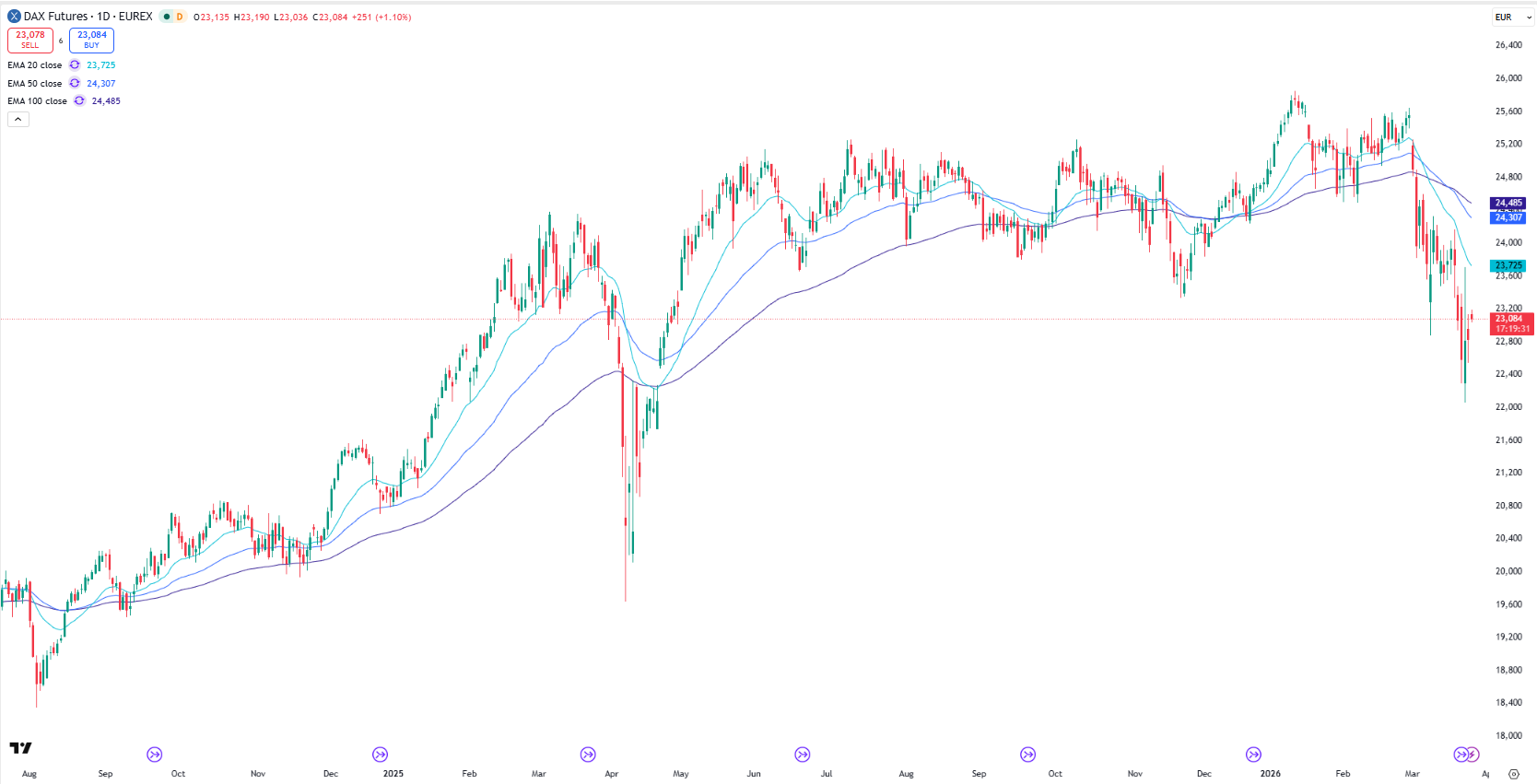
Oil prices are rising again, while (almost) everything else is falling: stock prices, bond prices—and even gold and silver. The “safe havens” are failing.
Hopes for a swift end to the war in Iran are fading. “The mullah regime in Tehran appears willing to do anything in its fight for survival, while the White House had underestimated its resistance and apparently has no Plan B,” notes Berndt Fernow of LBBW.
The conflict has recently escalated: On Saturday night, U.S. President Trump threatened to destroy Iran’s energy facilities if the country did not reopen the Strait of Hormuz within 48 hours. Iran responded by threatening to completely close the vital strait. “Reopening the Strait of Hormuz is one thing; repairing destroyed production facilities, terminals, and refineries is another,” explains Fernow. The financial markets therefore expected a noticeable rise in inflation.
Gold price nears the $4,000 mark
A barrel of Brent crude is trading at $114 on Monday morning; before the outbreak of war, it was around $70. Stocks continue to fall: The DAX slipped below 22,000 points on Monday morning after closing at 22,380 points on Friday. The Stoxx Europe 600 is also continuing its downward trend. U.S. markets closed with losses again on Friday.
The trend in precious metals is striking: a troy ounce of gold now costs just $4,200. At its all-time high in January, it was still $5,570. The price of silver has halved to its current level of $62 from its record high of nearly $122. The strong U.S. dollar and expectations of rising interest rates are making precious metals less attractive. Bitcoin has not continued its recent recovery and has slipped back below $68,000, also nearly half its record high.
“The global economy could still get off with a slap on the wrist”
“The longer the conflicts persist and the longer oil prices remain at significantly elevated levels, the more severe the dampening effects on the real economy will be,” notes Markus Reinwand of Helaba. In addition to price effects, supply chain disruptions could occur. However, the Global Supply Chain Pressure Index does not yet show any abnormalities. The fluctuations in shipping stocks, which serve as leading indicators, have also been manageable so far. “So it is still possible that the global economy will get off with a slap on the wrist.” With the latest corrections, the markets have indeed priced in a more realistic scenario. However, according to Reinwand’s assessment, there hasn’t been much room for positive surprises yet. “At present, there is still no truly attractive entry opportunity.”
Failed to hold support levels
“Times are more turbulent than they have been in a long while,” comments technical analyst Christoph Geyer. The DAX has recently fallen sharply below the support zone that had held for months. The next support level it has now reached is not particularly robust. “A lasting improvement in the situation can only be expected once the fighting comes to an end.”
As for earnings season, second- and third-tier companies will be reporting their results for the fourth quarter of 2025 this week, including Salzgitter, Drägerwerk, Jenoptik, Hornbach, CTS Eventim, and Cewe.
Key Economic and Business Data
Wednesday, March 25
10:00 a.m. Germany: ifo Business Climate Index for March. Given the war in Iran and the sharp rise in energy prices, anything other than a significant decline in the ifo business climate—and particularly in business expectations—would be a major surprise, according to Commerzbank.
Thursday, March 26
8:00 a.m. Germany: GfK Consumer Climate Index for March. According to DekaBank, consumer sentiment will be shaped by developments in the Middle East. In response to growing fears of a loss of purchasing power, the GfK Consumer Climate Index for Germany is likely to decline.
Take a view on the European Markets with Phillip Nova now!

以 1.50 欧元的价格交易 Micro-DAX® 和 Micro-EURO STOXX 50® 期货*。了解更多 此处.