CN
CN  EN
EN 
Four of the world’s most valuable companies (Meta, Microsoft, Google and Amazon) report earnings on the same day the Fed delivers its verdict on interest rates. For investors, these two days are as loaded as it gets.
Key Figures at a Glance
- Combined FY26 Capex (est.): ~$645 billion — up approximately 56% year-on-year
- Companies reporting 29 Apr: 4 (Meta, Microsoft, Alphabet, Amazon)
- Fed Funds Rate (current): 3.50–3.75% (target range)
- March 2026 CPI (YoY): 3.3% — well above the Fed’s 2% target
- Probability of rate hold: ~100% (futures market consensus)
OVERVIEW
Imagine four of the most consequential companies ever to exist all stepping up to the witness stand on the same afternoon — each carrying a trillion-dollar balance sheet, each betting enormous sums on the same technology, and each facing the same pointed question from the market: is all this AI spending actually working?
That is precisely what happens on Wednesday, 29 April 2026, when Meta, Microsoft, Alphabet, and Amazon simultaneously report their first-quarter results after the closing bell. And as if that were not enough, the same afternoon also delivers the Federal Reserve’s latest interest rate decision — the last one to be presided over by Chair Jerome Powell before his term expires.
For anyone watching the AI infrastructure build-out closely, this confluence of events is remarkable. For the broader investing community, it is two days that could meaningfully reshape the market narrative for the rest of the year.
THE AI CAPITAL CYCLE From ambition to accountability — the market wants proof
Earlier in 2026, investor nerves were rattled by fears of AI overbuilding. The emergence of lean, highly capable Chinese AI models briefly called into question the logic of deploying hundreds of billions into data centres. That anxiety has since moderated as compute shortages remain real, demand signals continue to beat forecasts, and newer frontier models have reaffirmed that raw scale still commands a premium.
But the mood has shifted subtly. Market participants are no longer willing to reward AI ambition on its own. They now want to see durable revenue growth, improving margins, and — most importantly — clearer evidence that the dollars being poured into silicon and server halls are translating into returns. This week is the first real stress-test of that thesis at scale.
“The market is no longer rewarding AI ambition alone. It now wants evidence that spending is still producing durable growth, stronger earnings, and clearer returns on investment.”
The number that changes everything
Combined, the four companies reporting on 29 April are expected to deploy roughly $645 billion in capital expenditure across 2026 — a year-on-year increase of approximately 56%. The question the market is asking is no longer how much? It is what are we getting for it?
- Amazon: $200 billion — full-year 2026 guide (largest single spender)
- Alphabet: $175–185 billion — reiterated FY2026 plan
- Meta: $115–135 billion — 2026 capex guidance
- Microsoft: $37.5 billion+ in Q2 FY26 alone, up 66% year-on-year
COMPANY BRIEFINGS · Q1 2026 Four companies. One shared storyline.
Each company has its own flavour of the AI trade, and each comes into this week with a different set of expectations to manage.
Meta Platforms (NASD: META)
- REVENUE (EST.): ~$55B
- YOY GROWTH: ~32%
- EPS CONSENSUS: $6.65
Across 42 sell-side analysts, Meta carries zero Sell ratings — a rare feat that reflects the extraordinary momentum of its AI-powered advertising engine. The company’s $115–135 billion 2026 capex plan is aggressive, but management is increasingly shifting AI workloads to Meta’s own MTIA silicon, which could meaningfully reduce dependency on third-party chips and improve margins over time. If that efficiency story gains traction on the call, it could be a compelling counterpoint to the spending headline.
Microsoft (NASD: MSFT)
- EPS (EST.): $4.04
- AZURE CC GROWTH: 37–38%
- AI REV. FY26 (EST.): ~$25B
Microsoft’s quarter is almost entirely an Azure story. The company guided for constant-currency Azure growth of 37–38%, following 39% in the prior quarter. Investors will parse every word from management for signs of acceleration or deceleration. Beyond cloud, the traction of Microsoft 365 Copilot — priced at $30 per user per month — remains the most critical near-term AI monetisation metric. Seat count momentum here could move the stock materially.
Alphabet (NASD: GOOG)
- REVENUE (EST.): ~$107B
- YOY GROWTH: ~11–19%
- CLOUD RUN RATE: $70B ann.
Alphabet enters this week having successfully shed its reputation as an AI laggard. Google Cloud accelerated to 47.8% growth in Q4 2025, pushing the segment to a $70 billion annual run rate. The integration of Gemini across Gmail, Android, and now Apple’s Siri — a particularly striking validation — has reframed the narrative around Google’s competitive position. Alphabet has also reiterated its $175–185 billion FY2026 capex guide, and the market will be watching for any signal on FY2027 discipline.
Amazon (NASD: AMZN)
- REVENUE (EST.): ~$177B
- YOY GROWTH: ~14%
- FY26 CAPEX GUIDE: $200B
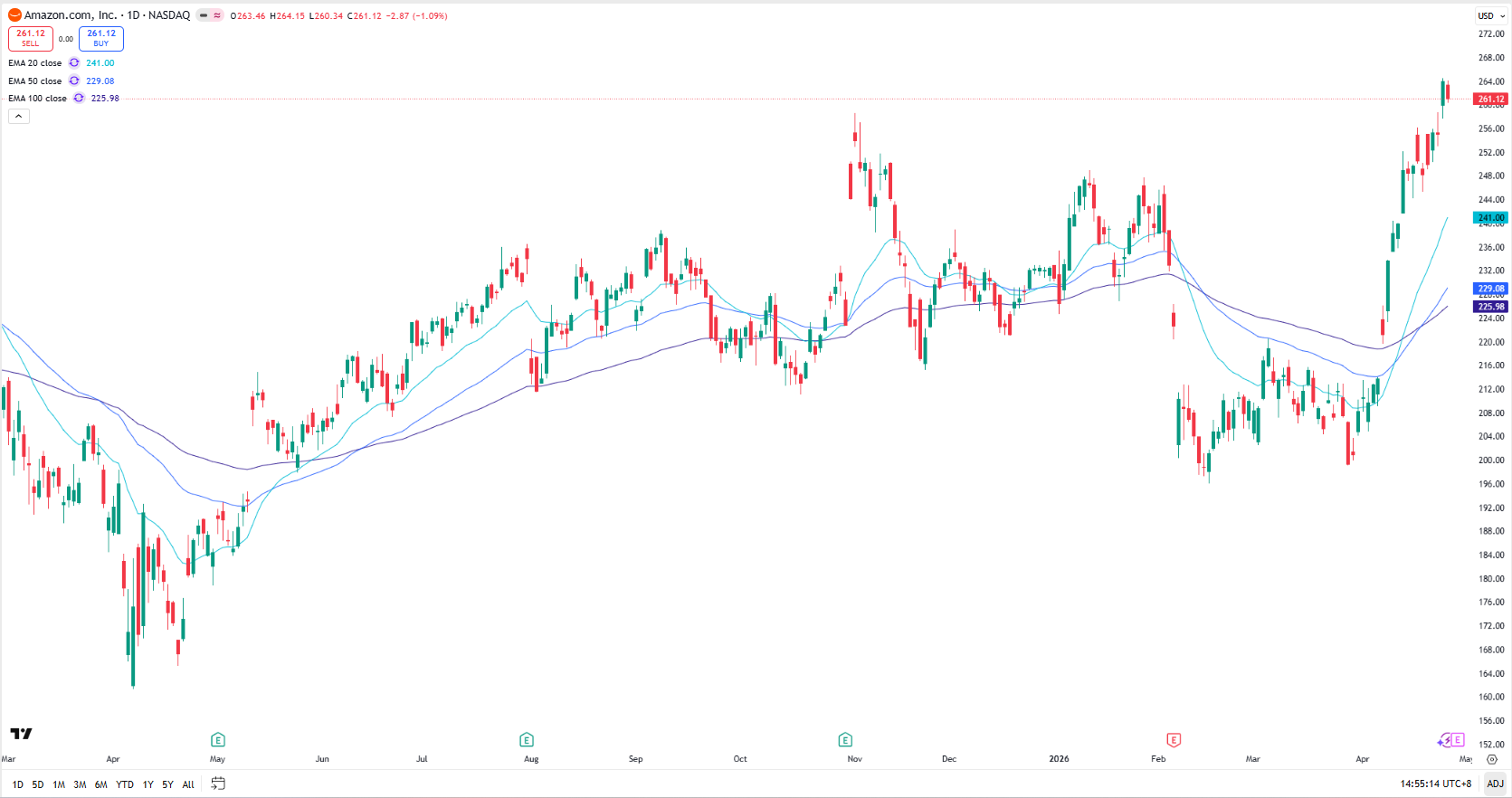
Amazon stands as the single largest AI infrastructure spender among the four, with a full-year 2026 capex guide of $200 billion — a figure that also reflects the company’s deepening partnership with Anthropic, in which Amazon announced an additional $5 billion investment on 21 April, with potential for $20 billion more over time. AWS is the crown jewel, and consensus expects $29.4 billion in cloud revenue this quarter with a 35% operating margin. Guidance commentary around AI demand for AWS will be the most closely scrutinised passage of any of the four calls.
MONETARY POLICY · FEDERAL RESERVE The Fed’s potential last act under Powell
As if the earnings slate were not enough, the Federal Open Market Committee wraps up its two-day meeting on 29 April, with Chair Jerome Powell’s press conference set for 2:00 PM ET — approximately two hours before markets close, and several hours before any of the earnings calls begin. That sequencing matters: traders will have already processed the Fed’s communication before the technology results land.
Key data heading into the decision
- Fed Funds Rate (target): 3.50–3.75% — held steady since March 2026
- March CPI (YoY): 3.3% — well above the 2% target
- March payrolls: +178,000 — above forecast; unemployment at 4.3%
- Probability of hold: ~100% (futures market consensus)
- Cuts projected in 2026: 1 cut — per FOMC dot-plot (March)
- Powell’s term as Chair: Ends 15 May 2026; Kevin Warsh nominated as successor
No one is expecting the Fed to move rates at this meeting — futures markets have priced in a near-certainty of no change. But the meeting carries unusual weight because it will likely be Powell’s final press conference as Chair. His term expires on 15 May 2026, and the Senate is expected to confirm Kevin Warsh as his successor this week.
What the market is genuinely interested in is the tone. With CPI running at 3.3% — a full percentage point above the Fed’s 2% target, and meaningfully hotter than February’s 2.4% reading — the question is how concerned Powell is about inflation’s stickiness. A hawkish tilt in the statement or press conference could dampen rate-cut hopes for the rest of 2026, adding a layer of complexity to the risk environment just as four mega-cap earnings calls get underway.
Compounding this, there is a Middle East conflict driving elevated energy prices, which the Fed acknowledged in its March statement as introducing meaningful uncertainty into the macroeconomic outlook. Powell’s language around this dimension will be read carefully.
THE BIGGER PICTURE Why confluences like this are so rare — and so electric
The experience of watching multiple mega-cap companies report on the same day is one of the genuinely thrilling aspects of following public markets. It is the rare moment when years of corporate strategy, billions of dollars in capital allocation decisions, and the collective intelligence of thousands of analysts all get tested against a single set of reported numbers.
When that coincides with a Fed decision — especially one with a leadership transition backdrop — the stakes are compounded. The interaction between technology growth narratives and the interest rate environment is not academic. Valuations of high-growth companies are acutely sensitive to the trajectory of discount rates, and the Fed’s signalling this week will inform how the market assigns multiples to the AI infrastructure story for months to come.
The Narrative Fork
There are two broad outcomes that could crystallise this week. The first is a confirmation scenario: four companies beat estimates, provide strong forward guidance, and demonstrate improving AI monetisation — arriving alongside a neutral-to-dovish Fed statement. That combination would likely reinforce the bull case for AI infrastructure spending and technology valuations broadly.
The second is a dispersion scenario: mixed results, cautious capex commentary, or rising inflation language from Powell creating uncertainty. Markets rarely move in one direction from events this loaded — the divergence between companies, and between the macro and micro reads, is often the most interesting story of all.
Things to watch closely
- Azure growth acceleration or deceleration. Microsoft guided 37–38% constant-currency growth. Any beat signals sustained enterprise AI adoption; a miss reopens questions about whether growth is peaking.
- Meta’s AI efficiency narrative. The key is whether management can credibly argue that its own MTIA chips are improving margins on that $135 billion capex commitment, not just inflating it.
- Amazon’s AWS demand commentary. With $200 billion going into infrastructure, investors need to hear that enterprise AI demand for AWS is accelerating — not merely stable. Watch for mentions of capacity constraints and pipeline.
- Alphabet’s FY2027 capex signals. Bloomberg estimates point to roughly $200 billion in 2027. Any hint of commitment or restraint around that figure will be treated as a forward signal for the AI capital cycle as a whole.
- Powell’s inflation language. Whether he describes recent CPI acceleration as transitory or structural will set the tone for rate-cut expectations for the second half of 2026 — and directly affect how the market discounts the AI growth story.
- The Warsh transition signal. Markets see Warsh as more disposed toward rate cuts if data allows. Any commentary suggesting a smooth handover — or a hawkish recalibration — could move bond markets and equities simultaneously.
The investing journey, in two days
What makes following public markets genuinely compelling — regardless of whether you are a seasoned participant or someone watching from the outside — is precisely these moments of compression. Two days. Trillions of dollars in market capitalisation. The future trajectory of the most significant technology investment cycle in a generation. And a monetary policy backdrop that is navigating inflation, geopolitical shocks, and a leadership transition all at once.
Earnings weeks involving this level of concentration are rare. They are the moments where abstract narratives about AI becoming infrastructural, about cloud becoming indispensable, about the relationship between technology and macroeconomics — all get put to the test by actual numbers. Whether the results confirm or complicate those narratives, the conversation they produce tends to shape how the market thinks for the quarters that follow.
That, ultimately, is why an event like this week deserves more than a passing glance at a headline. The story being told in earnings calls and Fed press conferences over the next 48 hours is, in many ways, the story of how the 2020s economy is being built.
Invest in Fractional Shares from just $1, at a flat fee of USD0.38. Click here to learn more now!
在 NOVA 交易 CFDs、ETF、外汇、期货、期权、贵金属和股票
NOVA 交易功能
- 接通超过 20 个全球交易所 通过超过 20 个全球交易所的 200 多个环球期货产品,把握市场机会。
- 全球股票交易机会 覆盖新加坡、美国、中国、香港、马来西亚及日本市场超过 11,000 只股票和 ETF。
- TradingView 图表支持 查看实时图表,并使用超过 100 种技术指标。
- 真正的多资产交易 通过 NOVA 的单一账簿,交易 CFDs、ETF、外汇、期货、期权、贵金属及股票。
- 美元及新元股票融资利率低至 4.5% p.a.
- 美股碎股低至 1 美元起
以低至 1 美元名义金额开始投资美股碎股,每笔订单佣金为 0.38 美元。