CN
CN  EN
EN 

Before trading CFDs, it is useful to have a clear trading plan instead of simply looking at a chart and asking, ‘Should I buy or sell?’
A CFD trading plan helps you manage your capital, risk, time, markets and strategies with greater discipline. This is especially important when trading leveraged products, where both potential gains and losses can be magnified.
With a clear plan and a suitable trading platform, retail traders can approach the markets in a more structured and risk-aware way. In this guide, we explain what a CFD trading plan is, how to build your plan, and how Phillip MetaTrader 5 (Phillip MT5) can support your trading journey with practical tools.
What Is a Trading Plan
A trading plan is a clear framework that guides how you approach trading before you enter the market. It helps you define your motivation, trading goals, available time, capital, risk tolerance, preferred markets, strategies, and review process.
In simple terms, a trading plan sets the overall direction for your trading. It is not just about deciding when to buy or sell. It is about making sure your trading decisions are aligned with your goals, available capital and risk tolerance.
It is also important to understand the difference between a trading plan 和一个 trading strategy.
| Term | What It Means | Example |
| Trading plan | Your overall framework for managing capital, risk, time, frequency, markets, strategies, and results | “How much capital should I allocate to CFD trading?” |
| Trading strategy | A specific method used to identify and manage trade opportunities | “Should I enter now, wait for confirmation, or skip this setup?” |
A trading strategy may help you decide when to buy or sell. A trading plan helps you decide whether that strategy fits your goals, risk tolerance, available capital, and trading style. Choosing your trading strategy is one part of building your trading plan.
Why CFD Traders Need a Trading Plan
CFD trading allows traders to access price movements across different markets such as indices, commodities, shares, ETFs and cryptocurrencies, without owning the underlying assets. This flexibility can create more trading opportunities, but it also means traders need a clear plan for managing capital, risk, market exposure, and trading discipline.
This is especially important because CFDs are traded with leverage, which allows traders to gain larger market exposure with a smaller initial margin. However, leverage can also magnify losses. Without a plan, it can be easy to overtrade or take on excessive risk exposure, which may lead to large losses.
A CFD trading plan should therefore help you answer questions such as:
- How much capital am I prepared to allocate to CFD trading?
- What is the maximum loss I am comfortable taking over a set period?
- Which CFD markets do I understand well enough to trade?
- What level of leverage, if any, is appropriate for my risk tolerance?
A good CFD trading plan should not encourage you to trade more. It should help you trade more selectively, manage risk more carefully, and use your trading platform with greater discipline.
How to Create Your Trading Plan
Step 1: Define Your Motivation and Trading Objectives
Every trader should have a clear reason for trading. Are you trading CFDs to earn additional income, capture short-term opportunities with leverage, or hedge short-term portfolio risk?
Once your motivation is clear, turn it into realistic and measurable trading objectives that reflect your financial background, available capital and overall financial goals.
Instead of setting a vague goal such as “I want to make money quickly”, define your objectives in clearer terms, such as:
- Setting a realistic return on committed trading capital over a defined period
- Exceeding a selected benchmark return by a certain percentage
- Hedging a certain proportion of total portfolio exposure through CFD trading
Your trading objectives should also be balanced with risk awareness. A higher return target usually comes with higher risk. A practical CFD trading plan should help you balance your expected return with the level of risk you are prepared to accept.
Step 2: Set Your Trading Capital and Risk Tolerance
Next, determine how much capital you can allocate to CFD trading as part of your broader financial plan, and how much risk you can tolerate. CFD trading should not be treated as your entire wealth strategy, especially because it involves leverage.
Capital allocation and risk tolerance should be considered together as part of your broader financial plan. If you are more risk-averse, it is better to allocate a relatively small proportion to CFD trading because the products involve leverage and are more risky than non-leveraged products. If your risk tolerance is higher, you may consider a larger CFD allocation, but it should still stay within clear limits based on your financial situation and overall portfolio.
Start with a few practical questions:
- How much of my overall wealth should be allocated to trading and investment?
- Within my portfolio, how much should be allocated to CFDs?
- Am I prepared for the possibility of losing the funds I commit to CFD trading?
- What is the maximum loss I can accept over a month or a year?
- What level of leverage can I realistically manage if the market moves against me?
Your answer should reflect both your financial situation and your willingness to take risk. For example, a trader with stable income, sufficient savings, a long-term investment portfolio and more trading experience may have a higher risk capacity than someone without the same conditions.
Because CFDs are leveraged, the amount of money placed as margin is not the same as your total market exposure. A small amount of capital can control a larger position, which means both gains and losses can be magnified. This is why traders should decide their CFD allocation based on their risk limits, including the maximum loss they can accept.
在 Phillip MT5, traders can check contract leverage, margin requirements and account activity in real time, helping them monitor whether their trading activity remains within their planned limits.
Step 3: Choose Your Trading Style
After defining your objectives, capital, and risk tolerance, choose a trading style that fits your time commitment.
A trading style describes how often you trade and how long you usually hold positions. It does not have to be fixed. Full-time traders may combine intraday trading with swing trading, while traders with limited time may prefer swing or position trading because these styles usually require less constant monitoring.
| Trading Style | Typical Holding Period | Usually Suitable For |
| 剥头皮 | Seconds to minutes | Traders who can monitor markets closely |
| Day trading | Within the same trading day | Traders who can follow active market sessions |
| Swing trading | Days to weeks | Traders with less screen time |
| Position trading | Weeks to months | Traders focused on longer-term market themes |
Your trading style will influence the strategies you use and how often you need to monitor the market. With Phillip MT5, traders can also use Expert Advisors to apply preset trading rules automatically and reduce manual execution, which may help reduce manual execution and time commitment. However, any EA should be tested and reviewed regularly to ensure it remains aligned with your trading objectives and risk limits.
Step 4: Choose the CFDs Markets You Understand
Next, decide which CFDs markets you want to focus on.
在 Phillip MT5, traders can access spot forex, spot precious metals, and CFDs across indices, stocks, ETFs, energies, commodities, and cryptocurrencies. However, a good trading plan should help you focus on markets you understand and can trade with confidence.
When selecting markets, start with those you are already familiar with from past trading or investing experience. If you are new to trading, learn what usually drives their price movements. For example, forex and spot precious metals are often influenced by macroeconomic factors, such as economic data, geopolitical events, central bank policies and treasury yields. Shares and ETFs CFD are likely more influenced by company fundamentals and sector trends.
随着 SK Hynix ADR(NASDAQ:SKHY)正式在纳斯达克交易,投资者可根据自身投资目标和风险承受能力,通过多种方式获得相关敞口。 Phillip MT5, traders can monitor different markets in one platform and track key economic events with the built-in economic calendar. This makes it easier to follow selected products and manage opportunities within a structured trading plan.
Step 5: Decide Your Trading Strategies
Once you know your preferred trading style and markets, decide which trading strategies can help you identify and manage opportunities in those markets.
A trading strategy is the method you use to decide when to enter, exit, wait, or skip a trade. For example, a trader may use a trend-following strategy to trade in the direction of the market, or a breakout strategy to look for price moves beyond key levels.
Your strategy should be able to answer such practical questions:
- What market conditions would support a buy or sell decision?
- What indicators or price patterns can signal these potential opportunities?
- When should I enter, exit, or skip the trade?
- How should I manage risk if the market moves against me?
You do not need to use many strategies at once. For beginners, it is usually better to start with one or two strategies, then review whether they fit your trading style, selected markets, committed capital, and most importantly, risk limits. A good strategy should make your trading decisions clearer, not more complicated.
Step 6: Choose a Trading Platform That Supports Your Plan
A good platform should support the practical parts of your trading plan, such as accessing markets, analysing charts, testing strategies, and reviewing your trading activity and performance.
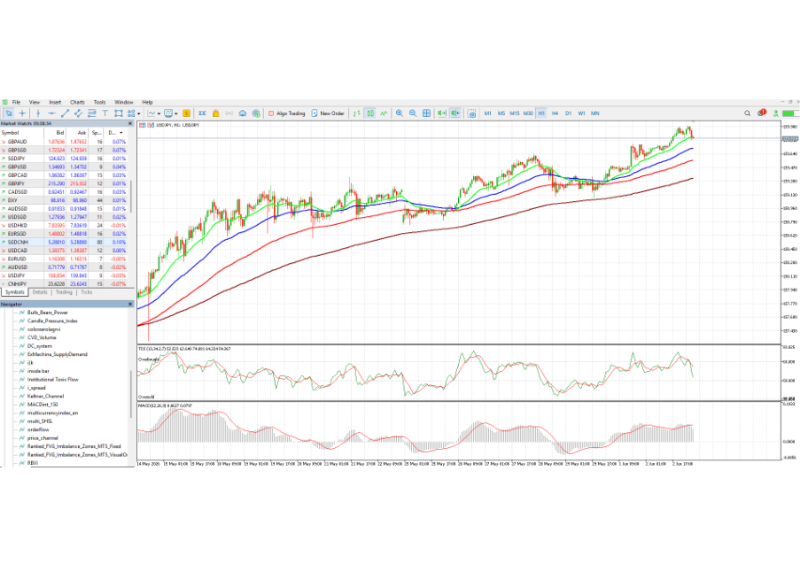
As shown in the Phillip MT5 interface, traders can monitor selected products, analyse charts with indicators, and manage their trading workflow in one place.
Source: Phillip MetaTrader 5
在 Phillip MT5, traders can access useful tools such as:
- Advanced charts and built-in indicators to support technical analysis across different timeframes.
- Market Watch to monitor selected product prices and spreads in real time.
- MQL5 Community 和 MQL5 Market to access free or paid indicators, trading tools, and Expert Advisors.
- MetaEditor to create custom indicators or Expert Advisors for strategy development and automated trading.
- Built-in economic calendar to track key economic events and view their timing on charts.
- Trading history 和 performance reports to review past trades and track performance over time.
A suitable platform can make it easier to follow, test and review your trading plan. Phillip MT5 gives traders access to market data, charting tools, indicators, Expert Advisors, and community resources in one platform, supporting a more systematic way of trading.
Step 7: Keep a Trading Journal and Review Your Plan
Once your trading plan is in place and your platform is set up, you can begin applying your plan in a structured way. However, a trading plan should not be something you write once and never revisit. It should be reviewed regularly as your objectives, financial situation, risk tolerance or market conditions change.
A trading journal helps you check whether your actual trading activity matches your plan and whether your current plan is supporting your trading objectives. For example, you can review whether your strategies are producing results that match your objectives and whether your markets, risk limits or trading styles need adjustments.
This is where Phillip MT5 can make the process more efficient. The platform can summarise your trading history and provide performance reports from different angles automatically. These reports include an overall performance summary, profit and loss, long and short positions, performance by symbols, and risk-related statistics. These reports can also be exported, making it easier to save records and track performance over time.
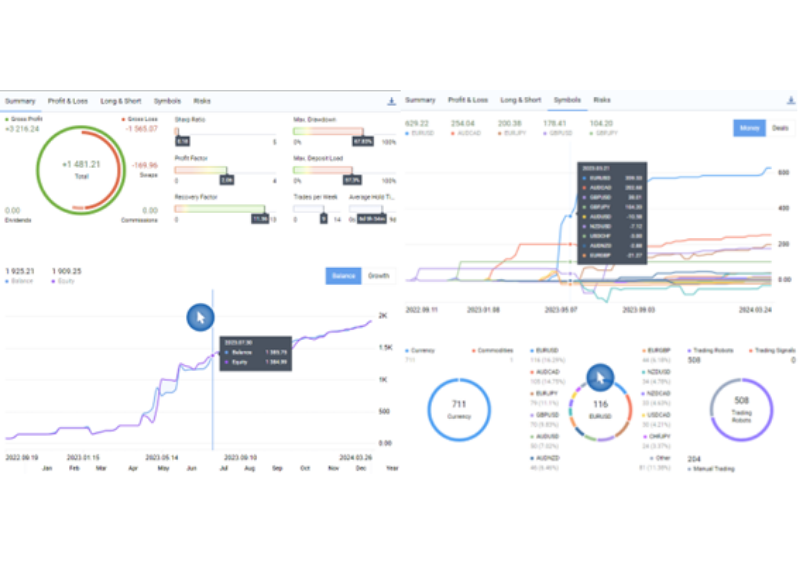
Source: Phillip MetaTrader 5, User Guide
By reviewing your trades regularly, you can identify what is working, what needs to change and whether your trading plan remains realistic. Over time, this process helps turn your trading plan from a one-time document into a practical framework for making more structured trading decisions.
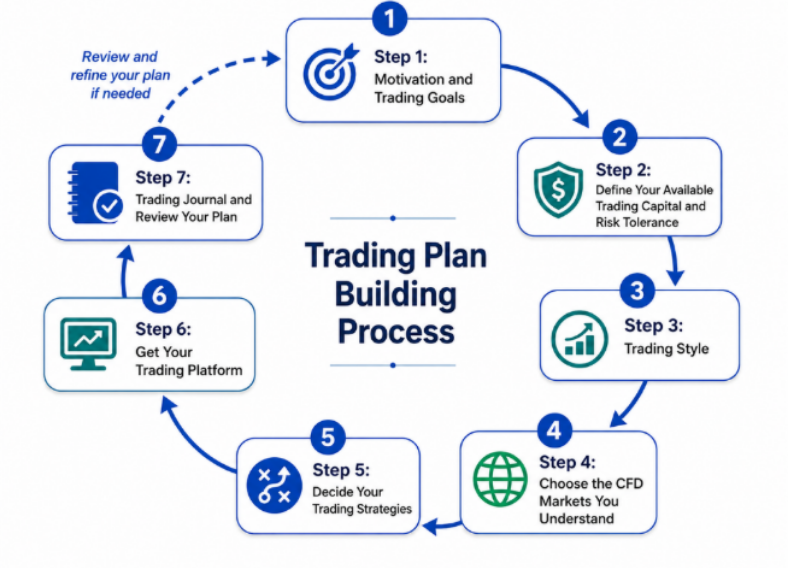
As the cycle process above shows, building a CFD trading plan is not a one-time checklist. After reviewing your trading journal and performance, you may need to refine different parts of your plan, such as your trading strategies, selected markets or trading objectives. By treating the plan as an ongoing cycle, traders can keep their approach practical, updated, and aligned with changing market conditions.
Conclusion
Building a trading plan may seem complex at first, but these steps are not meant to make trading more complicated. They are designed to help you trade with greater clarity, discipline, and risk awareness.
This is where the right trading platform can make a real difference. With Phillip MT5, traders can bring the practical parts of their trading plan into one platform, from selecting markets and analysing price movements to testing strategies with indicators and Expert Advisors, tracking economic events, and reviewing performance reports.
A trading plan helps you know what you want to do. Phillip MT5 can help you put that plan into action.
Ready to explore how a CFD trading plan works in practice? Open a 飞利浦 MT5 模拟账户 to explore the platform, browse markets, practise your strategies, and get familiar with the tools before moving to live trading.