CN
CN  EN
EN 
关键要点
- Oil prices extend gains for a third straight session as renewed US-Iran strikes and attacks on tankers heighten concerns over energy flows through the Strait of Hormuz.
- Risks to physical oil flows are growing, with Iran threatening Gulf exports while shipping activity through the Strait remains heavily disrupted.
- The market may be shifting from pricing the risk of escalation to the economic cost of a prolonged conflict, with potential implications for inflation, interest rates and global growth.
Oil prices climbed for a third consecutive session as renewed fighting between the US and Iran brought the Strait of Hormuz back into sharp focus.
The latest escalation follows reports of attacks on two oil tankers near the Strait, while the US military said it had completed another wave of strikes against Islamic Revolutionary Guard Corps (IRGC) targets in Iran. Shipping activity through the waterway has also fallen sharply, adding to concerns over physical energy flows through one of the world’s most important oil transit routes.
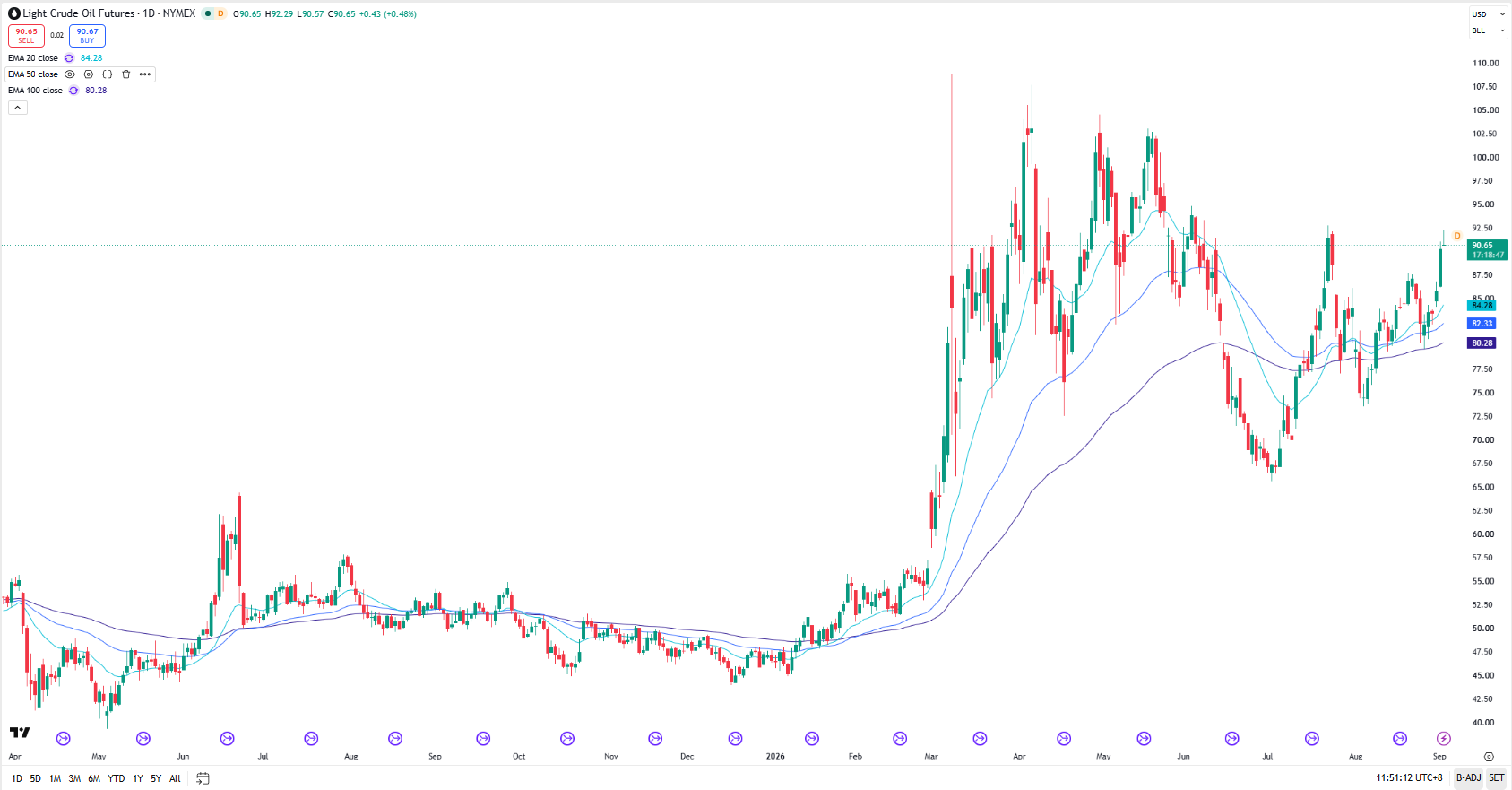
Both major crude benchmarks surged in the previous session, with WTI rising 5.2% to settle at US$90.22 per barrel and Brent gaining 4.6% to US$94.65. The upward momentum continued during Asian trading on Wednesday, with WTI trading around US$91 per barrel and Brent above US$95 earlier in the session.
Why Higher Oil Prices Matter Beyond the Energy Market
The significance of higher crude prices extends beyond the immediate threat of supply disruption.
Oil remains a critical input for the global economy, particularly for Asian economies that depend heavily on Middle Eastern energy supplies. A sustained increase in crude prices can raise transportation and production costs, feed into inflation and potentially influence expectations for interest rates.
That transmission matters across financial markets. If higher energy costs contribute to renewed inflationary pressure, investors may have to reassess the path of monetary policy, bond yields and ultimately valuations across multiple asset classes.
The latest developments are therefore particularly significant because the disruption is no longer centred solely on the possibility of military escalation. Attacks involving vessels transiting the Strait bring the risk directly into the physical energy supply chain.
Hormuz Remains the Critical Chokepoint
The Strait of Hormuz has long held enormous strategic importance because of the volume of global energy trade passing through the narrow waterway.
That importance is once again being tested.
Shipping traffic through the Strait fell sharply on Tuesday, with Kpler data showing only four commodity vessels transiting the waterway, compared with 10 the previous day and a 10-day average of around 13. Before the conflict, the Strait accounted for roughly 20% of global oil trade.
Iran has also renewed warnings over Gulf oil exports. Iranian parliament speaker Mohammad Baqer Qalibaf was quoted by Iranian media as warning that if Iran were prevented from exporting oil from the Persian Gulf, others could face similar disruption.
Even without a complete closure of the Strait, heightened security risks, attacks on tankers, rising insurance costs and reluctance among shipowners to transit the waterway could continue to constrain oil flows.
From Escalation Risk to Prolonged Disruption
Perhaps the bigger question for oil markets now is no longer simply whether tensions escalate further, but how long the disruption could last.
President Donald Trump said on Tuesday that he was not seeking to force Iran back to the negotiating table, while the latest exchange of strikes has further complicated prospects for a near-term diplomatic breakthrough.
For markets, the duration of the conflict could become increasingly important.
A prolonged period of disrupted shipping, elevated insurance costs and constrained crude flows could keep a geopolitical risk premium embedded in oil prices. The longer these conditions persist, the greater the potential for higher energy costs to filter through to inflation expectations and monetary-policy decisions.
In other words, the oil market may be moving beyond pricing the risk of conflict and towards pricing the cost of an unresolved one.
Asia Could Feel the Pressure More Acutely
Asia is particularly exposed to developments in the Strait of Hormuz because of its dependence on Middle Eastern energy supplies.
A sustained period of higher crude prices could increase import costs for energy-dependent economies, pressure trade balances and add to inflationary pressures. The challenge becomes more complicated for central banks if an energy-driven inflation shock emerges while underlying inflation remains elevated.
This makes crude oil not merely an energy story, but potentially an important macroeconomic variable for Asian markets in the months ahead.
What Should Traders Watch Next?
Rather than focusing solely on the next military headline, traders may want to monitor several indicators that could provide a clearer picture of whether conditions are improving or deteriorating:
- Tanker traffic through the Strait of Hormuz
- Physical crude loadings and export flows
- Shipping and insurance costs
- Further attacks on energy infrastructure or commercial vessels
- Signs of a credible diplomatic breakthrough
- WTI and Brent’s response to changes in physical supply conditions
Until there is clearer evidence of sustained de-escalation and a normalisation of energy flows through the Strait, geopolitical developments are likely to remain an important driver of crude oil volatility.
The key question for markets may therefore be shifting from “Will the conflict escalate?” to “How long could the disruption last?”
Navigate the Crude Oil Futures and Options market on NOVA, or monitor prices on related ETFs, CFDs and stocks now. 立即开立账户.
在 NOVA 交易 CFDs、ETF、外汇、期货、期权、贵金属和股票
NOVA 交易功能
- 接通超过 20 个全球交易所 通过超过 20 个全球交易所的 200 多个环球期货产品,把握市场机会。
- 全球股票交易机会 覆盖新加坡、美国、中国、香港、马来西亚及日本市场超过 11,000 只股票和 ETF。
- TradingView 图表支持 查看实时图表,并使用超过 100 种技术指标。
- 真正的多资产交易 通过 NOVA 的单一账簿,交易 CFDs、ETF、外汇、期货、期权、贵金属及股票。
- 美元及新元股票融资利率低至 4.5% p.a.
- 美股碎股低至 1 美元起
以低至 1 美元名义金额开始投资美股碎股,每笔订单佣金为 0.38 美元。