CN
CN  EN
EN 
Why traders should be watching COPPER
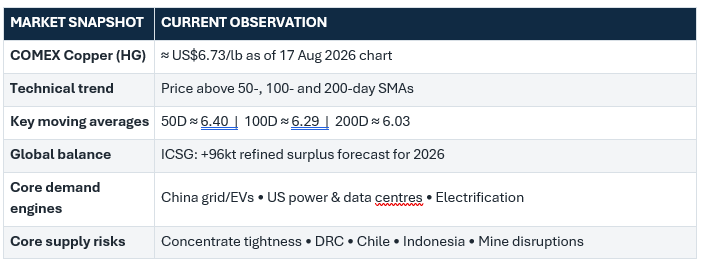
Copper has moved into price discovery as a major technical breakout meets a tightening mine/concentrate backdrop and powerful structural demand from electrification, grids, EVs and AI-related power infrastructure. The near-term price signal is stronger than the headline global balance: ICSG still forecasts a modest refined surplus, but notes that unreported Chinese stocks and geopolitical disruptions can materially change the realised balance.
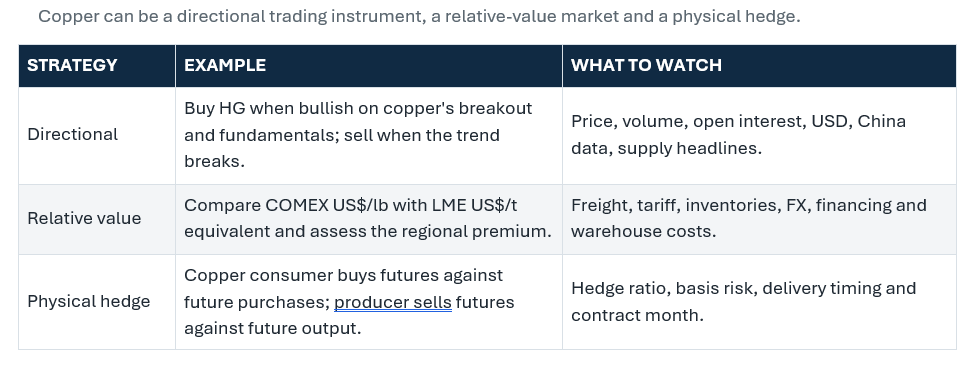
For traders, this creates three distinct opportunities: Directional exposure, COMEX–LME relative value Arbitrage and price hedging against physical positions.
Copper Enters Price Discovery
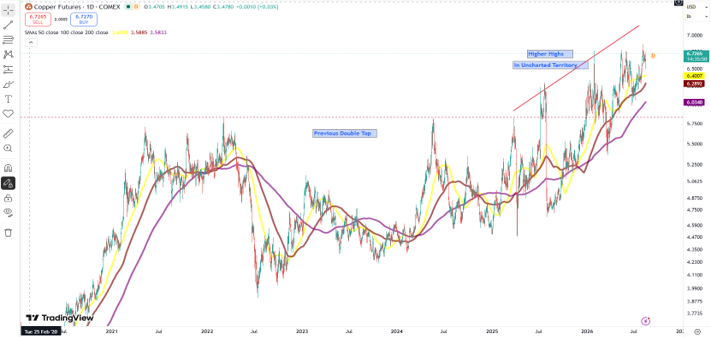
(Chart from TradingView, 17 August 2026)
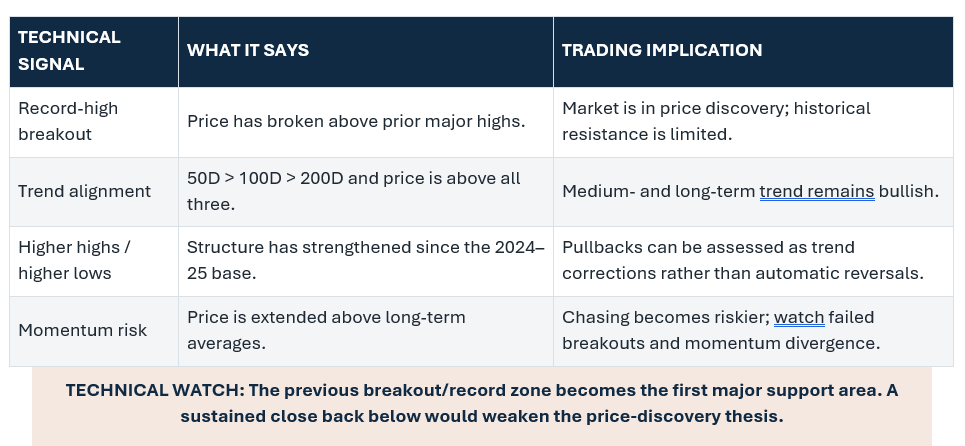
Copper is becoming the infrastructure metal of Electrification
Why AI matters for copper
- AI data centres are not only a semiconductor story: they require power generation, transformers, switchgear, cabling and grid connections, which are all copper-intensive infrastructure.
- The US power-demand outlook is increasingly being shaped by data centres and electrification, making copper exposure a way to express a broader power-infrastructure theme.
- Copper’s electrical conductivity and durability make it difficult to substitute in many high-performance electrical applications.
China remains the marginal demand engine
- Asia remains the key driver of refined copper usage growth in the ICSG 2026-27 outlook.
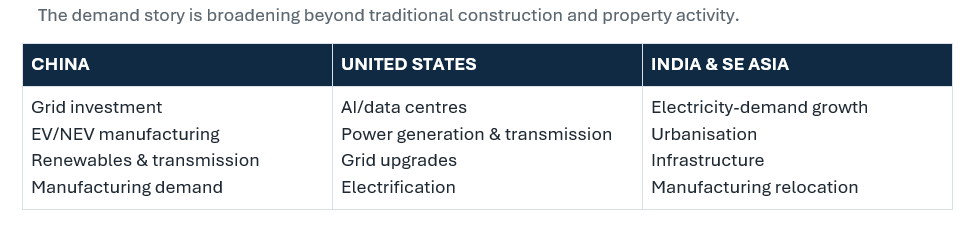
- China’s demand mix is shifting: grid investment, EVs/NEVs, renewables and manufacturing are increasingly important alongside the weaker traditional property story.
- China’s inventory behaviour matters enormously: ICSG explicitly warns that unreported Chinese stocks can materially change the apparent global balance.
KEY TAKEAWAY | Copper demand is becoming more structural and less dependent on a single end-market. Power infrastructure is the common denominator.
The bottleneck is increasingly the mine, not the smelter
A modest refined surplus can coexist with acute tightness in concentrate and specific regions.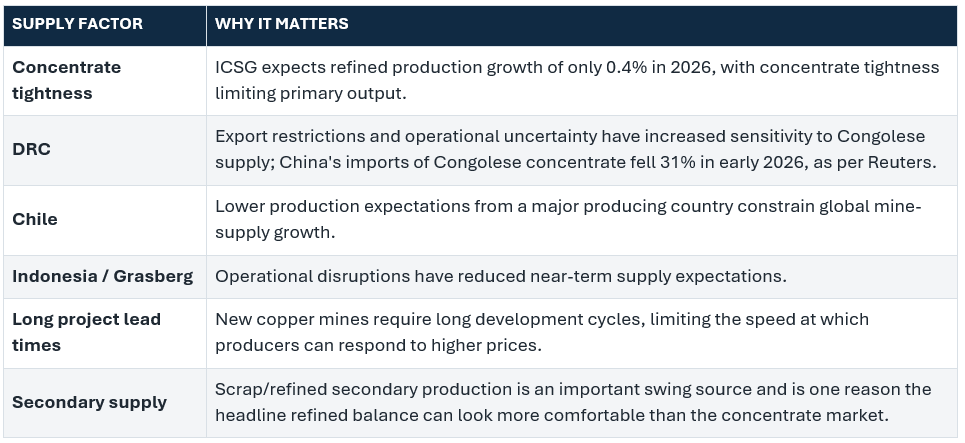
The important distinction
The copper market does not need to be in a large annual deficit for prices to rally sharply. Regional premiums, inventory relocation, concentrate scarcity and expectations around US trade policy can tighten the marginal market and create a significant futures premium.
Middle East: an indirect copper risk
- The Middle East is not a direct copper-shipping chokepoint in the way the Strait of Hormuz is for oil.
- The more relevant link is the potential disruption to sulphur supply and sulphuric-acid economics, which can affect mineral processing costs and availability.
- Investors should treat this as a second-order supply risk, not the primary explanation for the copper rally.
Three ways to use copper futures
A simple hedging example
A manufacturer expects to purchase 2.5 million lb of copper in six months. 100 COMEX HG contracts represent 2.5 million lb (100 × 25,000 lb). A long futures position can help offset a rise in the physical purchase price.
A producer with future copper output faces the opposite risk: selling futures can help protect the future selling price.
For active traders
• Watch the interaction between price and open interest: a rally supported by fresh participation is different from a rally driven mainly by short covering.
• Track CFTC positioning for crowding and potential liquidation risk.
• Monitor COMEX, LME and SHFE inventories together rather than relying on a single warehouse number.
• Use the US$/lb versus US$/tonne conversion routinely when comparing COMEX and LME prices.
Source: CME Group copper hedging education and contract specifications; LME contract specifications. Examples are illustrative and not recommendations.
Trade the copper market with Phillip Nova
Why this matters for traders
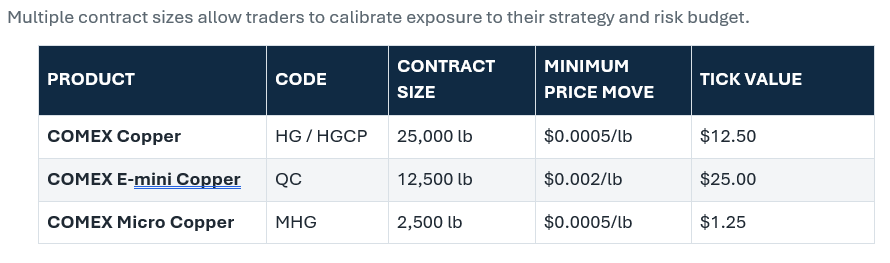
• HG provides the benchmark 25,000-lb COMEX copper exposure.
• QC offers a 12,500-lb contract for a smaller notional exposure.
• MHG is one-tenth the size of the benchmark HG contract, allowing finer position sizing.
• Phillip Nova provides access to commodity futures and access to global futures markets, with NOVA offering charting, market depth, calendar spread and multi-asset tools.
What can move copper next?
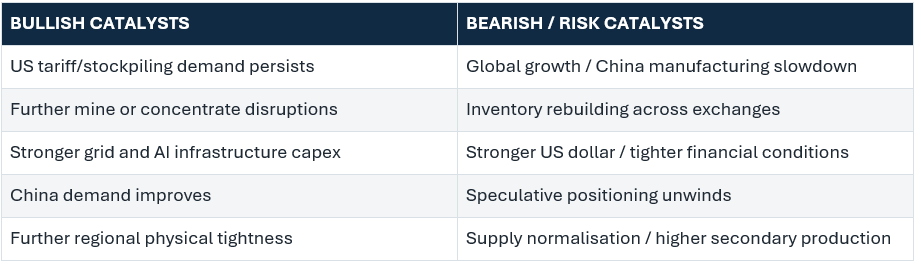
The copper checklist
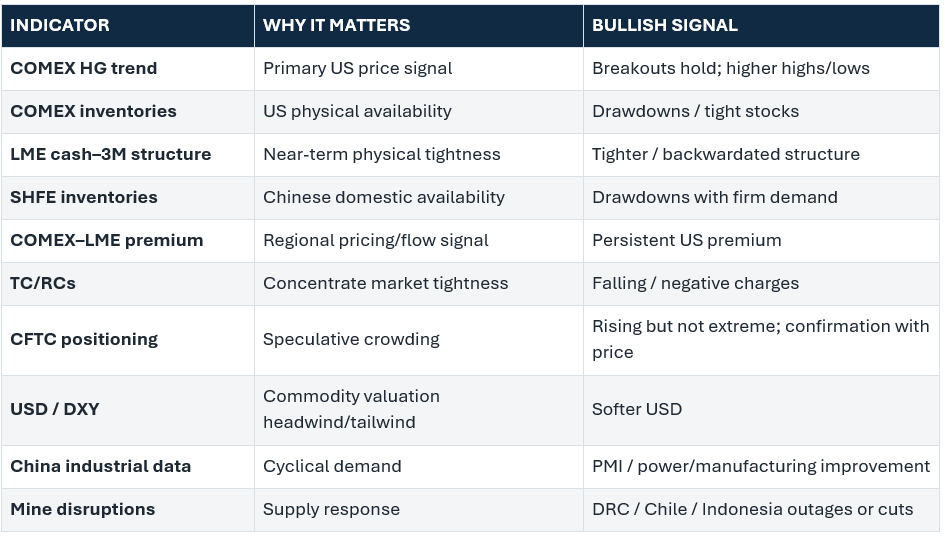
THE COPPER TRADE IS NO LONGER JUST ‘CHINA + CONSTRUCTION’. The market increasingly sits at the intersection of Electrification, AI infrastructure, global trade policy and constrained mine supply.
Bottom line
The bullish copper thesis has substance, but the record-high price also raises the risk of sharp corrections. For traders, the most useful approach is to combine technical price discovery with physical-market signals and the COMEX–LME regional spread. For commercial participants, futures provide a transparent mechanism to manage future copper price exposure.
Our view: Copper deserves greater attention as a tradable asset class – not only as an industrial metal, but as a liquid macro, relative-value and hedging instrument.
Phillip Nova has lowered the commission on Micro Copper Futures (MHG) to just $0.98.
Lowered commission rates mean lower trading costs, giving traders a more cost-efficient way to access Copper futures exposure with Micro Copper Futures.
Ready to trade Copper?
👉 Trade Micro Copper Futures (MHG) at just $0.98 commission on Phillip Nova.
Navigate the Copper Futures market on NOVA, or monitor prices on related ETFs and Stocks now. 立即开立账户.
在 NOVA 交易 CFDs、ETF、外汇、期货、期权、贵金属和股票
NOVA 交易功能
- 接通超过 20 个全球交易所 通过超过 20 个全球交易所的 200 多个环球期货产品,把握市场机会。
- 全球股票交易机会 覆盖新加坡、美国、中国、香港、马来西亚及日本市场超过 11,000 只股票和 ETF。
- TradingView 图表支持 查看实时图表,并使用超过 100 种技术指标。
- 真正的多资产交易 通过 NOVA 的单一账簿,交易 CFDs、ETF、外汇、期货、期权、贵金属及股票。
- 美元及新元股票融资利率低至 4.5% p.a.
- 美股碎股低至 1 美元起
以低至 1 美元名义金额开始投资美股碎股,每笔订单佣金为 0.38 美元。