Gold Defies Safe-Haven Demand: Why Prices Are Falling Amid Global Tensions

25 Mar 2026


Gold is traditionally seen as the go-to safe-haven asset during periods of geopolitical uncertainty. Yet, in a surprising turn, gold prices have been falling even as tensions in the Middle East intensify.

At first glance, this may seem counterintuitive. However, a closer look shows that broader macroeconomic forces are currently outweighing gold’s usual safe-haven appeal.

It is also worth noting that gold had already rallied strongly earlier in 2026, reaching near-record highs before the latest geopolitical tensions escalated. This positioning plays an important role in understanding the recent pullback.


Interest Rates Are Taking Centre Stage

The biggest pressure on gold right now comes from interest rates.

Recent developments in the Middle East have pushed oil prices higher, raising concerns that inflation could remain elevated for longer. In response, markets are adjusting to expectations of fewer rate cuts anticipated and a growing belief that interest rates may stay higher for longer.

In simple terms, when interest rates rise, investors can earn better returns from assets like bonds or cash. Since gold does not generate income, it becomes relatively less attractive in comparison.


A Stronger US Dollar Is Dampening Demand

At the same time, the US dollar has been strengthening. Because gold is priced in US dollars globally, a stronger dollar makes gold more expensive for buyers using other currencies. This reduces demand and puts downward pressure on prices.

As a result, some investors have leaned toward holding cash or dollar-denominated assets instead of gold during this period.


Oil and Inflation Are Shaping Market Focus

Another key factor is the surge in oil prices. Supply concerns linked to the Middle East, particularly around critical transport routes, have heightened inflation worries. This has shifted market attention toward the economic impact of rising energy costs, rather than purely the uncertainty itself.

In other words, markets are reacting more to the inflationary consequences of geopolitical tensions than to the tensions alone.


Profit-Taking After a Strong Run

Gold’s earlier rally also helps explain the recent decline. After reaching elevated levels, the latest geopolitical developments did not trigger a sustained breakout. Instead, some investors took the opportunity to lock in gains, contributing to downward pressure on prices.

This reflects a common market dynamic where prior positioning influences how prices react to new developments.


Short-Term Positioning Is Driving Volatility

In periods of uncertainty, liquidity becomes a priority. Rather than moving heavily into gold, some investors have shifted toward cash and short-term instruments. This reflects a more cautious and flexible approach, where maintaining liquidity takes precedence over traditional hedging. As a result, gold’s reaction has been more muted, and even negative, in the short term.


Stocks & ETFs in Focus

Against this backdrop, market participants have been watching a mix of gold-related and energy-linked assets:

  • Newmont Corporation (NYSE: NEM)
    One of the world’s largest gold producers, often reflecting movements in gold prices while also being influenced by rising operational costs such as energy.

  • Barrick Gold (NYSE: B)
    A major global miner with diversified operations, providing exposure to both gold price trends and broader commodity cycles.

  • SPDR Gold Shares (AMEX: GLD / SGX: GSD)
    Tracks the price of physical gold and is widely used as a benchmark for gold performance in financial markets.

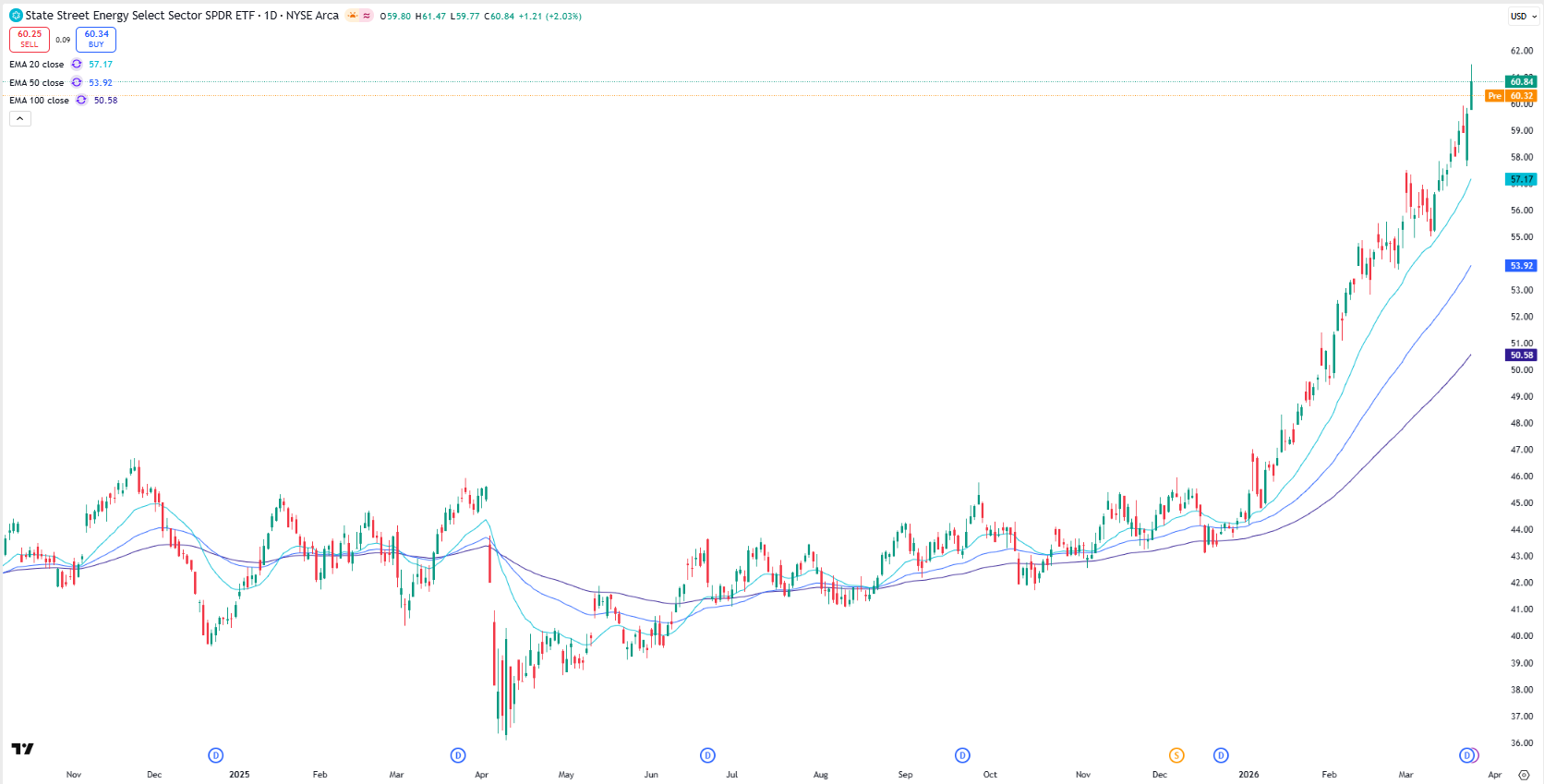
  • Energy Select Sector SPDR Fund (AMEX: XLE)
    Offers exposure to large US energy companies, which have been in focus amid rising oil prices and supply concerns.


The Bigger Picture

Gold’s recent decline highlights an important reality: markets are rarely driven by a single factor. While geopolitical tensions would typically support gold, today’s environment is being shaped more by interest rates, currency strength, and inflation expectations. These forces can outweigh traditional relationships, at least in the short term.

For now, the divergence between gold and energy markets reflects how capital is being repositioned in a complex and evolving macro landscape.

Navigate Gold and Energy related Stocks and ETFs on NOVA now. Click here to get started!


Trade CFDs, ETFs, Forex, Futures, Options, Precious Metals, and Stocks on NOVA

Features of trading on NOVA

  • Gain Access to Over 20 Global Exchanges
    Capture opportunities from over 200 global futures from over 20 global exchanges
  • Trade Opportunities in Global Stocks
    Over 11,000 Stocks and ETFs across Singapore, US, China, Hong Kong, Malaysia and Japan markets.
  • Charting Powered by TradingView
    View live charts and gain access to over 100 technical indicators
  • True Multi-Asset Trading
    Trade CFDs, ETFs, Forex, Futures, Options, Precious Metals and Stocks on a single ledger on NOVA
  • USD Shares Margin Rate at Only 4.5% p.a
  • Fractional Shares from US$1
An Exchange Traded Fund (ETF) is a marketable security that is formed to track nearly anything, ranging from a specific index, sector, commodity, or increasingly, theme. They are most commonly used to track a basket of stocks, and can typically be accessed through the same channels as regular stocks. ETFs are typically separated into passively-managed ETFs that simply mirror the security they are tracking (e.g. the STI), and actively managed ones that attempt to deliver higher returns or specific investment objectives, often with a pre-specified theme in mind (e.g. ARK Invest’s Innovation ETF).

Why should I trade in ETF CFDs?

  • ETFs have been growing in popularity over the years. 2020 was the best year for ETFs yet, with global equity ETFs seeing more than $1T in inflows within a 12-month period. Using CFDs to gain exposure to ETFs allows for greater capital efficiency because only a portion of the contract value is required as margin to establish a position.
  • ETFs are particularly popular with investors seeking a relatively hassle-free investing experience, while desiring exposure to a range of specific and relatively understandable securities. Trading ETF CFDs brings greater convenience by eliminating the need for traders to hold multiple currencies in order to access global ETFs.
  • An investor wanting exposure to the post-pandemic economic recovery could open a position in the well-known SPDR S&P 500 ETF (SPY), which tracks the performance of the S&P 500. Another investor that may be convinced of the future importance of Environmental, Social and Governance concerns (ESG) may find the increasing selection of ESG-themed ETFs that track a basket of high ESG-rating companies to be a good investment, rather than cherry-picking individual equities by hand. ETF CFDs can act as a powerful tool for traders can profit from both directions of the market by taking on long or short positions.

A look at two ETF CFDs we offer:

1) Has the ARKK been sunk?

ARK Innovation ETF (ARKK) ARKK is an actively managed ETF by ARK Invest that invests in a range of companies based on their innovative and industry-disrupting potential. ARKK’s largest holdings are in companies such as Tesla, Square, and Zoom. ARKK is down around -33% from peaking on 12th Feb and is currently in the red for the year to date as the market experiences a risk-off outflow of funds. Superstar fund manager Cathie Wood has however been consistently doubling down on her bets, buying even more shares in growth stocks that are going through their own tumultuous periods such as DraftKings, Peloton, Teladoc, and Tesla. In her view, ARKK is playing the long game, and remains steadfastly convinced in the long-term prospects of these growth stocks beyond this current bout of volatility. Similarly on outflows, investors are still betting big on ARKK as ARK Invest has only lost about $1.2B in assets this year across all its six funds, compared to seeing an inflow of $15.1B during the same period. Recently, investors have been nervously eyeing ARKK’s basket of tech stocks as their future earnings potential remain vulnerable to erosion through high inflation – the dominant concern of the market in recent weeks. As commodities – the major contributor to the recent heightened inflation fears – drops sharply from record highs, are investor concerns over hyperinflation overblown?

2) Searching for exposure to Asian equities?

iShares MSCI Asia ex Japan ETF (AAXJ) The AAXJ is currently trading -10.6% adrift of all-time highs seen in February, giving up gains in tandem with an Asia-wide equity sell-off at the time. Given that slightly over 40% of the ETF’s holdings are based in China, the ongoing tumult seen in Chinese equities currently have carried over nearly perfectly in the AAXJ, as Chinese investors take a breather after the stellar gains made over the past year. Looking ahead, Asia – and particularly China, is steaming ahead with its economic recovery. China is widely expected to be one of the best-performing major economies this year, providing a major boost to the outlook for corporate earnings. As the rest of Asia and the world gradually opens up their own economies, AAXJ is likely to again benefit from strong Asian outperformance amidst a strengthening trade outlook.

CFD is available for trading on Phillip MetaTrader 5 (MT5).

Features of trading CFD:

  • Trade in both the bull and the bear markets
    The ability to enter a long and/or short position allow traders to take advantage of both rising and falling markets.
  • Smaller barrier to entry
    Flexible and smaller contract sizes. This means that traders will be able to enter into a contract with a modest amount of capital.
  • No expiration date or risk of delivery
    Unlike futures which commonly have a fixed expiration date, CFD allows traders to perpetually hold the position(s). CFD is cash settled, no need to worry about the delivery of the underlying asset.


Benefits of using Phillip MT5:

Trade at zero commission on a dynamic platform that offers low spreads. Integrated with Autochartist and Trading Central Indicators, and available on mobile, web and desktop app, you will never miss a trading opportunity with Phillip MT5.

Register for a FREE 30-day Phillip MetaTrader 5 Demo Account

More Market Trends

Gold Holds Key Levels as Markets Weigh Shifting Geopolitical Signals

Read More >

The BYD Recovery: A Story of Valuation Cycles and Technical Breakouts

Read More >