EN
EN  CN
CN 
In recent weeks, you have probably heard friends or family talking about switching to an electric vehicle. With petrol prices in Singapore rising sharply, the conversation is no longer just about sustainability. It is increasingly about cost.
Geopolitical tensions involving Iran have highlighted the fragility of global oil supply chains. Even without a direct disruption, heightened uncertainty around the Strait of Hormuz, through which roughly 20% of the world’s oil flows, has pushed oil prices higher. For consumers and businesses, this reinforces the cost advantage of alternatives such as electric vehicles (EVs), whose operating costs are less exposed to oil volatility.
While short-term market movements rarely trigger an immediate surge in EV sales, periods of elevated fuel prices act as a structural accelerant, reinforcing trends already supported by policy, technology, and environmental factors.
Rising Fuel Prices Strengthen the EV Case
As petrol and diesel prices rise, the total cost of ownership (TCO) for conventional vehicles increases. Fleet operators and consumers are placing greater emphasis on predictable running costs, making EVs more attractive. Research from BloombergNEF shows that as fuel costs rise and battery prices fall, EVs become increasingly competitive with internal combustion vehicles, with fuel and maintenance savings helping to offset upfront price differences.
Even though electricity generation in many regions still relies partly on fossil fuels or LNG, EVs remain highly energy efficient. Electric drivetrains convert energy more efficiently than combustion engines, allowing electricity to deliver more mileage per unit of energy. EVs also have fewer moving parts, resulting in lower maintenance costs.
These factors make EVs economically competitive today, particularly in China where battery costs have declined sharply and pricing is approaching parity with conventional vehicles. According to the Global EV Outlook 2025 by the International Energy Agency, the sales-weighted average price of battery electric SUVs in China fell by nearly 10% year-on-year in 2024, supported by a roughly 30% decline in battery pack prices.
That said, challenges remain. Charging infrastructure, upfront costs, and battery supply chains continue to shape the pace of adoption, even as improving affordability strengthens the long-term case for EVs.
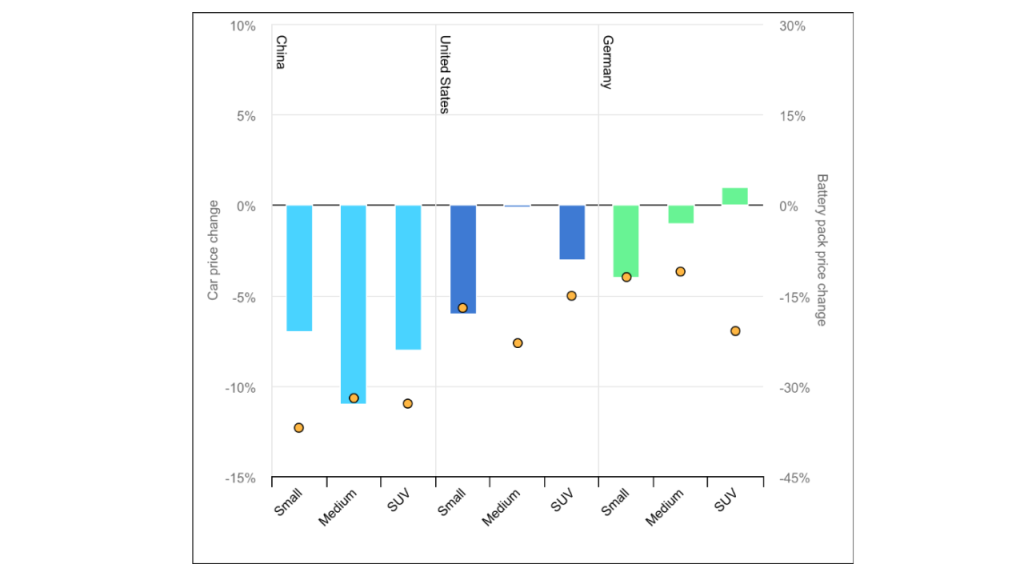
Changes in Car Price vs Battery Pack in China, US and Germany
Source: International Energy Agency
China’s EV Makers Are Potential Beneficiaries
China is both the world’s largest EV market and a dominant global manufacturer, positioning its EV companies as key beneficiaries of this structural shift. Rising fuel prices reinforce domestic EV demand while supporting export growth. Key players include:
- BYD Company Limited (SGX: HYDD / SEHK: 1211)
- Geely Automobile Holdings Ltd (SEHK: 0175)
- Contemporary Amperex Technology Co. Limited (SGX: HCCD / SEHK: 3750)
ETFs for Broader Exposure
For investors seeking diversified exposure, there are several EVs-focused ETFs such as:
- Amova-StraitsTrading MSCI China Electric Vehicles and Future Mobility Index ETF (SGX: EVS)
- Global X China Electric Vehicle and Battery ETF (SEHK: 2845)
Key Risks to Consider
Even with supportive conditions, several risks remain. Economic slowdowns or higher interest rates could dampen vehicle demand. Policy support, including subsidies, may be reduced over time. Supply chain constraints, particularly for battery materials, could limit production, while increasing competition from global automakers may pressure market share.
Final Thoughts
Short-term fuel price spikes are unlikely to drive immediate shifts in EV adoption, but they reinforce the long-term structural transition toward electrification. China, as the world’s largest EV market and producer, is well positioned to benefit. Companies such as BYD, Geely, and CATL remain central to this trend, supported by scale, cost competitiveness, and growing global demand.
Sources: https://www.iea.org/reports/global-ev-outlook-2025/trends-in-electric-car-affordability https://about.bnef.com/insights/clean-transport/electric-vehicle-outlook/#authors
Navigate EV Stocks and ETFs on NOVA now. Click here to get started!
Trade CFDs, ETFs, Forex, Futures, Options, Precious Metals, and Stocks on NOVA
Features of trading on NOVA
- Gain Access to Over 20 Global Exchanges
Capture opportunities from over 200 global futures from over 20 global exchanges - Trade Opportunities in Global Stocks
Over 11,000 Stocks and ETFs across Singapore, US, China, Hong Kong, Malaysia and Japan markets. - Charting Powered by TradingView
View live charts and gain access to over 100 technical indicators - True Multi-Asset Trading
Trade CFDs, ETFs, Forex, Futures, Options, Precious Metals and Stocks on a single ledger on NOVA - USD & SGD Shares Margin Rate at Only 4.5% p.a
- Fractional Shares from US$1
Start investing in fractional shares from US$1 notional value, at US$0.38 commission per order.