EN
EN  CN
CN 

What Is Pre-Market Trading for US Shares CFD?
The US stock market does not always wait for the opening bell to move. Company earnings, economic data, analyst ratings, and major global events can all influence price action before the regular trading session begins. For traders who follow these developments closely, pre-market trading offers an earlier opportunity to react.
In US Shares Contracts for Difference (CFDs), pre-market trading refers to trading that takes place before the regular hours of the underlying US equity market. In general, the main US market session runs from 9:30 a.m. to 4:00 p.m. ET, while pre-market trading typically takes place from 4:00 a.m. to 9:30 a.m. ET. This allows traders to access price movements ahead of the official market open, particularly when markets are responding to overnight news or fresh developments.
However, pre-market trading can be very different from trading during regular market hours. Liquidity may be lower, price movements may be sharper, and execution conditions may be less predictable. Understanding these differences is important before deciding whether pre-market trading suits your trading style.
How pre-market trading works
For Singapore-based traders, pre-market trading in US Shares CFD typically takes place in the late afternoon and evening. In general, the US pre-market session corresponds to 4:00 p.m. to 9:30 p.m. SGT during US daylight saving time, and 5:00 p.m. to 10:30 p.m. SGT outside US daylight saving time. The regular US market session begins immediately after that.
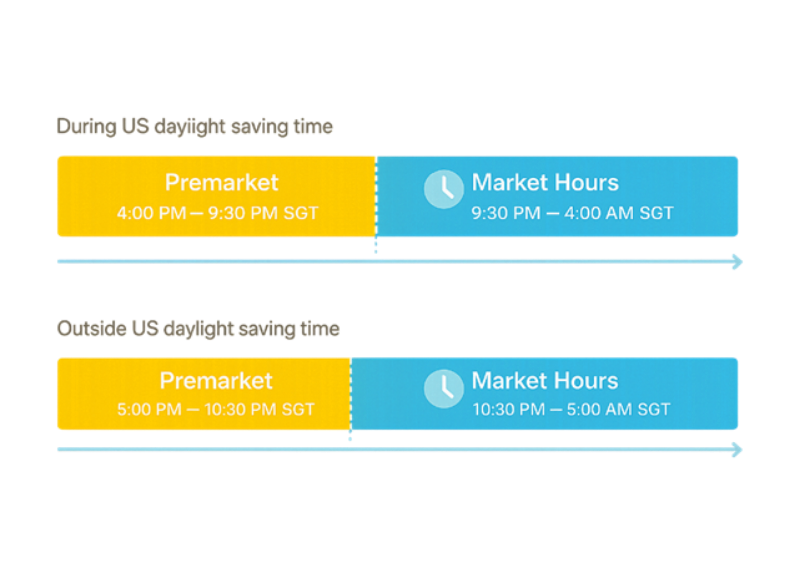
During the pre-market session, pricing and execution for US Shares CFD are based on quotes provided by liquidity providers and reference markets operating outside regular exchange hours. Because trading take place before the main market session, liquidity is typically lower and market conditions may differ materially from those seen during normal trading hours.
Pre-market price action is often driven by developments released while the main market is closed, such as:
- corporate earnings announcements
- economic data releases
- company guidance updates
- market-moving geopolitical or macroeconomic news
With fewer participants in the market, these developments can have a greater impact on prices. As a result, pre-market trading may see sharper price swings, wider spreads, and price gaps relative to the previous session’s close.
Why some traders use pre-market trading
One reason some traders use pre-market trading is to respond to market-moving developments before the regular US session begins. When important news is released outside normal trading hours, waiting for the market to open may mean missing part of the initial price reaction.
This can be especially relevant during earnings season, when companies often announce results before the opening bell. In such cases, share prices may begin moving in the pre-market session well before regular trading starts. For active traders, this can provide an earlier window to assess sentiment and decide how they want to respond.
Some traders use pre-market trading to:
- React to overnight news and corporate announcements sooner
- Manage existing exposures before the main market opens
- Monitor sentiment and price direction ahead of the regular trading session
- Identify potential opportunities from early price movements
At the same time, earlier access does not always mean better execution. Because pre-market session often involves lower liquidity and higher volatility, traders should weigh the potential opportunities against the added risks.
Phillip Nova’s US Shares CFD contract types
Phillip Nova offers two types of US Shares CFD contracts on Phillip MetaTrader5, designed for clients with different trading preference and access requirements.
1. Pre-Market + Main Session Contracts (“PM” Contracts)
These contracts allow trading during both the pre-market session and the regular trading session on Phillip MetaTrader 5.
Trading hours:
- During US Daylight Saving Time (DST) [from March 8, 2026 to November 1, 2026]: 16:01 to 04:00 SGT (next day)
- During non-DST: 17:01 to 05:00 SGT (next day)
2. Main Session Contracts
These contracts are available during the regular trading hours of the underlying US equity market only.
Trading hours:
- During US Daylight Saving Time (DST): 21:30 to 04:00 SGT (next day)
- During non-DST: 22:30 to 05:00 SGT (next day)
Important: PM Contracts and Main Session Contracts are separate
Clients should note that PM Contracts and Main Session Contracts are maintained as separate positions. Hence, margins for PM Contracts and Main Session Contracts are also calculated separated.
Assume the margin required for a position is USD 100 under a PM Contract and USD 100 under a Main Session Contract. If a client holds both positions at the same time, the total margin required will be USD 200.
This also means positions cannot be:
- transferred between contract types
- offset against each other
- consolidated into a single position
This is an important product feature to understand before trading, especially for clients who may assume both contract types operate as one.
Key risks of pre-market trading for US Shares CFD
PM Contracts provide earlier access to the market, but trading conditions during the pre-market session differ from those during regular hours.
Liquidity during pre-market hours is typically lower than during the regular market session because of fewer market participants and less depth in the market, which could lead to following risks:
- Wider spreads
With lower liquidity, bid-ask spreads will be wider than more liquid session which can increase transaction costs and affect the price at which trades are executed.
- Partial fills and order limitations
Because available liquidity at a price level may be limited, orders placed during pre-market hours may be:
- Partially filled
- Filled in smaller quantities
This can be especially relevant during periods of fast-moving news when price moves faster than execution speed.
- Trade-through risk
In fast-moving or thinly traded conditions, execution may occur at a price different from the requested level. This means clients may experience a slippage between the price they want to enter and the actual price they entered when available liquidity is limited.
- Margin and forced liquidation risk
Normal risk management measures continue to apply during both pre-market and regular trading sessions. This includes margin monitoring and forced liquidation where account equity is insufficient.
Clients may therefore be subject to margin calls or forced liquidation during pre-market hours, depending on prevailing market conditions.
- Order size limitations
Maximum order sizes for Pre-Market + Main Session (“PM”) contracts may be lower than those for Main Session contracts. This is due to reduced liquidity and risk controls imposed by liquidity providers.
Is pre-market trading suitable for every trader?
Not necessarily.
Pre-market trading may appeal to traders who actively follow market developments and want to respond before the regular US session begins. However, it should not be viewed as simply an extension of normal market hours.
Compared with the main session, pre-market trading may involve lower liquidity, wider spreads, reduced order depth, and less predictable execution. For this reason, clients should ensure they understand:
- How pre-market pricing and execution work
- The differences between “PM” contracts and Main Session contracts
- The additional risks involved in trading outside regular market hours
- How margin requirements and liquidation risk continue to apply
For traders who value earlier market access, PM contracts can offer added flexibility. At the same time, it is important to understand the product structure and trading conditions before deciding whether pre-market trading suits your needs.
Why Trade US Shares CFD with Phillip Nova?
Cost matters when choosing a provider for US Shares CFD. With Phillip Nova, clients benefit from zero commissions with no minimum commission charge, making trading costs simpler and more transparent.
There are also no platform fees, no market data fees, and no brokerage fees. Instead, clients trade with a straightforward cost structure centred on competitive spreads and overnight financing charges, so they can focus on market opportunities without unnecessary additional charges.
For traders seeking efficient access to US Shares CFD, Phillip Nova delivers a transparent and competitive pricing model built for active trading.
Final thoughts
Pre-market trading for US Shares CFD can offer earlier access to market opportunities before the main US session begins. This may be useful for traders looking to respond to overnight earnings releases, economic data, or other market-moving developments.
However, earlier access also comes with a different trading environment and additional execution risks. Before trading PM Contracts, clients should ensure they understand how the product works, how positions are maintained, and the risks involved in trading outside regular market hours.
Ready to apply this in real trading? Phillip MetaTrader 5 (MT5) supports a range of order types and execution settings, enabling traders to place trades with greater confidence and manage risk in a more disciplined way. You may start by setting up a free MT5 demo account to practise, or proceed to open a trading account on Phillip MT5 when you are ready.