EN
EN  CN
CN 
Understanding inverse products across different market scenarios
When market sentiment turns defensive, long-only portfolios tend to bear the brunt. For investors and traders looking to understand their options during a downturn, inverse and leveraged inverse products are worth understanding.
Here’s how SSS, SQQQ, and SOXS differ across key dimensions:
Product | Target Index | Leverage | Volatility Profile |
SSS | MSCI Singapore Index (SiMSCI) | -1x | Moderate |
SQQQ | NASDAQ-100 Index | -3x | High |
SOXS | NYSE Semiconductor Index | -3x | Extreme |
How do these products differ from each other?
Phillip-Nova MSCI Singapore Daily (-1X) Inverse Product (SGX: SSS)
SSS tracks the inverse of the MSCI Singapore Index (SiMSCI) at a 1-to-1 ratio. Because it carries no leverage multiplier, it experiences significantly less volatility decay during choppy, sideways markets compared to its leveraged US counterparts. It’s most commonly discussed in the context of portfolios concentrated in Singapore blue chips and REITs.
ProShares UltraPro Short QQQ (NASDAQ: SQQQ)
SQQQ tracks three times the inverse daily return of the NASDAQ-100 — the index that houses the world’s largest technology companies. The leverage factor means both potential gains and potential losses are amplified relative to the underlying index’s daily moves.
Direxion Daily Semiconductor Bear 3X Shares (NYSE Arca: SOXS)
SOXS tracks three times the inverse daily return of the NYSE Semiconductor Index. Semiconductors are among the most volatile sectors in global equities — they tend to lead markets on the upside, and fall sharply when the cycle turns. That underlying volatility is amplified further by the 3x leverage.
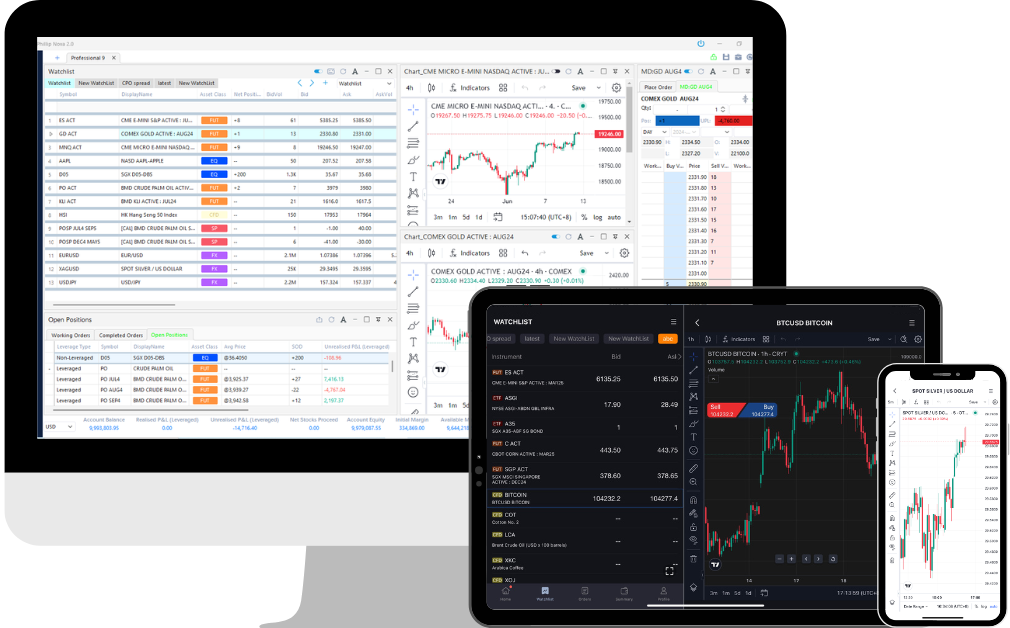
Find SSS, SQQQ, SOXS, and other Leveraged & Inverse Products on NOVA.
Three scenarios investors often ask about
Scenario 1: Singapore market weakness
If you hold Singapore equities and are weighing your options during a period of local market softness — without wanting to liquidate positions you’ve held for years — what tools exist to help manage that exposure in the short term?
SSS is one product that comes up in that conversation, given its direct relationship to the SiMSCI index.
Scenario 2: A broad US tech correction
The NASDAQ-100 is sensitive to macro signals: inflation data, interest rate expectations, and shifts in how the market values high-growth technology companies. When those conditions shift quickly, the entire index can reprice sharply.
For traders researching options to express a broad bearish view on US technology — not a single stock, but the sector as a whole — SQQQ is one instrument worth understanding.
Scenario 3: A semiconductor-specific downturn
Chip stocks can move violently on sector-specific catalysts: a major earnings miss, a downward revision in revenue guidance, or a signal that inventory is building up faster than demand. These moves can be sharp and concentrated in the semiconductor space even when the broader market is stable.
SOXS is designed around that specific dynamic, and is frequently discussed by traders researching high-conviction, short-duration plays in the chip sector.
What every investor should understand before going further
All three products target daily inverse returns. Because they mathematically rebalance each day, holding them through a choppy or sideways market will erode capital over time — even if the underlying index ends the period roughly flat. This effect is meaningful in SQQQ and more extreme in SOXS, given the intraday volatility of chip stocks.
These are short-duration instruments. They behave very differently over a week or a month than they do over a single day, and that distinction matters before any decision is made.
As with any complex financial product, these instruments carry significant risk and may not be suitable for all investors. This article is intended for educational purposes only and does not constitute financial advice.
Find SSS, SQQQ, SOXS, and other Leveraged & Inverse Products on NOVA.
The NOVA Platform
- Access to Stocks, ETFs, Futures, Forex, CFDs, and more
- USD and SGD shares margin rate at only 4.5% p.a.
- Trade and invest on a single platform
- Access all contracts with just one account
- No custodian and platform fees
- Available on mobile, iPad, and desktop
- Charting powered by TradingView
No minimum funding required.