EN
EN  CN
CN 
Key Takeaways
- Oil prices extend gains for a third straight session as renewed US-Iran strikes and attacks on tankers heighten concerns over energy flows through the Strait of Hormuz.
- Risks to physical oil flows are growing, with Iran threatening Gulf exports while shipping activity through the Strait remains heavily disrupted.
- The market may be shifting from pricing the risk of escalation to the economic cost of a prolonged conflict, with potential implications for inflation, interest rates and global growth.
Oil prices climbed for a third consecutive session as renewed fighting between the US and Iran brought the Strait of Hormuz back into sharp focus.
The latest escalation follows reports of attacks on two oil tankers near the Strait, while the US military said it had completed another wave of strikes against Islamic Revolutionary Guard Corps (IRGC) targets in Iran. Shipping activity through the waterway has also fallen sharply, adding to concerns over physical energy flows through one of the world’s most important oil transit routes.
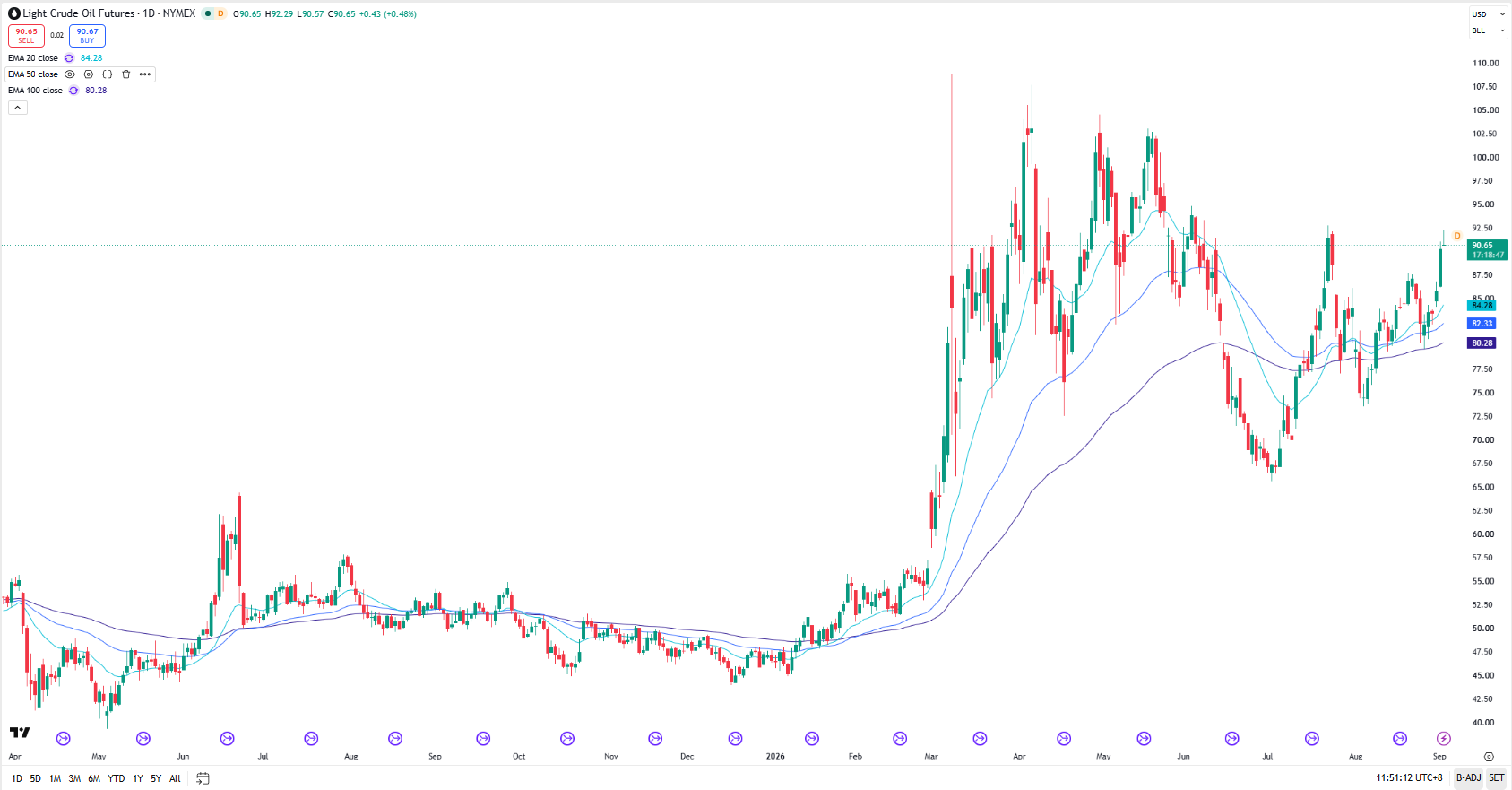
Both major crude benchmarks surged in the previous session, with WTI rising 5.2% to settle at US$90.22 per barrel and Brent gaining 4.6% to US$94.65. The upward momentum continued during Asian trading on Wednesday, with WTI trading around US$91 per barrel and Brent above US$95 earlier in the session.
Why Higher Oil Prices Matter Beyond the Energy Market
The significance of higher crude prices extends beyond the immediate threat of supply disruption.
Oil remains a critical input for the global economy, particularly for Asian economies that depend heavily on Middle Eastern energy supplies. A sustained increase in crude prices can raise transportation and production costs, feed into inflation and potentially influence expectations for interest rates.
That transmission matters across financial markets. If higher energy costs contribute to renewed inflationary pressure, investors may have to reassess the path of monetary policy, bond yields and ultimately valuations across multiple asset classes.
The latest developments are therefore particularly significant because the disruption is no longer centred solely on the possibility of military escalation. Attacks involving vessels transiting the Strait bring the risk directly into the physical energy supply chain.
Hormuz Remains the Critical Chokepoint
The Strait of Hormuz has long held enormous strategic importance because of the volume of global energy trade passing through the narrow waterway.
That importance is once again being tested.
Shipping traffic through the Strait fell sharply on Tuesday, with Kpler data showing only four commodity vessels transiting the waterway, compared with 10 the previous day and a 10-day average of around 13. Before the conflict, the Strait accounted for roughly 20% of global oil trade.
Iran has also renewed warnings over Gulf oil exports. Iranian parliament speaker Mohammad Baqer Qalibaf was quoted by Iranian media as warning that if Iran were prevented from exporting oil from the Persian Gulf, others could face similar disruption.
Even without a complete closure of the Strait, heightened security risks, attacks on tankers, rising insurance costs and reluctance among shipowners to transit the waterway could continue to constrain oil flows.
From Escalation Risk to Prolonged Disruption
Perhaps the bigger question for oil markets now is no longer simply whether tensions escalate further, but how long the disruption could last.
President Donald Trump said on Tuesday that he was not seeking to force Iran back to the negotiating table, while the latest exchange of strikes has further complicated prospects for a near-term diplomatic breakthrough.
For markets, the duration of the conflict could become increasingly important.
A prolonged period of disrupted shipping, elevated insurance costs and constrained crude flows could keep a geopolitical risk premium embedded in oil prices. The longer these conditions persist, the greater the potential for higher energy costs to filter through to inflation expectations and monetary-policy decisions.
In other words, the oil market may be moving beyond pricing the risk of conflict and towards pricing the cost of an unresolved one.
Asia Could Feel the Pressure More Acutely
Asia is particularly exposed to developments in the Strait of Hormuz because of its dependence on Middle Eastern energy supplies.
A sustained period of higher crude prices could increase import costs for energy-dependent economies, pressure trade balances and add to inflationary pressures. The challenge becomes more complicated for central banks if an energy-driven inflation shock emerges while underlying inflation remains elevated.
This makes crude oil not merely an energy story, but potentially an important macroeconomic variable for Asian markets in the months ahead.
What Should Traders Watch Next?
Rather than focusing solely on the next military headline, traders may want to monitor several indicators that could provide a clearer picture of whether conditions are improving or deteriorating:
- Tanker traffic through the Strait of Hormuz
- Physical crude loadings and export flows
- Shipping and insurance costs
- Further attacks on energy infrastructure or commercial vessels
- Signs of a credible diplomatic breakthrough
- WTI and Brent’s response to changes in physical supply conditions
Until there is clearer evidence of sustained de-escalation and a normalisation of energy flows through the Strait, geopolitical developments are likely to remain an important driver of crude oil volatility.
The key question for markets may therefore be shifting from “Will the conflict escalate?” to “How long could the disruption last?”
Navigate the Crude Oil Futures and Options market on NOVA, or monitor prices on related ETFs, CFDs and stocks now. Open an account here.
Trade CFDs, ETFs, Forex, Futures, Options, Precious Metals, and Stocks on NOVA
Features of trading on NOVA
- Gain Access to Over 20 Global Exchanges
Capture opportunities from over 200 global futures from over 20 global exchanges - Trade Opportunities in Global Stocks
Over 11,000 Stocks and ETFs across Singapore, US, China, Hong Kong, Malaysia and Japan markets. - Charting Powered by TradingView
View live charts and gain access to over 100 technical indicators - True Multi-Asset Trading
Trade CFDs, ETFs, Forex, Futures, Options, Precious Metals and Stocks on a single ledger on NOVA - USD & SGD Shares Margin Rate at Only 4.5% p.a
- Fractional Shares from US$1
Start investing in fractional shares from US$1 notional value, at US$0.38 commission per order.