EN
EN  CN
CN 
From 5 October 2026, investors will need just S$771 to buy a board lot of DBS, compared with S$7,711 today. Here’s what is changing, and what it could mean for participation in Singapore’s equity market.
For years, the biggest hurdle to owning Singapore’s blue-chip stocks was not necessarily a lack of interest. It was the upfront capital required.
At DBS’s share price of S$77.11 as at 15 September 2026, one standard board lot of 100 shares costs S$7,711. For OCBC, the same 100-share lot costs S$3,132, while UOB requires S$4,155.
For investors working with a smaller budget, those entry points can make individual blue-chip stocks difficult to access.
That changes on 5 October 2026.
SGX RegCo is reducing the standard board lot size from 100 units to 10 units for stocks priced above S$10 and up to S$100, and to 1 unit for stocks priced above S$100.
The first batch covers 11 counters, including DBS, OCBC, UOB, SGX, Keppel, Jardine Matheson, Jardine Cycle & Carriage, Great Eastern, Haw Par, Prudential PLC and Venture Corporation. Together, these counters accounted for 35% of trading activity in the first half of 2026.
The list will be reviewed quarterly, with the next review scheduled for January 2027.
The maths: 90% less capital for three major banks
The impact becomes clearer when you look at the numbers.
| Counter | Price (15 Sep 2026) | Cost of 1 lot today | Cost of 1 lot from 5 Oct 2026 |
|---|---|---|---|
| DBS (D05) | S$77.11 | S$7,711 | S$771.10 |
| OCBC (O39) | S$31.32 | S$3,132 | S$313.20 |
| UOB (U11) | S$41.55 | S$4,155 | S$415.50 |
For these three banks, the minimum capital required for one board lot falls by 90%.
That takes DBS from almost S$7,700 to about S$770, OCBC from about S$3,100 to S$313, and UOB from about S$4,200 to S$416.
The companies themselves have not become cheaper. Their share prices and underlying fundamentals remain unchanged by the board lot reform.
What has changed is the amount of capital needed to take a position.
A lower entry ticket, not a lower-risk investment
Board lot size can have an outsized influence on how accessible a stock feels.
A S$77 stock can appear much less affordable than a S$7 stock when investors are thinking in terms of the minimum number of shares they can buy. Yet the share price alone does not determine whether an investment represents good value or appropriate risk.
The new board lot structure removes part of that mechanical barrier.
An investor who previously needed several thousand dollars to buy a single lot of a major bank will now be able to start with several hundred dollars.
That does not make DBS, OCBC or UOB less volatile, nor does it change the risks associated with investing in individual shares. It simply gives investors more flexibility over how much capital they put to work.
Could smaller board lots support more market participation?
Singapore has seen this effect before.
In January 2015, SGX reduced the standard board lot from 1,000 shares to 100 shares. For higher-priced counters such as UOB, the change significantly reduced the capital needed to purchase a standard lot.
At the time, then-SGX CEO Magnus Bocker pointed to early signs of increased trading activity following the reform.
History, however, does not guarantee the same outcome this time. A smaller board lot does not automatically mean higher volumes, tighter spreads or stronger retail participation.
But lowering the minimum capital required to transact can make it easier for smaller investors to participate — particularly when combined with other changes to Singapore’s equity market.
The board lot reform therefore forms part of a broader evolution of the SGX market, alongside developments such as the broker custody model introduced in July 2026 and the proposed SGX-Nasdaq dual-listing bridge.
What could a S$1,000 allocation look like?
The practical difference becomes more interesting for investors working with a fixed amount of capital.
Before the change, S$1,000 would not be enough to buy a standard board lot of DBS, OCBC or UOB.
From October, S$1,000 could potentially be spread across smaller positions in two or even three of these counters, depending on their prevailing share prices.
That gives investors greater flexibility to construct a diversified Singapore equity allocation rather than having the minimum board lot determine where most of their capital goes.
Investors could also combine individual stocks with broader exposure through Singapore-focused ETFs, including STI and iEdge Singapore Next 50 ETFs.
The key point is not that smaller board lots make individual stocks more attractive. Rather, they make position sizing more flexible.
One important caveat: only 11 counters for now
The reform does not apply to every stock on SGX.
The initial list covers 11 counters, and SGX RegCo will review eligible stocks quarterly. This means the impact across the broader Singapore market will depend on which additional counters are included in future reviews.
And while the entry ticket is falling, the investment risk is not.
Buying 10 shares of DBS instead of 100 shares means putting less capital at risk, but the percentage gain or loss on the shares remains the same.
Investors should therefore continue to consider factors such as valuation, business fundamentals, diversification and their own risk tolerance when deciding how much to invest.
A more accessible Singapore market
The board lot reform does something relatively simple: it gives investors more control over how much they put into a stock.
For Singapore’s blue chips, that means the gap between wanting to own a stock and having enough capital to buy one board lot is about to become much smaller.
For investors building a Singapore allocation, the change could make it easier to combine individual blue chips with broader market exposure — without needing several thousand dollars just to get started.
Invest in Singapore. Get Rewarded.
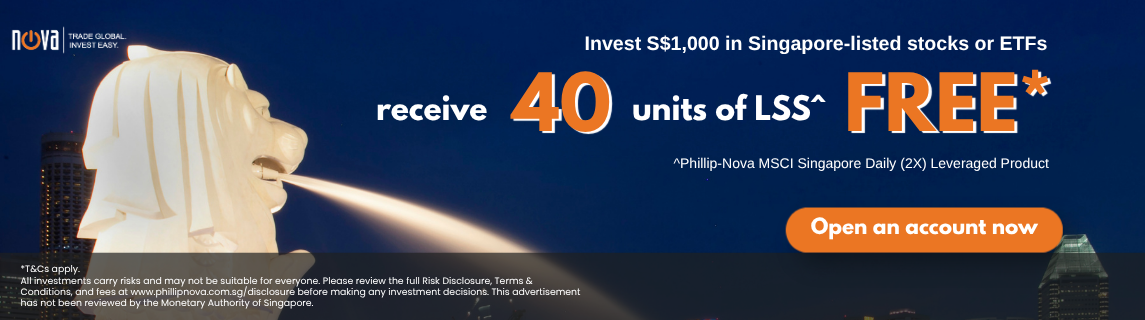
Receive 40 FREE LSS Shares* when you open a new NOVA Trading Account and invest S$1,000 in SGX-listed stocks or ETFs. Find out more here.
Trade CFDs, ETFs, Forex, Futures, Options, Precious Metals, and Stocks on NOVA
Features of trading on NOVA
- Gain Access to Over 20 Global Exchanges
Capture opportunities from over 200 global futures from over 20 global exchanges - Trade Opportunities in Global Stocks
Over 11,000 Stocks and ETFs across Singapore, US, China, Hong Kong, Malaysia and Japan markets. - Charting Powered by TradingView
View live charts and gain access to over 100 technical indicators - True Multi-Asset Trading
Trade CFDs, ETFs, Forex, Futures, Options, Precious Metals and Stocks on a single ledger on NOVA - USD & SGD Shares Margin Rate at Only 4.5% p.a
- Fractional Shares from US$1
Start investing in fractional shares from US$1 notional value, at US$0.38 commission per order.