EN
 CN

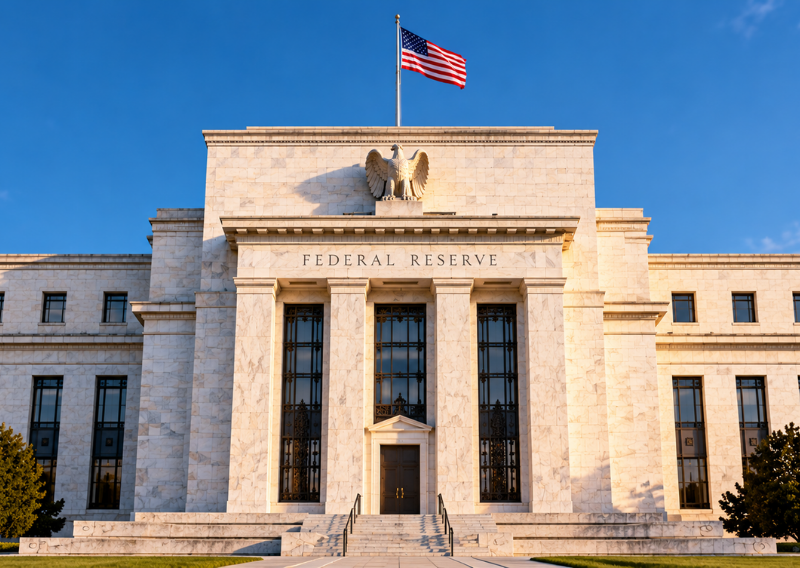
The Federal Reserve (FED) raised interest rates by 25 basis points to 3.75%–4.00% at its September meeting, marking its first rate increase since 2023 as policymakers responded to persistent inflation.
Markets are now focused not only on the September hike, but also on how far the tightening cycle could extend and what it could mean for Treasury yields, the US dollar and risk assets.
What Drove the Fed’s Latest Interest Rate Decision?
The Fed’s latest rate hike decision was shaped mainly by persistent inflation, alongside resilient economic activity and a labour market that gave policymakers room to focus more heavily on price stability. Higher energy prices added to inflation risks, while elevated Treasury yields meant broader borrowing costs were already relatively high.
Inflation Remained the Key Concern
Inflation remained at the centre of the Fed’s decision. August CPI rose 0.4% month-on-month and 3.4% year-on-year, while core CPI increased 0.3% on the month and 2.4% from a year earlier.
The Fed’s September projections also indicated a slightly firmer inflation outlook. Median 2026 Personal Consumption Expenditures inflation was projected at 3.7%, up from 3.6% in June, while core PCE inflation was projected at 3.4%.
The key question remained whether inflation was making convincing progress toward the Fed’s 2% target.
A Resilient Labour Market Gave the Fed More Flexibility
August nonfarm payrolls rose by 162,000, well above the 55,000 forecast, while unemployment held at 4.1%.
A stable labour market reduced the urgency for the Fed to support employment through lower interest rates, giving policymakers more room to focus on inflation.
The Fed’s September projections reinforced that view by lowering the median 2026 unemployment-rate forecast to 4.1% from 4.3% in June.
Higher Oil Prices Added Inflation Risks
Higher energy prices added another inflation risk. Middle East tensions pushed oil prices higher, increasing the possibility that fuel and transportation costs could feed into broader inflation.
Warsh also indicated that renewed geopolitical tensions and higher gas prices were among the factors strengthening the case for the September hike as gasoline prices rose 3.9% in August, contributing more than one-third of the monthly increase in headline CPI.
While higher rates cannot directly address an energy-supply shock, the Fed may still respond if sustained price increases begin feeding into broader inflation.
Financial Conditions Were Already Tightening
The Fed also raised rates against a backdrop of already-tight financial conditions. The 10-year Treasury yield had exceeded 5% ahead of the meeting, reflecting a combination of higher-for-longer rate expectations, inflation risks and long-term uncertainty.
What the Fed’s Latest Projections Signal
Taken together, persistent inflation, a resilient labour market and already-tight financial conditions gave the Fed room to raise rates again.
The updated projections pointed to a more restrictive path, with interest rates potentially staying higher for longer. The median federal funds rate projection rose to 4.1% for both 2026 and 2027, compared with 3.8% and 3.6%, respectively, in June.
This suggests that September may not mark the end of the tightening cycle, with policy makers still leaving room for further rate increases if inflation remains elevated.
How Does the Fed Rate Decision Move Financial Markets?
Fed rate decisions can affect multiple financial markets by changing expectations for interest rates, borrowing costs and the economic outlook. Market reactions often depend on how much of the decision was already priced in and what the Fed signals about future monetary policy.
Before the Decision: Markets Were Already Pricing in a Rate Hike
Ahead of the September meeting, markets were already pricing a high probability of a 25-basis-point rate increase, reducing the likelihood of a large reaction to the decision itself.
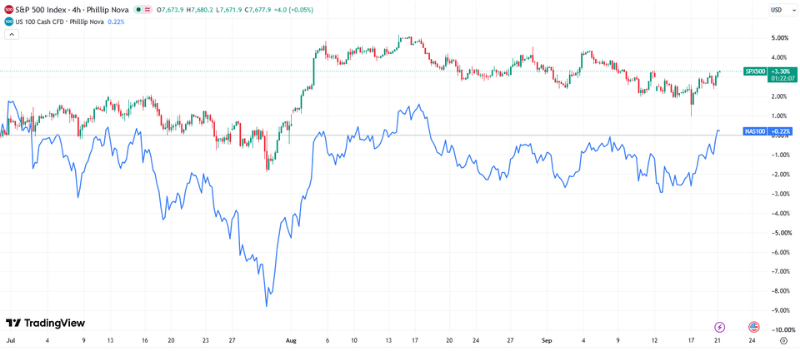
US equities had been volatile well before the September Federal Open Market Committee (FOMC) meeting. The S&P 500 and Nasdaq 100 both experienced a notable pullback in July amid renewed US-Iran tensions and higher oil prices.
Markets subsequently recovered, with the S&P 500 returning to positive territory and the Nasdaq 100 rebounding from its late-July lows.
From August into September, both indices lost momentum but their pullbacks remained relatively contained ahead of the meeting. This was consistent with investors having already absorbed much of the expected rate-hike risk.
Source: TradingView.com
Gold had also lost some momentum ahead of the September Fed meeting, alongside a stronger US dollar and higher yields.
This illustrates why markets can sometimes react more strongly to the Fed’s forward guidance than to rate decision that has already been largely priced in.
After the Decision: Focus Shifted to Future Rate Hikes
Following the September rate hike, attention shifted to how far and how quickly the Fed may tighten monetary policy.
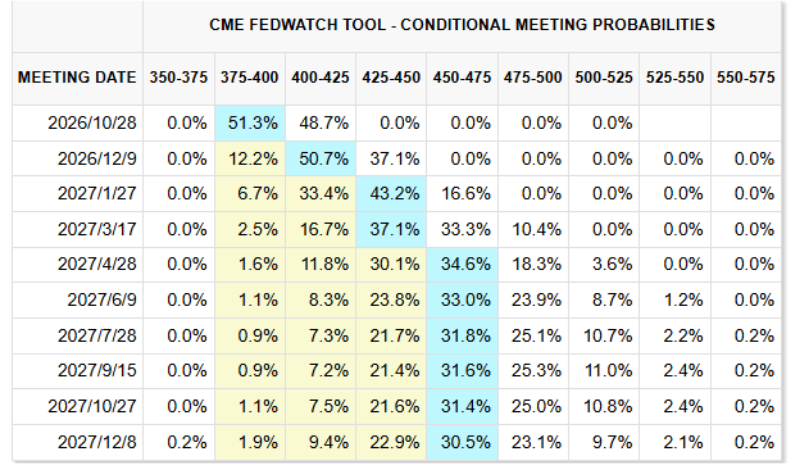
CME FedWatch probabilities showed markets almost evenly split between no change and another 25-basis-point increase at the October meeting.
Further out, however, probabilities were more clearly tilted toward higher interest rates. By December, the highest probability was assigned to a 4.00%–4.25% target range, while by January 2027 the most probable range shifted to 4.25%–4.50%.
This suggests that while the timing of the next hike remained uncertain, markets were increasingly pricing in additional tightening over the following several meetings.
Source: CME
If inflation remains elevated and markets increasingly price in further rate hikes, Treasury yields and the US dollar could rise. That could weigh on rate-sensitive equities and gold as financial conditions tighten further.
Conversely, if inflation cools and expectations for further tightening ease, Treasury yields and the US dollar could lose some support. This may reduce pressure on equities and gold, although market reactions would also depend on whether softer inflation is accompanied by resilient or weakening economic growth.
What Should Traders Watch After a Fed Decision?
Traders can monitor three key areas to assess changing expectations for Fed policy: US Treasury yields and the dollar, CME FedWatch probabilities and upcoming economic data.
Monitor US Treasury Yields and the US Dollar
US Treasury yields and the US Dollar Index (DXY) offer two perspectives on changing Fed expectations. Treasury yields reflect how interest-rate expectations are being repriced across different maturities, while DXY indicates whether those shifts are also reflected in currency markets.
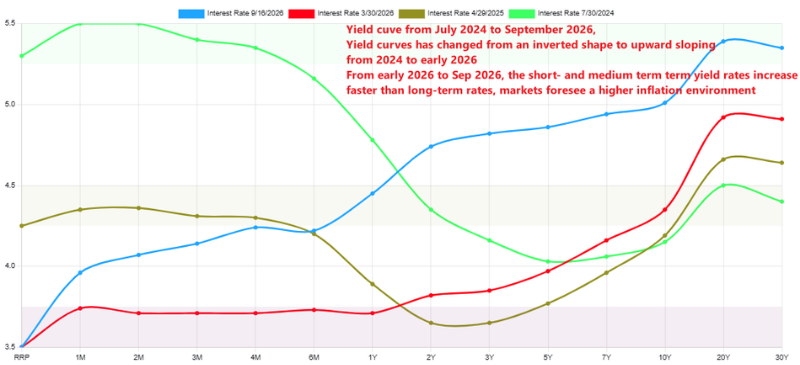
The yield curve provides further context. From July 2024 to early 2026, the curve shifted from a more inverted shape toward a more upward-sloping structure, indicating that markets were increasingly pricing in an easier interest rate environment and potential Fed rate cuts.
From early 2026 to September 2026, short- and medium-term yields then rose faster than longer-term yields, causing parts of the curve to flatten again. This suggests markets were pricing in a higher-for-longer rate environment and a more restrictive near-term Fed policy path, while longer-term expectations shifted less dramatically.
Source: US Treasury Yield Curve
The currency market showed a similar sensitivity to changing rate expectations. The dollar strengthened as expectations for a September hike became more firmly priced, and it rose again after the Fed delivered the increase and signalled that further tightening remained possible.
DXY can therefore serve as a useful cross-check. When the US dollar strengthens alongside rising Treasury yields, both markets may be signalling expectations of tighter US monetary policy.
Check the CME FedWatch Tool
The CME FedWatch Tool allows traders to track changes in market-implied probabilities for future Fed policy rates.
When higher policy-rate ranges carry greater probabilities, markets are pricing in a more restrictive Fed path. Conversely, a shift toward lower rate ranges suggests expectations of less restrictive policy.
FedWatch should be treated as a snapshot of market expectations rather than a forecast. Probabilities can change quickly following new economic data, policy developments or Fed communication.
Follow the Economic Calendar
Traders can use an economic calendar to identify upcoming data releases that may influence Fed policy expectations, including Consumer Price Index (CPI), Personal Consumption Expenditures (PCE) inflation, nonfarm payrolls, unemployment, gross domestic product (GDP) and retail sales.
These releases matter because they can quickly shift the interest rate probabilities reflected in the CME FedWatch Tool, as well as movements in Treasury yields and the US dollar.
For example, higher-than-expected inflation could increase expectations of tighter monetary policy, while softer inflation data may reduce them.
The Bottom Line for Traders
The Fed’s September rate hike highlighted persistent inflation as a key policy concern, while resilient economic activity gave policymakers room to maintain restrictive monetary policy. For markets, the focus now shifts to how far the tightening cycle could extend and how long interest rates may remain elevated.
With Phillip Nova, traders can access real-time market charts and monitor key instruments, including major currency pairs, gold and global indices, on Phillip MetaTrader 5.
New to trading? Open a demo account to explore the platform and monitor market developments surrounding future Fed decisions and major economic releases.
About the Author
Chen Yurui
Strategist
Chen Yurui graduated from the National University of Singapore with a major in Finance and is currently a CFA Level III candidate. He has experience in financial market analysis and OTC derivatives, with a focus on FX, precious metals, CFDs and macroeconomic outlook.
Through his work, he has gained hands-on experience in algorithmic trading and trading systems, including developing, backtesting and optimising Expert Advisors (EAs) on MetaTrader 5. He aims to make financial markets and trading concepts more practical and accessible to investors.