EN
EN  CN
CN 
Singapore’s equity toolkit has expanded meaningfully. Beyond direct stocks and broad-market STI trackers, traders now have listed index futures and — newer to the shelf — Leveraged & Inverse (L&I) Exchange-Traded Products (ETPs) tied to the MSCI Singapore Index.
Together, these instruments allow investors to express their views bi-directionally, and across different risk profiles.
Traditional Methods in Singapore Equity Markets
- Straits Times Index (STI) ETFs
- Singapore Stocks
- MSCI Singapore Index (SiMSCI) Futures
Straits Times Index (STI) ETFs
Long-term, buy-and-hold friendly
- These ETFs track the Straits Times Index, covering the 30 largest and most liquid SG companies
- The STI is sensitive to interest rates as Banks (~50%) and S-REITs (~11%) have high weightages
- Top holdings include DBS, OCBC, UOB, Singtel, Jardine Matheson, SGX, and CapitaLand Integrated Commercial Trust
- The 2 most active STI ETFs are:
- SPDR® STI ETF (ES3) │ Expense Ratio: 0.28% │ 12Mth Yield: 4.13%
- Nikko AM/Amova STI ETF (G3B) │ Expense Ratio: 0.24% │ 12Mth Yield: 4.06%
- Dividends are distributed semi-annually
- Investing in STI-tracking ETFs is simple, provides dividends, and ideal for a long-term buy-and-hold strategy
- Provides investors with instant diversification (lower single-company risk)
- Suited for investors who don’t have time to monitor news, earnings, and risks
Singapore Stocks
High-conviction bets, best for alpha
- If conviction is high, investing in single stocks provide the highest upside.
- A correct stock call typically provides the highest returns, allowing investors to beat the broader index.
- No ongoing management fee or expense ratios.
MSCI Singapore Index (SiMSCI) Futures
High beta and leverage
- The SiMSCI Index Futures is an exchange-traded derivative that provides leveraged exposure to the SiMSCI Index
- In comparison to the STI, the SiMSCI has exposure to international-listed companies like Sea Ltd and Grab Holdings
- Hence, the SiMSCI tilts more towards growth and volatility vs the STI, making it a preferred vehicle for investors seeking higher-growth and higher-beta exposure within Singapore equities
- The SiMSCI Index stands out with its exposure to international-listed constituents like Sea (~18% of index), and Grab (~3.5% of index)
- In terms of factor tilt, as seen below, the SiMSCI Index has noticeably higher exposure to growth and volatility compared to the STI. But at the cost of lower dividends
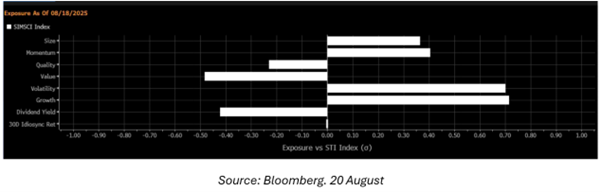
- In terms of sector exposure, the SiMSCI has a lower allocation to S-REITs than the STI
- Futures allows for bidirectional trading— providing investors with the ability to go long or short, depending on the individual’s market view or trading purpose
- Typically used for tactical hedges, leveraged bets, and event-driven strategies (e.g., earnings season)
Straits Times Index (STI) ETFs, Singapore Stocks, and MSCI Singapore Index (SiMSCI) Futures are all available on NOVA.
New Method in Singapore Equity Markets
- Phillip-Nova MSCI Singapore Daily (2X) Leveraged Product (SGX: LSS)
- Expense Ratio: 8.60%
- Aims for ~2X the daily SiMSCI return
- Phillip-Nova MSCI Singapore Daily (-1X) Inverse Product (SGX: SSS)
- Expense Ratio: 6.80%
- Targets the daily inverse return of the SiMSCI
Both products are exchange-traded, futures-based, and classified in Singapore as Specified Investment Products (SIPs) that are available on NOVA.
The Decay Effect
Due to the compounding effect, over multi-day holding periods, performance can diverge from simple 2X/–1X math.
Examples below all start at 100.
(1) Sideways/flat but volatile
- Index: +10% then −9.09%
→ back to 100 (0% return) - 2X ETP: +20% then −18.18%
→ 98.18 (−1.82% return)
(2) Symmetric move
- Index: +10% then −10%
→ 99 (−1% return) - 2X ETP: +20% then −20%
→ 96 (−4% return)
→ Return is worse than just “2X −1%”
(3) Steady uptrend
- Index: +1% daily for 10 days
→ 100 x 1.01¹⁰ ≈ 110.46 (+10.46% return) - 2X ETF (+2% daily)
→100 × 1.02¹⁰ ≈ 121.90 (+21.90% return)
→ Compounding is positive and smooth
Ultimately, over multi-day holding periods, returns become path-dependent.
In a steady uptrend with low volatility, leveraged ETPs can work as positive compounding works favourably. However, in range-bound or whipsaw markets, decay is severe.
Hence, L&I ETPs are typically utilised as short-term tactical tools for tactical trading, market timing or hedging, not as a buy-and-hold investment.
How to Choose Which Method in Singapore Equity Markets
Objective | Instrument Fit | Products |
Passive long-term investing, low-cost core exposure. | STI ETFs provide simple passive investing that provides income Minimal maintenance |
|
High-conviction, stock-specific alpha | Single Singapore stocks rather than index products |
|
Higher leverage | Futures contracts provide higher leverage without “decay” effect P&L is not based on % of daily movement. |
|
Tactical, short-term directional view on Singapore broad market | L&I products (2X for bullish momentum; –1X for hedging short-term downside Less risk of margin call and less rollover risk, easier than futures |
|
Closing Insight: L&I ETPs Broaden The Toolkit
Phillip Nova’s MSCI Singapore L&I products fill a useful gap between cash equities/ETPs and Futures: listed, easily accessible tactical tools for expressing a market view or implementing a hedge when shorting or derivatives access is constrained. Used correctly — with awareness of daily reset and SIP suitability — they can improve execution flexibility for both retail and professional traders.
- Phillip-Nova MSCI Singapore Daily (2X) Leveraged Product (SGX: LSS)
- Phillip-Nova MSCI Singapore Daily (-1X) Inverse Product (SGX: SSS)
Now available for trading on NOVA.

The NOVA Platform
- Access to Stocks, ETFs, Futures, Forex, CFDs, and more
- Trade and invest on a single platform
- Access all contracts with just one account
- No custodian and platform fees
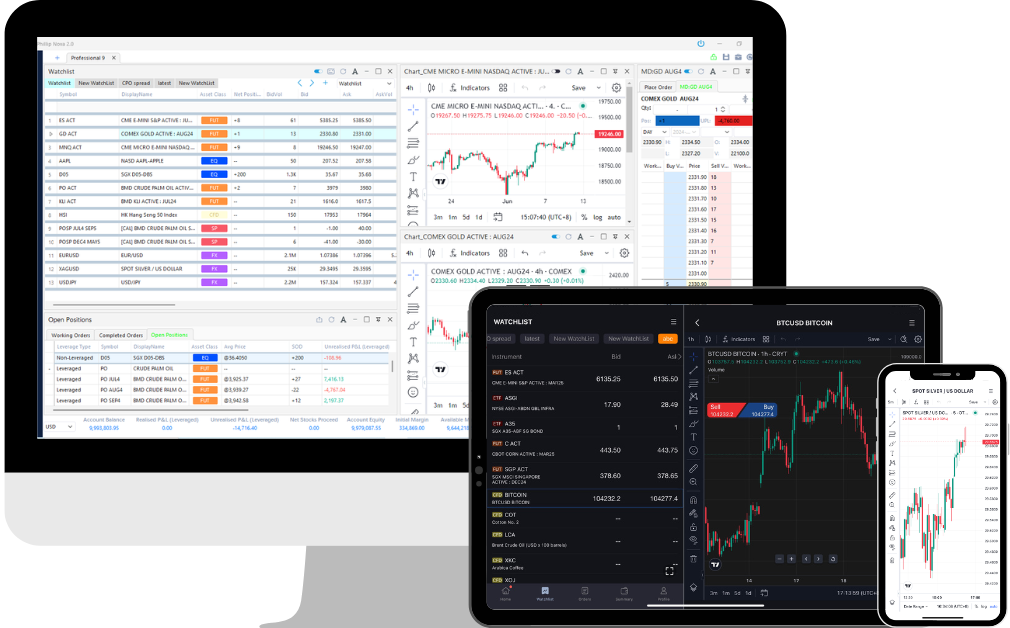
- Available on mobile, iPad, and desktop
- Charting powered by TradingView
No minimum funding required.