
Gold’s USD5,000 Moment Is Within Reach

23 Jan 2026

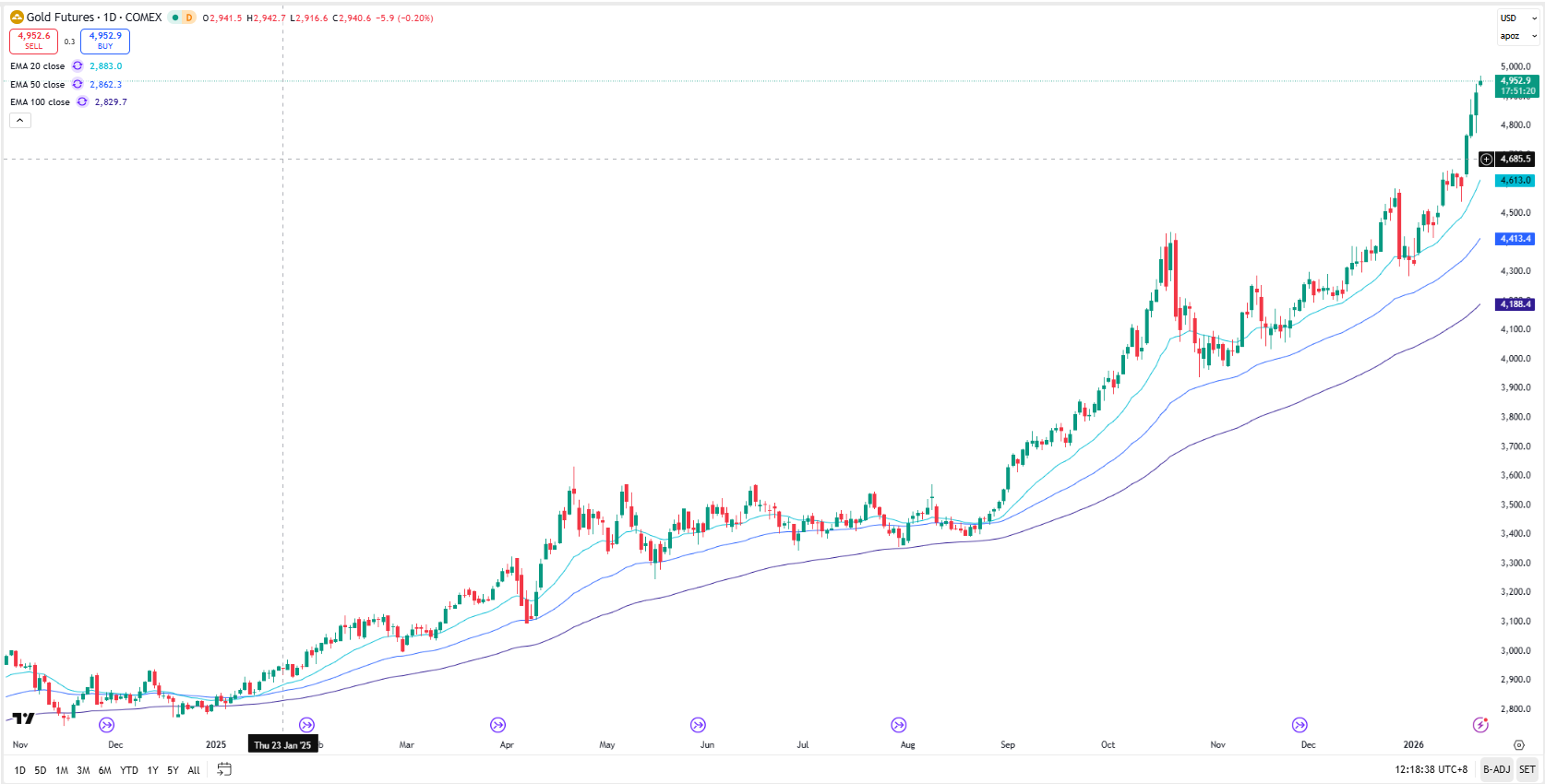
Gold has emerged as one of the most-watched assets in global markets over the past year. Prices have surged to record highs, outperforming equities, bonds, and even cryptocurrencies. What makes this rally stand out is not just the speed of the move, but the quality of the drivers behind it. Throughout 2025, Gold dominated headlines as it registered 48 all-time highs, with the rally extending well into early 2026. Gold has outperformed global equities and US Treasuries and is no longer just a hedge against uncertainty; it has firmly re-established itself as a core macro asset.


The rally we are witnessing in gold is underpinned by four major structural drivers: sustained central bank buying, expectations of easing real yields as monetary policy pivots, persistent geopolitical flare-ups, and strong inflows into gold-backed ETFs. The current rally in precious metal space is built on foundations, not frenzy.


Global central banks have been net buyers of gold for three consecutive years, with emerging market central banks actively diversifying away from US dollar assets. In fact, for the first time in five decades, foreign central banks hold more gold reserves than US Treasuries. Central bank buying reaccelerated in 3Q25 to around 220 tonnes of net purchases, and from a fundamental perspective, Central bank’s are no longer trading gold; they are strategically accumulating it.


At the same time, real yields and monetary policy uncertainty continue to support gold prices. Gold typically performs well when real interest rates fall. Geopolitical risks remain elevated, while rising sovereign debt levels and widening fiscal deficits continue to fuel concerns over currency debasement, reinforcing gold’s appeal as a store of value.


Investment demand has also been quietly building. Global gold-backed ETFs recorded five consecutive months of inflows in 2025, lifting year-to-date holdings to approximately US$89 billion, equivalent to around 674 tonnes. These steady inflows highlight resilient physical demand and signal that gold is being accumulated within portfolios rather than chased speculatively.


Looking ahead into 2026, we expect the gold rally to moderate, but the balance of risks remains skewed to the upside. Gold reaching US$5,000 per ounce appears more likely than prices falling back to US$3,000 per ounce. In our opinion, looking at the momentum in Gold, despite easing concerns of rift around “Greenland”, Gold bulls likely won’t stop before breaching the US$5000 mark.


Gold’s more volatile cousin Silver, has also entered a strong uptrend and is increasingly benefiting from many of the same macro drivers as gold. However, silver enjoys additional support from its industrial demand profile, which sets it apart.


Like gold, silver benefits from declining real yields, geopolitical uncertainty, and diversification flows. But unlike gold, more than half of silver demand comes from industrial uses, including solar panels, electronics, electric vehicles, and energy-transition technologies. The silver market is also facing a persistent supply deficit. Global silver supply has struggled to keep pace with rising demand, with mine production constrained and recycling unable to fill the gap. China plays a critical role here, as it remains a key driver of industrial silver demand, particularly through solar manufacturing and advanced electronics. Any stabilisation or recovery in Chinese industrial activity could further tighten the silver market.


With silver prices just an arm’s length from the US$100 per ounce mark, the metal is beginning to reflect both its monetary and industrial value. Historically, silver tends to outperform gold in the later stages of precious-metal bull cycles, and the narrowing gold-silver ratio reinforces this view. While silver is more volatile than gold, its upside potential remains compelling in an environment of supply tightness and structurally strong demand.


What’s interesting is that while Gold may pause or consolidate in the near term, the structural drivers behind the rally remain firmly intact. We expect precious metals to retain bullish bias; however, a two-sided, volatile rally rather than a straight line. Pullbacks may offer opportunities to accumulate gradually, with gold best viewed as portfolio insurance. Meanwhile, Silver offers a higher-beta expression of the same macro theme, supported by additional industrial demand and supply constraints.

 

Take a view on Gold and Silver Micro Futures now. Learn more now!

Or take a view on precious metals via ETFs, mining Stocks and Forex now! 


Trade CFDs, ETFs, Forex, Futures, Options, Precious Metals, and Stocks with Phillip Nova 2.0

Features of trading on Phillip Nova 2.0

  • Gain Access to Over 20 Global Exchanges
    Capture opportunities from over 200 global futures from over 20 global exchanges
  • Trade Opportunities in Global Stocks
    Over 11,000 Stocks and ETFs across Singapore, US, China, Hong Kong, Malaysia and Japan markets.
  • Charting Powered by TradingView
    View live charts and gain access to over 100 technical indicators
  • True Multi-Asset Trading
    Trade CFDs, ETFs, Forex, Futures, Options, Precious Metals and Stocks on a single ledger on Phillip Nova 2.0

An Exchange Traded Fund (ETF) is a marketable security that is formed to track nearly anything, ranging from a specific index, sector, commodity, or increasingly, theme. They are most commonly used to track a basket of stocks, and can typically be accessed through the same channels as regular stocks. ETFs are typically separated into passively-managed ETFs that simply mirror the security they are tracking (e.g. the STI), and actively managed ones that attempt to deliver higher returns or specific investment objectives, often with a pre-specified theme in mind (e.g. ARK Invest’s Innovation ETF).

Why should I trade in ETF CFDs?

  • ETFs have been growing in popularity over the years. 2020 was the best year for ETFs yet, with global equity ETFs seeing more than $1T in inflows within a 12-month period. Using CFDs to gain exposure to ETFs allows for greater capital efficiency because only a portion of the contract value is required as margin to establish a position.
  • ETFs are particularly popular with investors seeking a relatively hassle-free investing experience, while desiring exposure to a range of specific and relatively understandable securities. Trading ETF CFDs brings greater convenience by eliminating the need for traders to hold multiple currencies in order to access global ETFs.
  • An investor wanting exposure to the post-pandemic economic recovery could open a position in the well-known SPDR S&P 500 ETF (SPY), which tracks the performance of the S&P 500. Another investor that may be convinced of the future importance of Environmental, Social and Governance concerns (ESG) may find the increasing selection of ESG-themed ETFs that track a basket of high ESG-rating companies to be a good investment, rather than cherry-picking individual equities by hand. ETF CFDs can act as a powerful tool for traders can profit from both directions of the market by taking on long or short positions.

A look at two ETF CFDs we offer:

1) Has the ARKK been sunk?

ARK Innovation ETF (ARKK) ARKK is an actively managed ETF by ARK Invest that invests in a range of companies based on their innovative and industry-disrupting potential. ARKK’s largest holdings are in companies such as Tesla, Square, and Zoom. ARKK is down around -33% from peaking on 12th Feb and is currently in the red for the year to date as the market experiences a risk-off outflow of funds. Superstar fund manager Cathie Wood has however been consistently doubling down on her bets, buying even more shares in growth stocks that are going through their own tumultuous periods such as DraftKings, Peloton, Teladoc, and Tesla. In her view, ARKK is playing the long game, and remains steadfastly convinced in the long-term prospects of these growth stocks beyond this current bout of volatility. Similarly on outflows, investors are still betting big on ARKK as ARK Invest has only lost about $1.2B in assets this year across all its six funds, compared to seeing an inflow of $15.1B during the same period. Recently, investors have been nervously eyeing ARKK’s basket of tech stocks as their future earnings potential remain vulnerable to erosion through high inflation – the dominant concern of the market in recent weeks. As commodities – the major contributor to the recent heightened inflation fears – drops sharply from record highs, are investor concerns over hyperinflation overblown?

2) Searching for exposure to Asian equities?

iShares MSCI Asia ex Japan ETF (AAXJ) The AAXJ is currently trading -10.6% adrift of all-time highs seen in February, giving up gains in tandem with an Asia-wide equity sell-off at the time. Given that slightly over 40% of the ETF’s holdings are based in China, the ongoing tumult seen in Chinese equities currently have carried over nearly perfectly in the AAXJ, as Chinese investors take a breather after the stellar gains made over the past year. Looking ahead, Asia – and particularly China, is steaming ahead with its economic recovery. China is widely expected to be one of the best-performing major economies this year, providing a major boost to the outlook for corporate earnings. As the rest of Asia and the world gradually opens up their own economies, AAXJ is likely to again benefit from strong Asian outperformance amidst a strengthening trade outlook.

CFD is available for trading on Phillip MetaTrader 5 (MT5).

Features of trading CFD:

  • Trade in both the bull and the bear markets
    The ability to enter a long and/or short position allow traders to take advantage of both rising and falling markets.
  • Smaller barrier to entry
    Flexible and smaller contract sizes. This means that traders will be able to enter into a contract with a modest amount of capital.
  • No expiration date or risk of delivery
    Unlike futures which commonly have a fixed expiration date, CFD allows traders to perpetually hold the position(s). CFD is cash settled, no need to worry about the delivery of the underlying asset.


Benefits of using Phillip MT5:

Trade at zero commission on a dynamic platform that offers low spreads. Integrated with Autochartist and Trading Central Indicators, and available on mobile, web and desktop app, you will never miss a trading opportunity with Phillip MT5.

Register for a FREE 30-day Phillip MetaTrader 5 Demo Account

More Market Trends

DAX Outlook: New Tariff Fears After All-Time High

Read More >

Invest Smarter, Not Bigger: A Beginner’s Guide to Fractional Stocks

Read More >

AI Fuels Taiwan Index’s Record Run, Could We See More Upside To Come?

Read More >