EN
EN  CN
CN 
If you’ve ever waited in line for a table at Sushiro, you’ll know one thing: people are willing to queue for good sushi.
What many diners may not realise is that behind those colour-coded conveyor belts sits Food & Life Companies Ltd. (TSE: 3563), the operator of Japan’s largest kaiten-zushi chain and one of the country’s standout consumer stocks. Now, the company is serving up something that has investors paying close attention—a highly anticipated 2-for-1 stock split set to take effect on 29 June 2026.
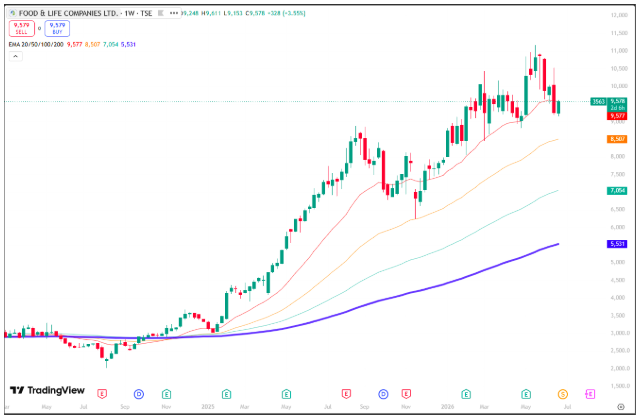
As of today’s market action, the stock has been showing renewed momentum, rising 1.62% to ¥9,597 in morning trading on steady retail volume. While Sushiro’s strong brand and resilient demand story continue to support investor interest, the bigger catalyst right now lies in a corporate action that could make the shares more accessible to a wider pool of investors.
With the stock split just days away, Food & Life Companies has become one of the more closely watched names on the Tokyo Stock Exchange, offering investors a front-row seat to some of the key themes driving Japan’s market today—from shareholder-friendly reforms and improving corporate profitability to the continued recovery of inbound tourism.
Riding Japan’s Corporate Governance Tailwind
For decades, many high-quality Japanese equities were difficult for retail investors to access due to Japan’s minimum trading unit system, which typically requires investors to purchase at least 100 shares. At nearly ¥9,600 per share, a standard lot of Food & Life Companies would cost close to ¥1 million.
As part of broader efforts by the Tokyo Stock Exchange to improve market accessibility and encourage greater retail participation, companies across Japan have increasingly turned to stock splits. By halving its nominal share price next Monday, Food & Life Companies is effectively lowering the entry barrier for a wider pool of investors while improving liquidity in its shares.
The timing is notable because the corporate action follows a strong set of earnings results and an upgrade to the company’s FY2026 outlook.
In its latest second-quarter earnings report, the company delivered a solid beat across key metrics:
- Revenue climbed to ¥131.53 billion, surpassing expectations as domestic pricing power remained resilient and overseas expansion continued to gain traction.
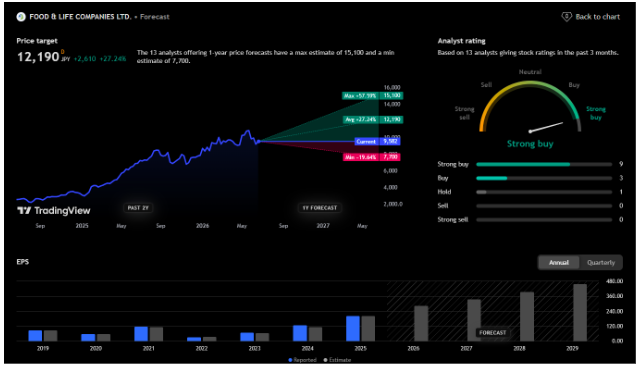
- Adjusted EPS reached ¥81.39, beating consensus estimates by 14.78%.
- Quarterly net income surged 61% year-on-year, highlighting strong operating leverage despite ongoing cost pressures.
Benefiting from Japan’s Tourism Boom
Food & Life Companies also serves as a proxy for one of Japan’s strongest structural themes: inbound tourism.
While some consumer-facing businesses have experienced uneven demand patterns, Sushiro’s value-for-money positioning continues to resonate with both local diners and international visitors. The company’s extensive network of outlets allows it to benefit directly from rising tourist traffic while maintaining broad appeal among domestic consumers.
Even amid raw material inflation and fluctuating seafood supply chains, Food & Life Companies has maintained a healthy trailing operating margin of 11.11%. A key contributor has been its investment in automation and operational efficiency, including proprietary technologies such as IC-tagged plate tracking systems that help optimise food management and reduce waste.
Why Investors Are Paying Attention
As a consumer cyclical growth story, Food & Life Companies commands a premium valuation. The stock currently trades at a trailing P/E ratio of 37.59 times, reflecting market expectations for continued earnings growth and expansion.
Following the stock split on 29 June, investor attention may increasingly shift toward shareholder returns. The company’s next ex-dividend date is scheduled for 29 September 2026, giving investors an opportunity to participate in its dividend programme while benefiting from the improved accessibility created by the split.
The Bottom Line
Food & Life Companies is a compelling example of how Japan’s corporate governance reforms are reshaping the investment landscape.
The company has combined strong earnings execution, technology-driven operational efficiency, growing exposure to Japan’s tourism recovery and a shareholder-friendly 2-for-1 stock split. Together, these factors are helping to position the Sushiro parent as a stock worth watching in the Japanese consumer sector.
More broadly, the company reflects several themes currently attracting investors to Japan: improving corporate profitability, stronger shareholder returns, growing retail participation and continued support from inbound tourism. As Japanese companies increasingly embrace shareholder-friendly initiatives, investors are finding more opportunities across one of Asia’s most dynamic equity markets.
Trade Japanese Stocks & ETFs with Live Prices on NOVA
As investor interest in Japan continues to grow, having access to real-time market information has become increasingly important.
With free live pricing on Japanese stocks through NOVA, investors can monitor market-moving developments as they happen and access a wide range of opportunities through a single trading platform.
On NOVA, clients can access:
- Live prices for Japanese stocks
- Live prices for Japan-listed ETFs
- Nikkei 225-linked ETFs and index products
- Thousands of Japanese securities through a single account
- Opportunities across stocks, ETFs, futures and other exchange-listed products
Whether you’re monitoring Toyota, Sony, Nintendo, Tokyo Electron, Advantest or the Nikkei 225 itself, live pricing can help investors and traders respond more effectively to market developments and identify opportunities as they emerge.
Japan Offers Opportunities Across Multiple Strategies
Japan’s equity market continues to attract global attention as AI-related investment, improving corporate profitability, shareholder-friendly reforms and supportive economic conditions drive renewed investor interest.
Some investors may focus on long-term exposure through quality Japanese companies and diversified ETFs. Others may seek shorter-term opportunities through futures, leveraged products or thematic sectors benefiting from structural growth trends.
With access to Japanese stocks, ETFs, Nikkei-linked products and live prices through NOVA, investors have a broader toolkit to express different market views and trading strategies.
Whether your outlook is bullish, bearish or somewhere in between, Japan’s market offers opportunities for both investors and traders alike.
Ready to explore Japan’s market opportunities?
Open a Phillip Nova account today and gain access to Japanese stocks, ETFs and global markets through a single trading platform.