
Chip Stocks Rebound: Is Wall Street’s Tech Rally Back on Track?

21 Oct 2026

US technology stocks are showing signs of recovery after a sharp selloff, but rising borrowing costs and questions surrounding AI investments could test the rally’s staying power.


Key Takeaways

  • Semiconductor stocks lead the recovery: The Philadelphia Semiconductor Index gained 1.6%, ending an eight-session losing streak.

  • AI investment remains under scrutiny: Investors are increasingly focused on whether corporate earnings can justify elevated technology valuations and substantial AI infrastructure spending.

  • Interest rates remain a headwind: Rising US Treasury yields and elevated oil prices could continue to influence market sentiment.


Semiconductor Stocks Spark a Wall Street Rebound

US equity futures edged higher in early trading on 20 October as a recovery in semiconductor stocks helped restore some confidence following a difficult week for technology shares.

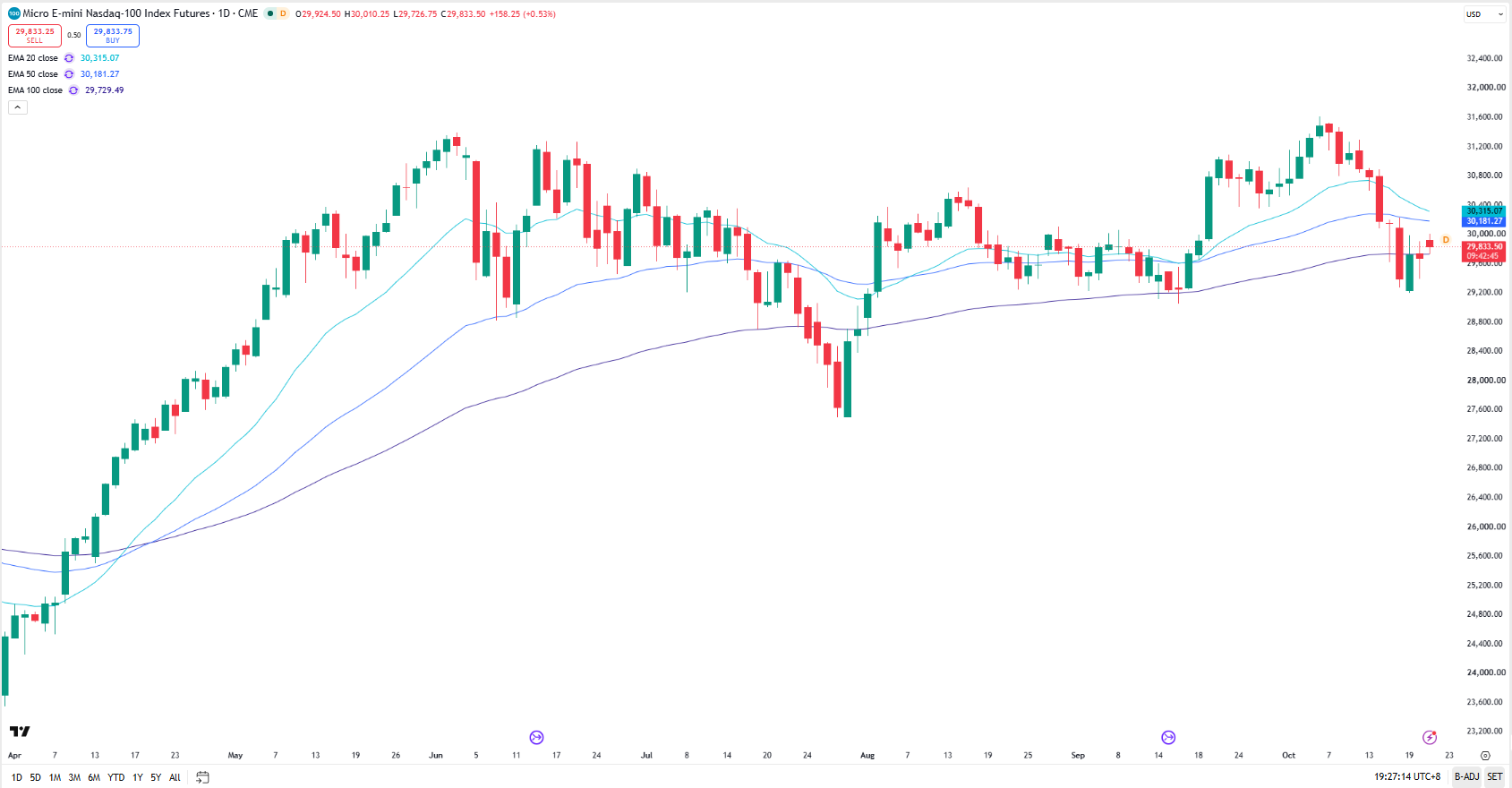
Nasdaq 100 futures advanced 0.2% after the underlying index climbed 1.2% in the previous session. The Philadelphia Semiconductor Index rose 1.6%, breaking an eight-session losing streak, while S&P 500 futures gained 0.1%.

The rebound followed a period of heightened volatility driven by concerns over the scale of AI infrastructure investments, elevated technology valuations and rising interest rates.

However, the recovery was less convincing across Asian markets, where futures pointed to a weaker opening in several major markets.


AI Boom Faces a Critical Earnings Test

The sustainability of the technology rebound could depend heavily on upcoming corporate earnings.

Investors are looking to major technology companies, including Meta Platforms and Tesla, for evidence that earnings growth can support the substantial capital being committed to AI development.

Reports that computing infrastructure provider Nscale was discussing a potential US$45 billion deal with Anthropic further highlighted the enormous scale of investment flowing into AI.

Yet concerns remain over whether these investments can generate sufficient returns, particularly as financing costs rise.

AI infrastructure provider CoreWeave has also attracted attention following recent pressure on its debt and share price, underscoring growing investor sensitivity to the financial risks associated with rapid expansion.


Rising Bond Yields Add to Market Uncertainty

Beyond the technology sector, higher US Treasury yields continue to present challenges for equity markets.

The benchmark 10-year Treasury yield rose to approximately 5.14% on 19 October as recovering risk appetite reduced demand for government bonds and investors reassessed expectations for future Federal Reserve interest-rate increases.

Higher yields can increase financing costs for businesses and place additional pressure on the valuations of growth-oriented companies.

Meanwhile, Brent crude remained above US$109 per barrel amid concerns over potential supply disruptions linked to Middle East tensions.

Persistently elevated energy prices could complicate the inflation outlook and reinforce expectations that interest rates may remain higher for longer.


What’s Next for Wall Street?

While the semiconductor-led rebound has provided some relief to investors, several developments could determine whether the recovery gathers momentum.

Corporate earnings: Strong results and encouraging guidance from major technology companies could help restore confidence in the AI investment cycle.

AI spending and profitability: Investors will be watching whether demand for computing infrastructure translates into sustainable earnings and cash flows.

Interest rates and oil prices: Rising bond yields and persistent energy-driven inflation could weigh on valuations and broader market sentiment.

Market breadth: A recovery extending beyond a handful of semiconductor and AI-related stocks could provide a stronger indication of improving investor confidence.

Ultimately, the rebound suggests that investor appetite for technology stocks has not disappeared. However, with valuations under scrutiny and financing costs elevated, the next phase of the rally may depend increasingly on earnings performance rather than AI enthusiasm alone.


The key question: Can strong corporate results turn the latest rebound into a sustainable recovery, or will macroeconomic pressures trigger another round of volatility?


Take a view now

Trade CME E-nano Index Futures at just $0.50* on NOVA, or monitor prices on related commodities, precious metals, ETFs, CFDs and Stocks now. Learn more here.

Open an account to get started here.


Trade CFDs, ETFs, Forex, Futures, Options, Precious Metals, and Stocks on NOVA

Features of trading on NOVA

  • Gain Access to Over 20 Global Exchanges
    Capture opportunities from over 200 global futures from over 20 global exchanges
  • Trade Opportunities in Global Stocks
    Over 11,000 Stocks and ETFs across Singapore, US, China, Hong Kong, Malaysia and Japan markets.
  • Charting Powered by TradingView
    View live charts and gain access to over 100 technical indicators
  • True Multi-Asset Trading
    Trade CFDs, ETFs, Forex, Futures, Options, Precious Metals and Stocks on a single ledger on NOVA
  • USD & SGD Shares Margin Rate at Only 4.5% p.a
  • Fractional Shares from US$1

Start investing in fractional shares from US$1 notional value, at US$0.38 commission per order.

An Exchange Traded Fund (ETF) is a marketable security that is formed to track nearly anything, ranging from a specific index, sector, commodity, or increasingly, theme. They are most commonly used to track a basket of stocks, and can typically be accessed through the same channels as regular stocks. ETFs are typically separated into passively-managed ETFs that simply mirror the security they are tracking (e.g. the STI), and actively managed ones that attempt to deliver higher returns or specific investment objectives, often with a pre-specified theme in mind (e.g. ARK Invest’s Innovation ETF).

Why should I trade in ETF CFDs?

  • ETFs have been growing in popularity over the years. 2020 was the best year for ETFs yet, with global equity ETFs seeing more than $1T in inflows within a 12-month period. Using CFDs to gain exposure to ETFs allows for greater capital efficiency because only a portion of the contract value is required as margin to establish a position.
  • ETFs are particularly popular with investors seeking a relatively hassle-free investing experience, while desiring exposure to a range of specific and relatively understandable securities. Trading ETF CFDs brings greater convenience by eliminating the need for traders to hold multiple currencies in order to access global ETFs.
  • An investor wanting exposure to the post-pandemic economic recovery could open a position in the well-known SPDR S&P 500 ETF (SPY), which tracks the performance of the S&P 500. Another investor that may be convinced of the future importance of Environmental, Social and Governance concerns (ESG) may find the increasing selection of ESG-themed ETFs that track a basket of high ESG-rating companies to be a good investment, rather than cherry-picking individual equities by hand. ETF CFDs can act as a powerful tool for traders can profit from both directions of the market by taking on long or short positions.

A look at two ETF CFDs we offer:

1) Has the ARKK been sunk?

ARK Innovation ETF (ARKK) ARKK is an actively managed ETF by ARK Invest that invests in a range of companies based on their innovative and industry-disrupting potential. ARKK’s largest holdings are in companies such as Tesla, Square, and Zoom. ARKK is down around -33% from peaking on 12th Feb and is currently in the red for the year to date as the market experiences a risk-off outflow of funds. Superstar fund manager Cathie Wood has however been consistently doubling down on her bets, buying even more shares in growth stocks that are going through their own tumultuous periods such as DraftKings, Peloton, Teladoc, and Tesla. In her view, ARKK is playing the long game, and remains steadfastly convinced in the long-term prospects of these growth stocks beyond this current bout of volatility. Similarly on outflows, investors are still betting big on ARKK as ARK Invest has only lost about $1.2B in assets this year across all its six funds, compared to seeing an inflow of $15.1B during the same period. Recently, investors have been nervously eyeing ARKK’s basket of tech stocks as their future earnings potential remain vulnerable to erosion through high inflation – the dominant concern of the market in recent weeks. As commodities – the major contributor to the recent heightened inflation fears – drops sharply from record highs, are investor concerns over hyperinflation overblown?

2) Searching for exposure to Asian equities?

iShares MSCI Asia ex Japan ETF (AAXJ) The AAXJ is currently trading -10.6% adrift of all-time highs seen in February, giving up gains in tandem with an Asia-wide equity sell-off at the time. Given that slightly over 40% of the ETF’s holdings are based in China, the ongoing tumult seen in Chinese equities currently have carried over nearly perfectly in the AAXJ, as Chinese investors take a breather after the stellar gains made over the past year. Looking ahead, Asia – and particularly China, is steaming ahead with its economic recovery. China is widely expected to be one of the best-performing major economies this year, providing a major boost to the outlook for corporate earnings. As the rest of Asia and the world gradually opens up their own economies, AAXJ is likely to again benefit from strong Asian outperformance amidst a strengthening trade outlook.

CFD is available for trading on Phillip MetaTrader 5 (MT5).

Features of trading CFD:

  • Trade in both the bull and the bear markets
    The ability to enter a long and/or short position allow traders to take advantage of both rising and falling markets.
  • Smaller barrier to entry
    Flexible and smaller contract sizes. This means that traders will be able to enter into a contract with a modest amount of capital.
  • No expiration date or risk of delivery
    Unlike futures which commonly have a fixed expiration date, CFD allows traders to perpetually hold the position(s). CFD is cash settled, no need to worry about the delivery of the underlying asset.


Benefits of using Phillip MT5:

Trade at zero commission on a dynamic platform that offers low spreads. Integrated with Autochartist and Trading Central Indicators, and available on mobile, web and desktop app, you will never miss a trading opportunity with Phillip MT5.

Register for a FREE 30-day Phillip MetaTrader 5 Demo Account

More Market Trends

S$6.5B Boost: MAS Expands EQDP to Support Singapore Equities

Read More >

Oil Above US$100: Could Middle East Tensions Trigger Another Price Surge?

Read More >

Catch up on Japan’s equity market moves for 5–9 October 2026, with Global X Japan’s weekly review of market performance and key developments.

Read More >

Scheduled Maintenance

Scheduled maintenance will take place on
11 July 2026 from 1:00 PM to 5:00 PM.

No downtime is expected, but there may be brief interruptions if any unexpected issues occur.

Thank you for your patience.