EN
 CN


It’s 10 AM in Singapore. Wall Street closed hours ago, but a US technology stock you follow is already down after an earnings announcement. If your trading access is limited to regular US market hours, you’ll have to wait until tonight to take action.
24-hour US Share CFDs offer an alternative. By providing access to selected US Share CFDs across regular and extended trading sessions, traders can respond to market developments during Singapore daytime rather than waiting for Wall Street to reopen.
Whether it’s an earnings announcement, a policy decision or changing global market sentiment, extended trading hours offer greater flexibility to monitor prices, explore trading opportunities and manage existing positions.
So how can traders make practical use of these additional trading hours, and when might it be better to wait?
What Are the US Stock Trading Hours in Singapore? (During US Daylight Saving Time)
| For US Users
(EDT) |
For Singapore Users
(SGT) |
|
| Pre-market | 4:01 a.m. – 9:30 a.m. | 4:01 p.m. – 9:30 p.m. |
| Regular Market | 9:30 a.m. – 4:00 p.m. | 9:30 p.m. – 4:00 a.m. |
| Post-market | 4:00 p.m. – 8:00 p.m. | 4:00 a.m. – 8:00 a.m. |
| Extended Hours | 8:00 p.m. – 4:00 a.m. | 8:00 a.m. – 4:00 p.m. |
Note: Outside US Daylight Saving Time, these trading sessions shift one hour later in Singapore. Trading availability is subject to the applicable contract schedule.
How Can Traders Respond to After-Hours Earnings Announcements?
Earnings announcements can trigger sharp share-price movements outside regular US trading hours. For traders holding positions overnight, the ability to respond to these developments can be particularly important
Suppose you hold a long position in Netflix Share CFDs ahead of an earnings announcement. Stronger-than-expected earnings might sound encouraging, but the company’s future outlook can have an even greater influence on its share price.
This was the case on 20 October 2026. Netflix reported third-quarter earnings above analysts’ expectations but lowered its full-year advertising revenue forecast and issued a weaker-than-expected fourth-quarter outlook. Its shares fell around 6% in after-hours trading, following the regular US market close.
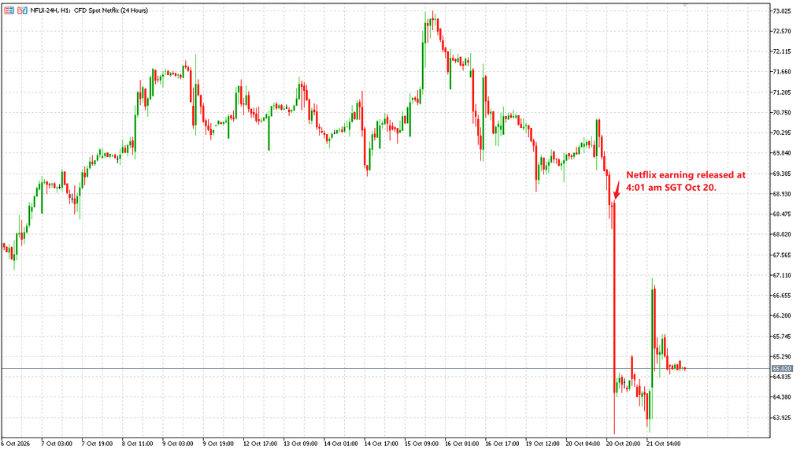
Source: Phillip MetaTrader 5
A trader holding a long position in Netflix’s 24-hour Share CFD (NFLX-24H) on Phillip MetaTrader 5 could manage potential earnings-related risks by reducing exposure before the announcement or setting a stop-loss in advance.
Following the announcement, 24-hour access allows the trader to reassess the position and potentially reduce or close it without waiting for the next regular US session. However, acting afterwards cannot reverse losses already incurred, and orders may execute at less favourable prices during sharp market movements.
For traders expecting further declines or a rebound that fails to hold, opening a separate short position during extended hours may also be an option, although this introduces additional trading risks.
The key advantage of 24-hour access is greater flexibility to manage existing positions or place new orders as market information emerges, rather than having to wait for Wall Street to reopen.
How Can Traders Use Price Levels Across Different Trading Sessions?
Beyond responding to market-moving news, traders can also use extended trading hours to monitor how price patterns develop across different sessions.
One practical approach is to monitor the highs and lows formed during the regular US session and subsequent extended-hours sessions. These levels can serve as reference points for identifying potential support, resistance and changes in buying or selling pressure.
Consider the hourly chart of Meta Platforms’ 24-hour Share CFD (META-24H) as an example. The two highlighted boxes show trading ranges formed across different sessions, with their upper and lower boundaries providing reference levels for subsequent price movements.
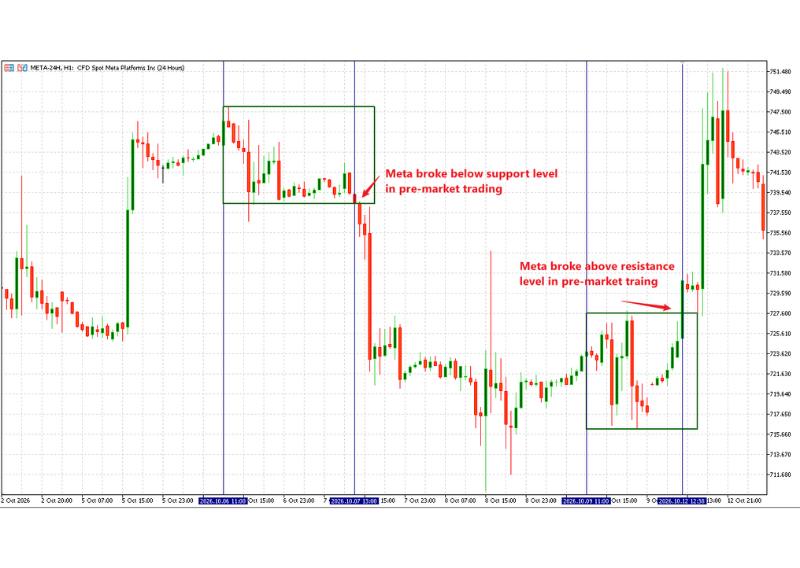
Source: Phillip MetaTrader 5.
In the first example, Meta’s price broke below the lower boundary of the range before the regular US market opened, with the decline extending further into the regular session. In the second example, the price broke above another trading range during pre-market hours, with buying momentum continuing after the market opened.
For traders, both the timing of a breakout and subsequent price movements are worth watching. A pre-market breakout that holds or strengthens after the regular session opens may suggest sustained momentum. Conversely, a quick return to the earlier trading range could indicate a false breakout.
With 24-hour US Share CFDs, traders can monitor these price levels across sessions and evaluate potential trading opportunities as they develop. However, a breakout alone does not guarantee that the price will continue moving in the same direction.
How Can Global Market Movements Influence US Share Prices?
Beyond individual price patterns, movements in other financial markets can provide valuable context for US share trading. While Wall Street is closed, traders can monitor overseas equity markets, US stock index futures, Treasury yields, currencies and commodities to assess changing market expectations.
For example, traders following NVIDIA or AMD may also monitor Asian semiconductor companies such as Samsung Electronics and SK hynix. On 22 October 2026, Samsung Electronics and SK hynix closed approximately 4% and 5.5% lower, respectively, while Nasdaq-100 futures also declined nearly 1% in early Asian trading. The weakness continued into the subsequent US regular session, with the Nasdaq-100 index closing nearly 3% lower. These movements reflected renewed concerns over AI-related spending and illustrated how global market signals can help traders assess developing sentiment towards US semiconductor shares.
Other financial markets can offer similar insights. Rising oil prices may support the earnings outlook for energy producers, while increasing operating costs for airlines. Meanwhile, higher US Treasury yields may weigh on equity valuations, particularly for growth stocks, while currency movements can affect the overseas earnings of multinational companies.
However, these relationships are not always straightforward. If a US share remains relatively stable despite weakness in related markets, traders can investigate whether company-specific developments or differences in market expectations explain the divergence.
With 24-hour US Share CFDs, traders can compare these global market signals with individual US share-price movements during Singapore daytime, helping them assess whether broader market trends are also reflected in the stocks they follow.
When Might It Be Better to Wait Before Trading?
Even when a potential trading opportunity emerges, acting immediately may not always be the best decision. Trading conditions can vary significantly between regular and extended-hours sessions.
During less active sessions, lower liquidity may result in wider bid-ask spreads, greater slippage and sharper price fluctuations. These factors can increase trading costs or lead to execution prices that differ from those expected.
For example, a share breaking above resistance may appear to present a buying opportunity. However, if the CFD’s bid-ask spread is unusually wide relative to the expected price movement, trading costs could significantly reduce the potential profit.
Traders may consider using limit orders to control their entry prices, although execution is not guaranteed. In some situations, waiting until trading activity increases around the regular US market opening may offer more favourable conditions.
Ultimately, 24-hour trading provides greater flexibility over when to trade, but knowing when to wait is just as important as knowing when to act.
Trade Beyond Regular US Market Hours with Phillip Nova
From earnings announcements to pre-market breakouts and changing global market sentiment, 24-hour US Share CFDs provide traders with greater flexibility to respond to market developments and manage their positions throughout the trading day.
With NOVA and Phillip MetaTrader 5 (MT5), traders can access 40 selected US Share CFDs across regular and extended trading sessions, including Singapore daytime.
Phillip MT5 also supports automated trading through Expert Advisors (EAs), allowing traders to monitor markets and execute predefined strategies automatically while the platform remains connected and the relevant contracts are available for trading.
Both NOVA and Phillip MT5 offer zero commission and no platform fee on Share CFDs. Spreads, overnight financing charges and other applicable trading costs may still apply.
Ready to explore trading opportunities beyond regular US market hours? Open your trading account and discover 24-hour US Share CFD trading on NOVA or Phillip MT5 today.
About the Author
Chen Yurui
Strategist
Chen Yurui graduated from the National University of Singapore with a major in Finance and has passed all three levels of the CFA Exams. He has experience in financial market analysis and OTC derivatives, with a focus on FX, precious metals, CFDs and macroeconomic outlook.
Through his work, he has gained hands-on experience in algorithmic trading and trading systems, including developing, backtesting and optimising Expert Advisors (EAs) on MetaTrader 5. He aims to make financial markets and trading concepts more practical and accessible to investors.