EN
EN  CN
CN 
Analysis courtesy of Eurex.
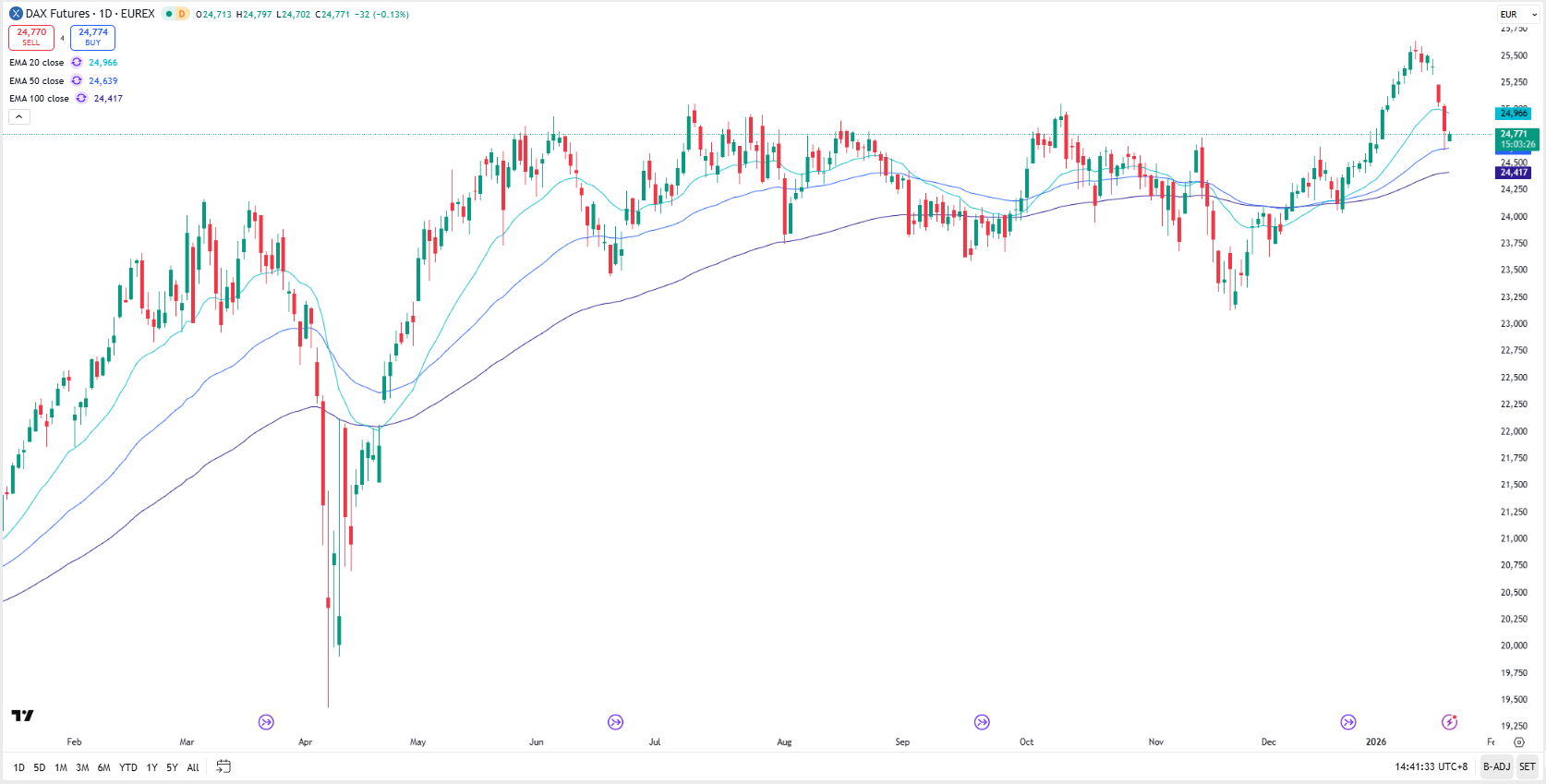
Donald Trump’s tariff threats against several European countries caused stock markets to fall at the start of the week. This poses risks, above all because the valuations of the DAX and other indices are widely considered to be excessive.
Almost exactly one year after being sworn in as US president, Donald Trump has once again wielded the tariff hammer, sending shockwaves through the stock markets. After the major cryptocurrencies suffered losses over the weekend, the stock markets also opened lower this morning. Precious metals such as gold and silver, currently sought after as “safe havens,” continue their upward trend and are reaching new all-time highs.
“Donald Trump has announced that he will impose additional import tariffs of ten percent on goods from eight European countries starting in February 2026. These tariffs are set to rise to 25 percent in June unless an agreement is reached on his demand to purchase Greenland,” Ulrich Stephan of Deutsche Bank summarized this morning’s events. The chief investment strategist fears that if this actually happens, it will have a significant negative impact on the European economy: “The tariffs will reduce prosperity on both sides, but will hit Europe structurally and sectorally, while the costs in the US will be spread broadly across consumers.” Against this backdrop, the World Economic Forum in Davos (with Donald Trump), from 19 to 23 January, is the focus of particular attention on the markets.
Price losses at the start of the week
The DAX is threatening to slip below the 25,000-point mark at the start of the week. After its dynamic rise at the start of the year, the leading German index took a short breather last week, closing at 25,297 points after a mini gain of 0.1 percent. During the week, the price barometer had marked a new all-time high at around 25,508 points. The Stoxx Europe 600 ended the week at just under the new record level of around 615 points after gaining 0.8 percent to a good 614 points. The US S&P 500 posted a weekly loss of 0.4 percent. Due to Martin Luther King Day, the stock exchanges in the US are closed today.
Eager anticipation for the reporting season
According to Martin Hartmann of Commerzbank, the overall very good start to the new stock market year was primarily driven by analysts’ expectations of strong growth in corporate profits worldwide. Companies listed on the DAX and Euro Stoxx 50 are expected to increase their profits by an average of 13 and 11 percent, respectively, in 2026. For the S&P 500 and Nasdaq 100, growth of 16 and 22 percent, respectively, is even forecast. This gives the outlooks during the reporting season that has just begun particular significance. Last week, for example, TSMC’s better-than-expected investment plans allayed fears of an AI bubble and electrified the semiconductor industry. This week, Netflix, 3M, Johnson & Johnson, General Electric, Intel, and Procter & Gamble, among others, will report their results. In Europe, the reporting season will begin a week later.
Dangerous “carelessness”
While Commerzbank sees further upside potential for the stock markets after a brief period of consolidation, mainly thanks to strong growth in the US economy, Uwe Streich of LBBW was already expressing considerable caution even before Donald Trump’s new tariff threats. In his view, investors feel secure after the successful years of the past and “underestimate the inherent risk of equity investments.”
The analyst describes this kind of “carelessness” as dangerous because it can lead to overconfidence and an increased willingness to take risks. “As long as prices continue to rise, this is not a problem. However, it becomes difficult when the pendulum suddenly swings in the other direction. Then the vast majority of investors are caught off guard at the same time and are forced to hastily restructure their investments and adapt to the new circumstances.” This is a scenario that could now become reality sooner than expected.
Valuation model urges caution
With regard to LBBW’s five-year DAX model, which has been very reliable for more than twenty years, Streich points out that prices have probably outpaced their fundamental development in recent years. With a 12-month forward P/E ratio of 15.1, the DAX is well above its median valuation of only 12.9. The cumulative DAX increase of 82 percent since the end of 2022 is offset by a mere 33 percent improvement in 12-month forward earnings.
The model, which forecasts the index’s p.a. performance for the following five years based on the dividend yield and DAX capitalization in relation to the M3 money supply, currently sees only an average potential of 3.6 percent (including approx. 2.5 percent dividend yield) per year. However, temporary downward deviations are also to be expected over the entire period.
30 years of MDAX
On January 19, 1996, the MDAX started with 70 stocks; today it stands at 31,500 points. The index for listed small and medium-sized companies shows how much power there is in the second tier of the German economy – with a total return of more than 1,000 percent since 1996, high resilience in crises, and a mix of industries that reflects the transformation from an industrial country to an innovation-driven economy.
Important dates
Wednesday, January 21
USA: Hearing before the US Supreme Court in the case of Fed Governor Lisa Cook against her dismissal. Although a ruling is not expected until spring, Deka believes that the course of the proceedings could already allow conclusions to be drawn: “If the judges rule in favor of the government, the legal hurdle for dismissing a board member would be significantly lower than previously assumed.
Thursday, January 22
2:30 p.m. USA: Private consumption price deflator. For Deutsche Bank economists, the PCE figures for October and November, which were delayed by the government shutdown, are the most important release in the US this week. US economists estimate core PCE growth at +0.1 percent for both months compared to the previous month and expect both income and consumption to rise by +0.3 percent.
Friday, January 23
Japan: BoJ interest rate decision. The consensus expects key interest rates to remain unchanged this time.
09:30 a.m. Germany: PMI manufacturing and services.
10:00 a.m. Eurozone: PMI manufacturing and services. According to analysts at Deutsche Bank, the figures, which are also published for other regions, will provide an initial impression of global growth. Last month, the indices for the manufacturing sector were at or above 50 points, with the exception of Germany and the eurozone.
Take a view on the European Markets with Phillip Nova now!

Trade Micro-DAX® and Micro-EURO STOXX 50® Futures at EUR1.50*. Learn more here.
Trade CFDs, ETFs, Forex, Futures, Options, Precious Metals, and Stocks on NOVA
Features of trading on NOVA
- Gain Access to Over 20 Global Exchanges
Capture opportunities from over 200 global futures from over 20 global exchanges - Trade Opportunities in Global Stocks
Over 11,000 Stocks and ETFs across Singapore, US, China, Hong Kong, Malaysia and Japan markets. - Charting Powered by TradingView
View live charts and gain access to over 100 technical indicators - True Multi-Asset Trading
Trade CFDs, ETFs, Forex, Futures, Options, Precious Metals and Stocks on a single ledger on NOVA - USD Shares Margin Rate at Only 4.5% p.a
- Fractional Shares from US$1